 Bug FAQ
Small Fan-footed Wave
Idaea biselata · Order: Lepidoptera · Family: Geometridae
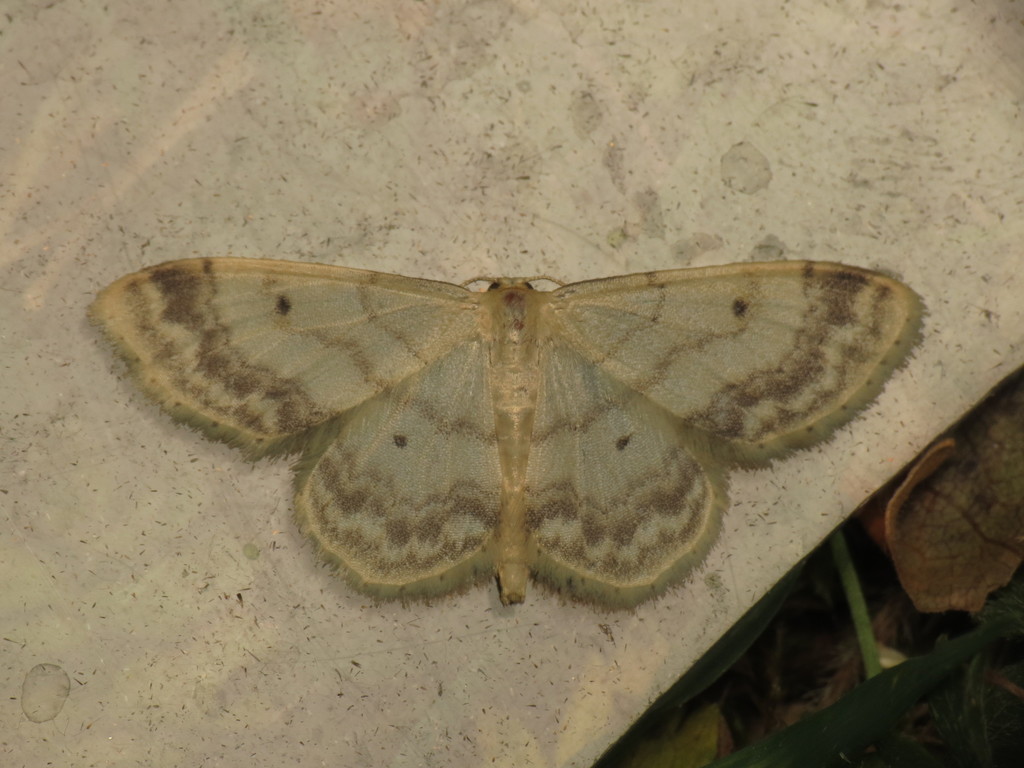
The small fan-footed wave is a tiny moth with a wingspan of about 22 to 25 mm. Its creamy-white wings have brownish bands and a tiny black spot on each wing. Adults fly from June to August, mostly at night and are attracted to lights.
Source: Wikipedia
How to recognize it
The fore- and hind-wings are creamy white with darker brown bands and each bears a small black discal spot. The overall ground colour ranges from yellow-white to slightly brownish-white, with pattern elements in brown to dark brown.
Source: Wikipedia
Size
Wingspan measures roughly 22 to 25 mm, making it easy to overlook.
Source: Wikipedia
Where it lives
It may make short daytime flights but is mainly nocturnal and comes to lights.
Source: Wikipedia
What it eats
Caterpillars feed on many plants such as asparagus, dandelion, knotgrass, oak, plantain and Rubus.
Source: Wikipedia
Life cycle
The species overwinters as a larva. Adults are active from June through August.
Source: Wikipedia
When you see it
Adult moths are on the wing during the summer months, June to August.
Source: Wikipedia
Where it comes from
Found across the British Isles, western Europe and eastward to the Urals. Its northern limit reaches central Fennoscandia.
Source: Wikipedia
More photos

Same family (Geometridae)
 Willow BeautyPeribatodes rhomboidaria
 Pale BeautyCampaea perlataDamages trees, gardens or crops
 Large Lace-border MothScopula limboundataDamages trees, gardens or crops
 Riband WaveIdaea aversata
 Yellow Shell MothCamptogramma bilineata
 Large Maple Spanworm MothProchoerodes lineolaDamages trees, gardens or crops
Sources
- Wikipedia: https://en.wikipedia.org/wiki/Small_fan-footed_wave
Look it up elsewhere: GBIF · iNaturalist · BugGuide · Wikipedia
Text written 2026-10-22 from the sources above and checked sentence by sentence against them. Data fetched 2026-10-22.