 Bug FAQ
Silver-ground Carpet
Xanthorhoe montanata · Order: Lepidoptera · Family: Geometridae

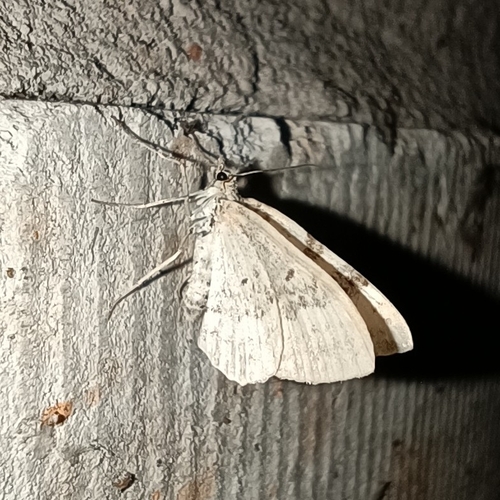
The moth has a wingspan of about 29 to 33 mm, with white forewings marked by a broad grey-to-black band and white hindwings with a pale band and a tiny black spot. It lives in many habitats across the Palearctic, from forests and moorlands to gardens, and the larvae overwinter and feed on low-growing plants such as bedstraw and primrose.
Source: Wikipedia
How to recognize it
Hindwings are also white, showing a pale band and a small black discal spot.
Source: Wikipedia
Size
The wingspan typically measures 29 to 33 mm, though northern populations may be smaller.
Source: Wikipedia
Where it lives
It occurs in many settings, including humid forests, moorland, shore areas, embankments, unimproved grass meadows, heathlands, and gardens.
Source: Wikipedia
What it eats
Larvae are grey with a purplish-brown back and have been recorded feeding on plants such as bedstraw, Corydalis, globeflower, hemlock, and primrose, likely using other low-growing plants as well.
Source: Wikipedia
Life cycle
The species overwinters in the larval stage.
Source: Wikipedia
When you see it
Adults fly from May to July, usually at dusk, in the British Isles; timing may differ elsewhere.
Source: Wikipedia
Lookalikes
It is a very variable species and may be confused with others; some authors treat fuscomarginata as a look-alike in the Pyrenees and Alps.
Source: Wikipedia
More photos
Same family (Geometridae)
 Willow BeautyPeribatodes rhomboidaria
 Pale BeautyCampaea perlataDamages trees, gardens or crops
 Large Lace-border MothScopula limboundataDamages trees, gardens or crops
 Riband WaveIdaea aversata
 Yellow Shell MothCamptogramma bilineata
 Large Maple Spanworm MothProchoerodes lineolaDamages trees, gardens or crops
Sources
- Wikipedia: https://en.wikipedia.org/wiki/Silver-ground_carpet
Look it up elsewhere: GBIF · iNaturalist · BugGuide · ITIS · Wikipedia
Text written 2026-10-22 from the sources above and checked sentence by sentence against them. Data fetched 2026-10-22.