 Bug FAQ
Shaded Broad-bar
Scotopteryx chenopodiata · Order: Lepidoptera · Family: Geometridae
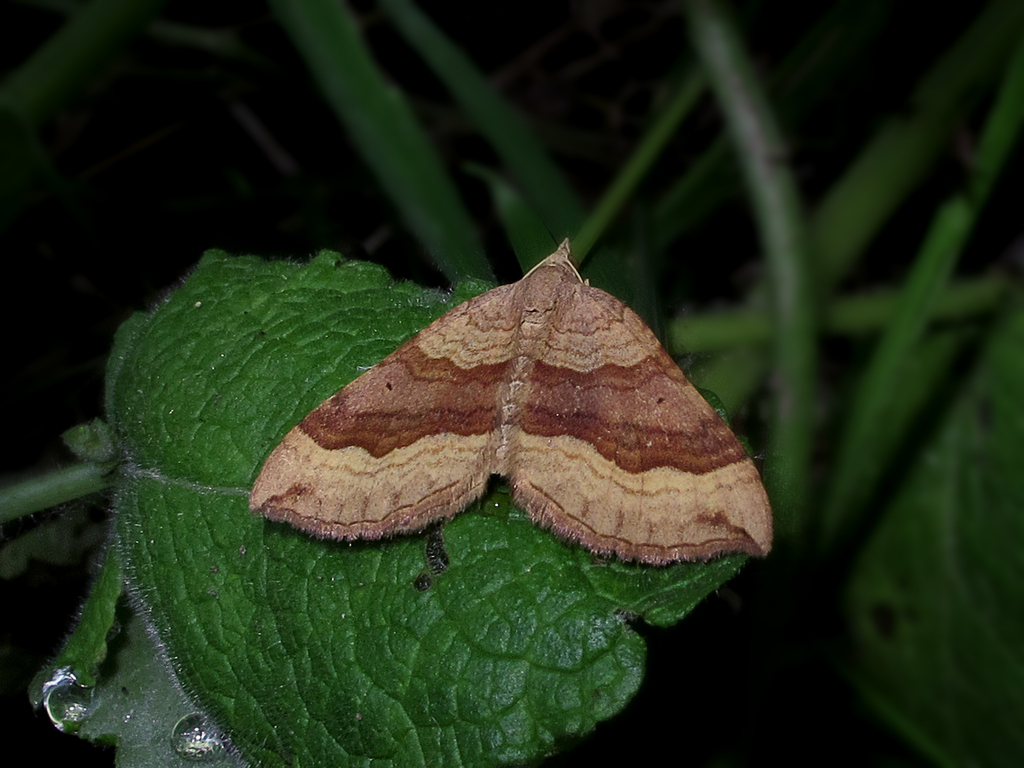
The Shaded Broad-bar moth has a wingspan of about 25 to 30 mm and forewings 16 to 19 mm long, with highly variable colours and several parallel wavy crosslines on the wings. It flies in a single generation from June to August, and its larvae feed on a range of herbaceous plants such as knautia, scabious, thistles and oregano.
Source: Wikipedia
How to recognize it
The moth’s colour varies a lot, but the forewings usually show several mostly parallel, wavy crosslines.
Source: Wikipedia
Size
Wingspan ranges from 25 to 30 mm. Forewing length is 16 to 19 mm.
Source: Wikipedia
Life cycle
The moth produces one generation that flies from June to August. Its pupa is reddish-brown, glossy and has a dotted surface.
Source: Wikipedia
When you see it
Adults are on the wing in a single generation between June and August.
Source: Wikipedia
Where it comes from
Found across much of the Palearctic, from Europe through Central Asia to Siberia and the Russian Far East. In Europe its range stretches from the Iberian Peninsula northward to northern Fennoscandia and southward to the Italian and Balkan Peninsulas.
Source: Wikipedia
Lookalikes
A dark form called ab. monodii has smoky wings with a very dark median band. Another form, ab. grisescens, is smaller, grey-brown, and has a straighter post-median line.
Source: Wikipedia
More photos

Same family (Geometridae)
 Willow BeautyPeribatodes rhomboidaria
 Pale BeautyCampaea perlataDamages trees, gardens or crops
 Large Lace-border MothScopula limboundataDamages trees, gardens or crops
 Riband WaveIdaea aversata
 Yellow Shell MothCamptogramma bilineata
 Large Maple Spanworm MothProchoerodes lineolaDamages trees, gardens or crops
Sources
- Wikipedia: https://en.wikipedia.org/wiki/Scotopteryx_chenopodiata
Look it up elsewhere: GBIF · iNaturalist · BugGuide · Wikipedia
Text written 2026-10-22 from the sources above and checked sentence by sentence against them. Data fetched 2026-10-22.