 Bug FAQ
Semaphore Fly
Poecilobothrus nobilitatus · Order: Diptera · Family: Dolichopodidae

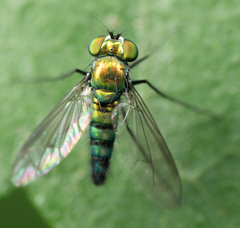
The Semaphore Fly is a small metallic green fly about 7 mm long, with smoky black wings that turn white at the tips. It lives around ponds and wetlands in many European countries and hunts small aquatic creatures on the water surface.
Source: Wikipedia
How to recognize it
Males have smoky black coloration on the outer half of their wings and white tips, while their bodies shine golden-green.
Source: Wikipedia
Size
Adults measure roughly 7 mm in length.
Source: Wikipedia
Where it lives
They are found near ponds and other wetland areas where they hunt and mate.
Source: Wikipedia
Life cycle
Mating requires the female to cooperate after the male’s courtship display. Males have a prominent, movable hypopygium that bends the abdomen to start copulation.
Source: Wikipedia
When you see it
Their mating behavior is well studied because of distinctive mate-selection rituals, and females tend to choose larger males.
Source: Wikipedia
Lookalikes
Many Dolichopodidae flies show metallic green reflections in their eyes due to wavelength-selective corneal reflectance, and the family shows great diversity in male signaling organs.
Source: Wikipedia
More photos


Same family (Dolichopodidae)


Sources
- Wikipedia: https://en.wikipedia.org/wiki/Poecilobothrus_nobilitatus
Look it up elsewhere: GBIF · iNaturalist · BugGuide · Wikipedia
Text written 2026-10-23 from the sources above and checked sentence by sentence against them. Data fetched 2026-10-22.