 Bug FAQ
Scopula guancharia
Scopula guancharia · Order: Lepidoptera · Family: Geometridae


Scopula guancharia is a small moth with a wingspan of about 23 to 24 mm. It lives on the Canary Islands and its larvae feed on herbaceous plants such as Calendula. Adults are active almost all year round.
Source: Wikipedia
How to recognize it
This species belongs to the Geometridae family of moths.
Source: Wikipedia
Size
The wings measure roughly 23 to 24 mm across.
Source: Wikipedia
Where it lives
It is found on the Canary Islands.
Source: Wikipedia
What it eats
The caterpillars eat a variety of herbaceous plants, including species of Calendula.
Source: Wikipedia
Life cycle
Adults are on the wing for most of the year.
Source: Wikipedia
When you see it
They can be seen flying nearly year-round.
Source: Wikipedia
Where it comes from
Its natural range is the Canary Islands.
Source: Wikipedia
Questions people ask
What plants do the larvae feed on?
The larvae eat various herbaceous plants, such as Calendula species.
Source: Wikipedia
When can I see adult Scopula guancharia?
Adults are active almost throughout the entire year.
Source: Wikipedia
Same family (Geometridae)
 Willow BeautyPeribatodes rhomboidaria
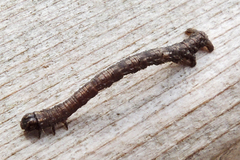 Pale BeautyCampaea perlataDamages trees, gardens or crops
 Large Lace-border MothScopula limboundataDamages trees, gardens or crops
 Riband WaveIdaea aversata
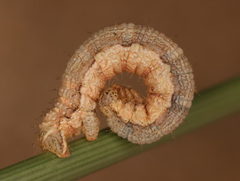 Yellow Shell MothCamptogramma bilineata
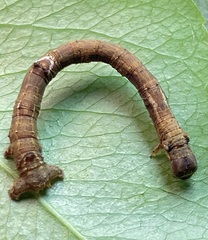 Large Maple Spanworm MothProchoerodes lineolaDamages trees, gardens or crops
Sources
- Wikipedia: https://en.wikipedia.org/wiki/Scopula_guancharia
Look it up elsewhere: GBIF · iNaturalist · BugGuide · Wikipedia
Text written 2026-10-23 from the sources above and checked sentence by sentence against them. Data fetched 2026-10-23.