 Bug FAQ
Scalloped Oak
Crocallis elinguaria · Order: Lepidoptera · Family: Geometridae
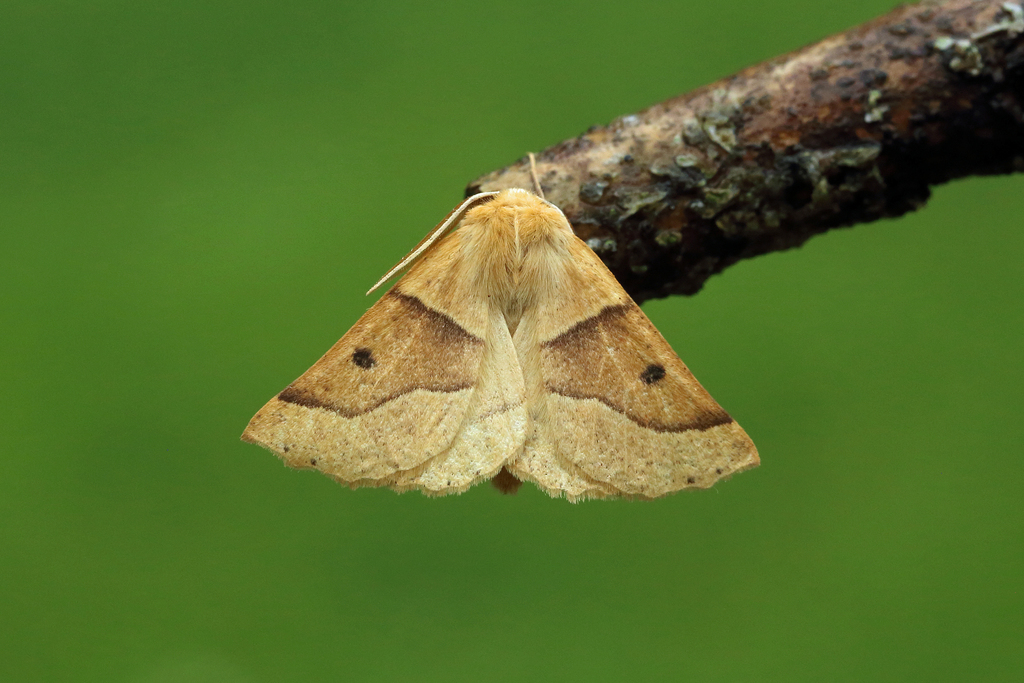
How to recognize it
Forewings are yellow-tan with a wide orange-brown band and a pointed tip, always showing a blackish discal spot near the middle of the band toward the front edge.
Source: Wikipedia
Size
Wingspan ranges from 32 to 46 mm.
Source: Wikipedia
What it eats
Larvae are grey, twig-like, and feed on a variety of trees and shrubs; they also eat smaller larvae.
Source: Wikipedia
Life cycle
The species has one generation per year and overwinters as an egg.
Source: Wikipedia
When you see it
Adults are nocturnal flyers from July through September and are attracted to light.
Source: Wikipedia
Where it comes from
Occurs from Europe eastward to Siberia.
Source: Wikipedia
Lookalikes
It resembles Crocallis albarracina.
Source: Wikipedia
Questions people ask
What do the caterpillars eat?
The grey, twig-like larvae feed on many trees and shrubs and may also eat smaller caterpillars.
Source: Wikipedia
Where can I find this moth?
It lives in a wide range of habitats including forests, hedgerows, parks and gardens across Europe to eastern Siberia.
Source: Wikipedia
Same family (Geometridae)
 Willow BeautyPeribatodes rhomboidaria
 Pale BeautyCampaea perlataDamages trees, gardens or crops
 Large Lace-border MothScopula limboundataDamages trees, gardens or crops
 Riband WaveIdaea aversata
 Yellow Shell MothCamptogramma bilineata
 Large Maple Spanworm MothProchoerodes lineolaDamages trees, gardens or crops
Sources
- Wikipedia: https://en.wikipedia.org/wiki/Scalloped_oak
Look it up elsewhere: GBIF · iNaturalist · BugGuide · Wikipedia
Text written 2026-10-22 from the sources above and checked sentence by sentence against them. Data fetched 2026-10-22.