 Bug FAQ
Saharan Silver Ant
Cataglyphis bombycina · Order: Hymenoptera · Family: Formicidae
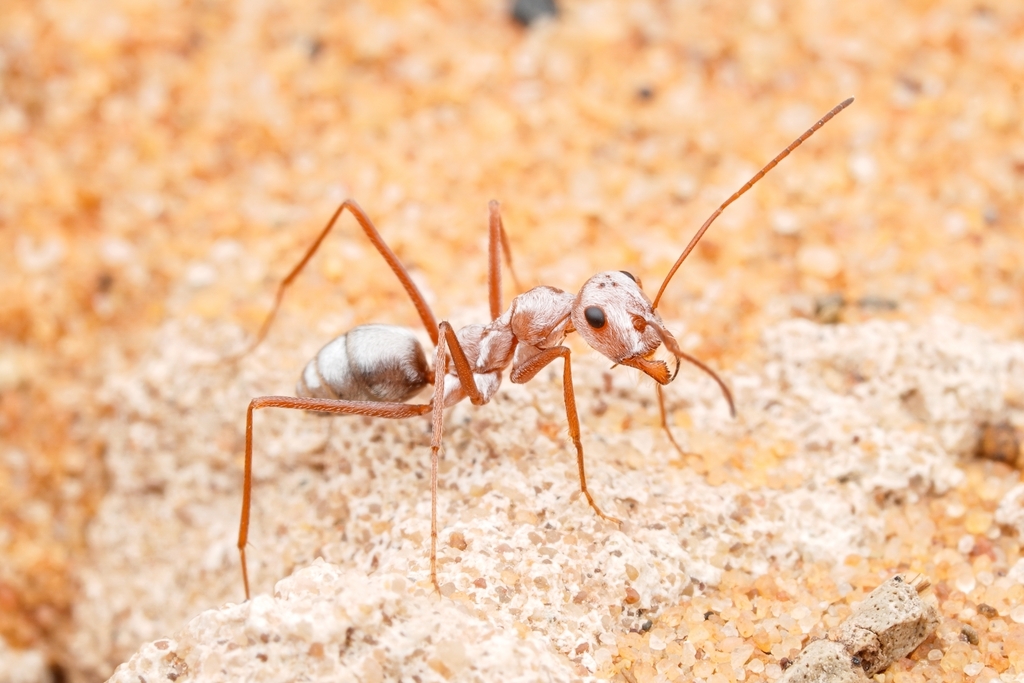
Saharan silver ants live in the Sahara Desert and are only active for about ten minutes each day because of extreme heat and predators. They can run at 855 mm s⁻¹, covering about 108 times their body length each second, making them the fastest ant species. Their bodies are covered with triangular hairs that reflect visible and near-infrared light, keeping them cool in intense sunlight.
Source: Wikipedia
How to recognize it
The ant’s back and sides are coated with uniquely shaped hairs that have a triangular cross-section. These hairs reflect both visible and near-infrared light, the wavelengths where solar radiation is strongest.
Source: Wikipedia
Size
It can travel a distance equal to 108 times its own body length each second, a speed matched only by two other tiny creatures.
Source: Wikipedia
Where it lives
The species inhabits the Sahara Desert.
Source: Wikipedia
What it eats
Workers scavenge the bodies of animals that have died from the extreme midday heat. Scout ants watch for lizards that hide in their burrows and alert the colony, prompting hundreds of ants to forage for food.
Source: Wikipedia
Life cycle
Above-ground activity is limited to roughly ten minutes each day due to temperature and predation pressures. They can only be active within a narrow temperature window between when predatory lizards stop moving and the ants’ own heat limit.
Source: Wikipedia
When you see it
Foraging occurs when midday temperatures reach about 47 °C (117 °F). The colony must finish foraging before temperatures hit 53 °C (127 °F), which can be lethal.
Source: Wikipedia
Where it comes from
It is native to the Sahara Desert.
Source: Wikipedia
Lookalikes
Its speed is comparable to a human walking pace; if a 1.8 m tall person ran at the same relative speed, it would be about 200 m s⁻¹ (720 km h⁻¹).
Source: Wikipedia
More photos


Questions people ask
How fast can Saharan silver ants run?
They can move at 855 mm s⁻¹, covering about 108 times their body length each second, making them the fastest ant species.
Source: Wikipedia
When are Saharan silver ants active?
They are only outside their nest for about ten minutes each day, usually during the hottest part of midday when temperatures are around 47 °C (117 °F).
Source: Wikipedia
What do Saharan silver ants eat?
They scavenge the carcasses of animals that have died from extreme heat and also collect food when scouts warn of lizards sheltering in their burrows.
Source: Wikipedia
Why do Saharan silver ants have silver-shiny hairs?
The triangular hairs on their bodies reflect visible and near-infrared light, helping keep them cool under intense solar radiation.
Source: Wikipedia
Same family (Formicidae)
 Eastern Black Carpenter AntCamponotus pennsylvanicusCan damage your home
 Red Imported Fire AntSolenopsis invictaCan sting
 American Winter AntPrenolepis imparis
 Argentine AntLinepithema humileNuisance, not dangerous
 Immigrant Pavement AntTetramorium immigransCan sting
 Odorous House AntTapinoma sessileCan damage your home
Sources
- Wikipedia: https://en.wikipedia.org/wiki/Saharan_silver_ant
Look it up elsewhere: GBIF · iNaturalist · BugGuide · ITIS · Wikipedia
Text written 2026-10-23 from the sources above and checked sentence by sentence against them. Data fetched 2026-10-23.