 Bug FAQ
Rosy Rustic
Hydraecia micacea · Order: Lepidoptera · Family: Noctuidae
Also called: Potato Stem Borer Moth, Potato stem worm, potato stem borer, Rosy Rustic Moth
Source: Wikipedia
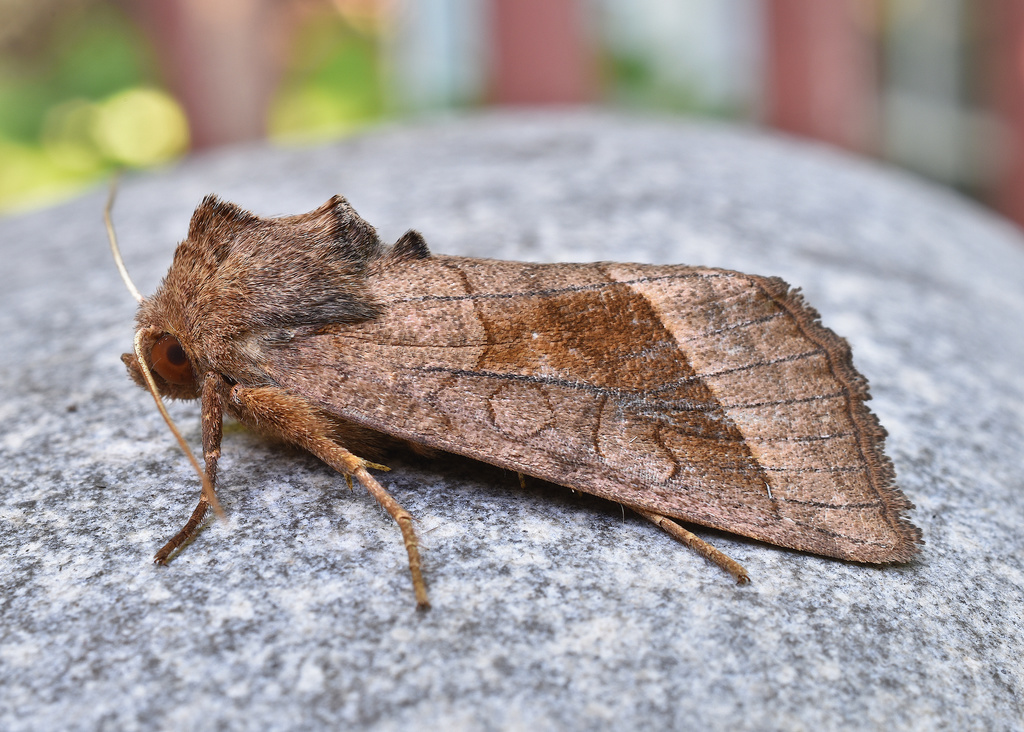
The Rosy Rustic moth has a wingspan of about 3 to 4.5 cm and forewings 1.4 to 2.1 cm long, with pale grey-ochre or dark grey coloring and a reddish-brown head. It lives across the Palearctic from Ireland to Siberia, has been introduced to eastern North America, and flies from early July through November in a single generation. The caterpillars feed on many herbaceous plants, notably potato, and can become a pest of cultivated crops.
Source: Wikipedia
How to recognize it
Forewings are pale grey-ochreous or dark grey with a strong reddish tint, while hindwings are luteous with a grey shade and a dark outer line.
Source: Wikipedia
Size
Wingspan ranges from 28 to 45 mm. Forewing length is between 14 and 21 mm.
Source: Wikipedia
Where it lives
It occurs throughout the Palearctic region, avoiding the southern parts. Introduced populations exist in eastern United States, Quebec and Ottawa.
Source: Wikipedia
What it eats
Larvae feed on a wide range of herbaceous plants, including cultivated potato.
Source: Wikipedia
Life cycle
Caterpillars are reddish-flesh coloured with black tubercles and spiracles, and have a shining red-brown head.
Source: Wikipedia
When you see it
Flight period extends from early July through November.
Source: Wikipedia
Where it comes from
Native to the Palearctic realm from Ireland to Siberia.
Source: Wikipedia
Lookalikes
It closely resembles Hydraecia ultima and Hydraecia nordstroemi, and reliable identification requires examination of the genitalia.
Source: Wikipedia
Where it is found in the US
Recorded in 12 of 51 states and DC. Most records: Michigan, New York, Maine, Vermont, New Hampshire, Massachusetts, Wisconsin, Florida.
Darker = more records. Counts are museum and citizen-science records, not population size.
Source: GBIF
Status: introduced in Canada; introduced in United States. Source: iNaturalist
Months it is reported in the US
Source: GBIF
More photos
Questions people ask
What plants do the larvae eat?
The caterpillars feed on many herbaceous plants, especially potato.
Source: Wikipedia
When can I see adult Rosy Rustic moths?
Adults fly in a single generation from early July until November.
Source: Wikipedia
How can I tell this moth apart from similar species?
It looks similar to two other Hydraecia species, and only genital examination can confirm the ID.
Source: Wikipedia
Same family (Noctuidae)
 Ipsilon Dart MothAgrotis ipsilonDamages trees, gardens or crops
 Fall Armyworm MothSpodoptera frugiperdaDamages trees, gardens or crops
 Army Cutworm MothEuxoa auxiliarisDamages trees, gardens or crops
 Large Yellow UnderwingNoctua pronubaDamages trees, gardens or crops
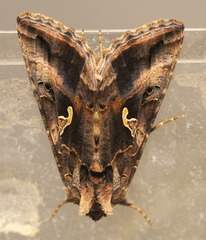 Silver ΥAutographa gamma
 American DaggerAcronicta americanaCan irritate skin
Sources
- Wikipedia: https://en.wikipedia.org/wiki/Hydraecia_micacea
Look it up elsewhere: GBIF · iNaturalist · BugGuide · ITIS · Wikipedia
Text written 2026-10-28 from the sources above and checked sentence by sentence against them. Data fetched 2026-10-28.