 Bug FAQ
Reticulated Net-winged Beetle
Calopteron reticulatum · Order: Coleoptera · Family: Lycidae
Also called: Banded Net-winged Beetle, Banded Net-wing

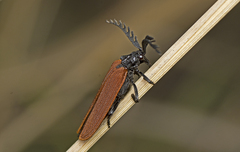
The reticulated net-winged beetle (Calopteron reticulatum) is a North American beetle often called the banded net-winged beetle, a name it shares with a close relative. Adults are active by day and lay their eggs on dead or decaying trees; the larvae live in leaf litter and hunt small arthropods.
Source: Wikipedia
How to recognize it
It is also called the banded net-winged beetle, a name shared with the similar Calopteron discrepans.
Source: Wikipedia
Where it lives
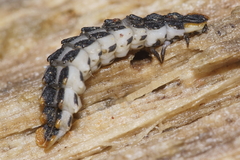
Adults are day-active and lay eggs on dead or decaying trees. Larvae hunt in leaf litter, feeding on other small arthropods.
Source: Wikipedia
What it eats
Larval beetles eat small arthropods they find in leaf litter.
Source: Wikipedia
Life cycle
Adults lay eggs on dead wood, and the species later pupates inside dead trees.
Source: Wikipedia
When you see it
Adults are active during daylight hours.
Source: Wikipedia
Where it comes from
It is found throughout North America.
Source: Wikipedia
Lookalikes
The name banded net-winged beetle is also used for the similar Calopteron discrepans.
Source: Wikipedia
Where it is found in the US
Recorded in 39 of 51 states and DC. Most records: Massachusetts, New York, Pennsylvania, New Hampshire, Ohio, Vermont, Maine, Michigan.
Darker = more records. Counts are museum and citizen-science records, not population size.
Source: GBIF
Status: native in North America; native in Canada. Source: iNaturalist
Months it is reported in the US
Source: GBIF
More photos
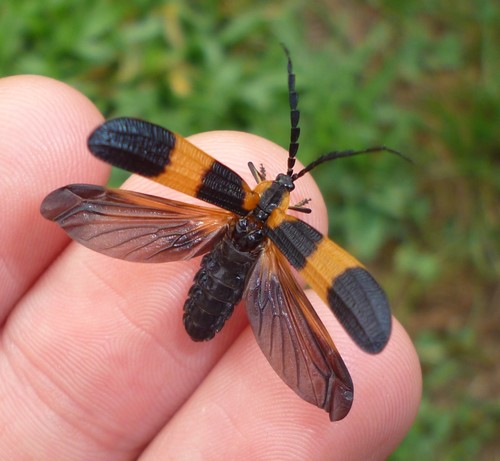
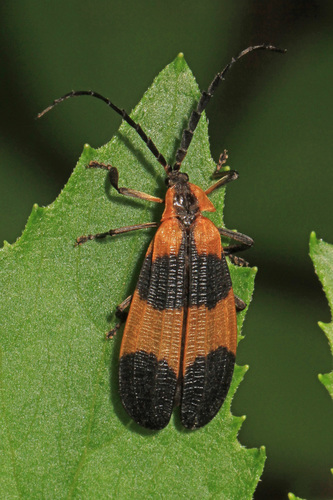
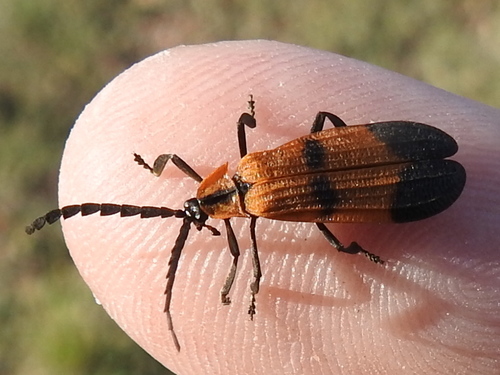
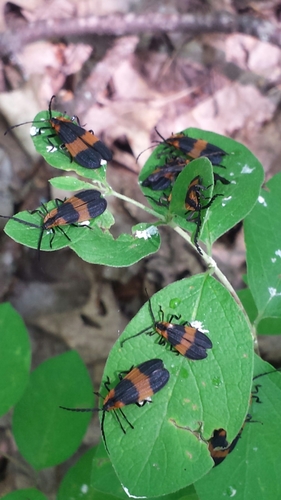
Same family (Lycidae)


Sources
- Wikipedia: https://en.wikipedia.org/wiki/Calopteron_reticulatum
Look it up elsewhere: GBIF · iNaturalist · BugGuide · ITIS · Wikipedia
Text written 2026-10-22 from the sources above and checked sentence by sentence against them. Data fetched 2026-10-22.