 Bug FAQ
Red-headed Pine Sawfly
Neodiprion lecontei · Order: Hymenoptera · Family: Diprionidae
Also called: redheaded pine sawfly
Source: Wikipedia
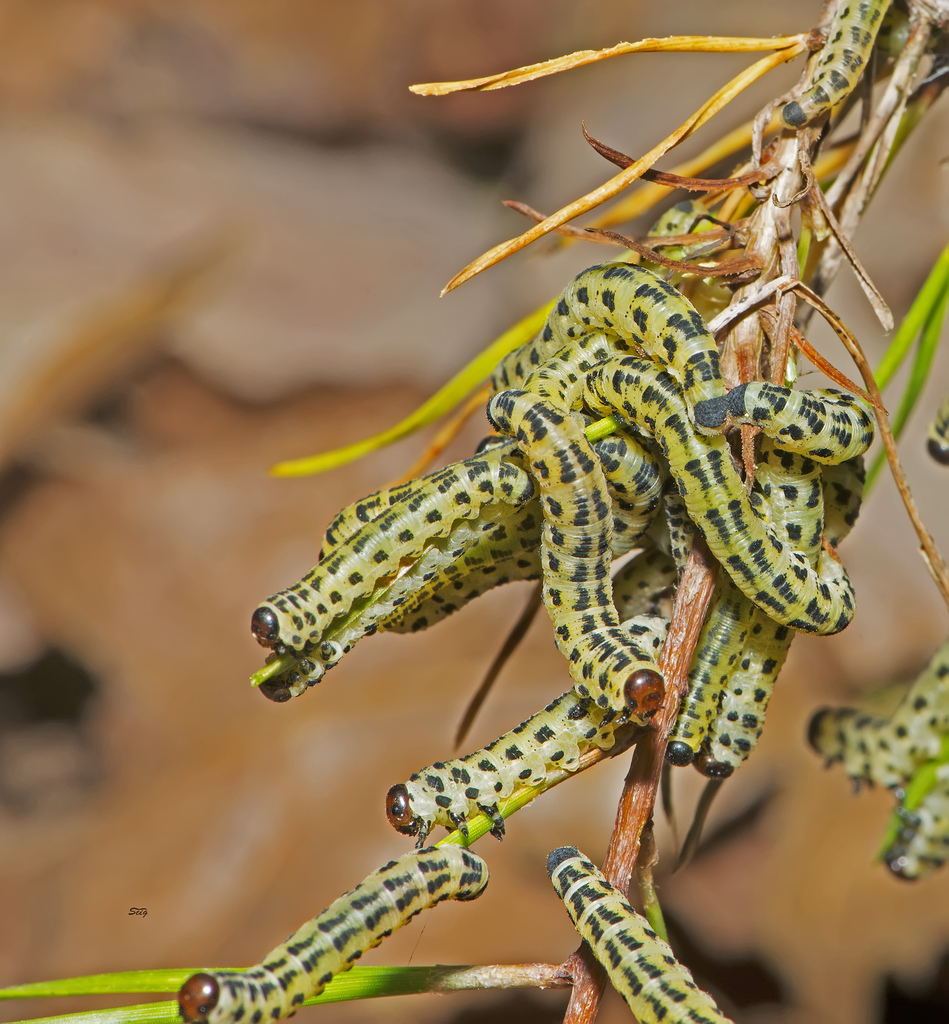
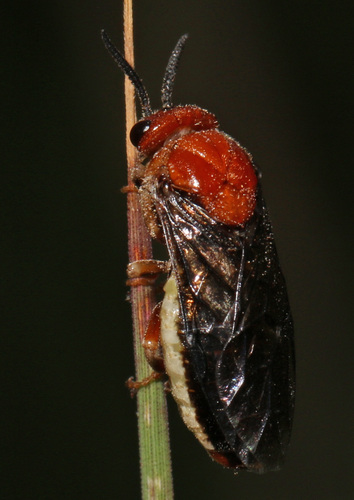
Adults are 5 to 8.5 mm long; females have reddish-brown heads and thorax while males are all black and a bit smaller. The gregarious larvae feed on many pine species and can defoliate whole branches, especially on trees under 5 m tall.
Source: Wikipedia
How to recognize it
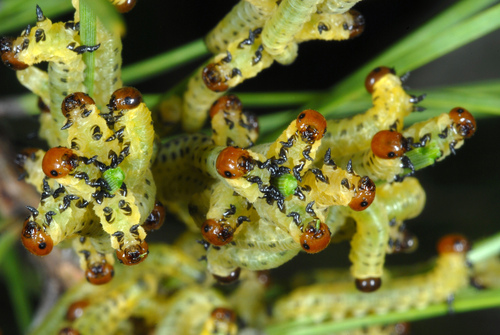
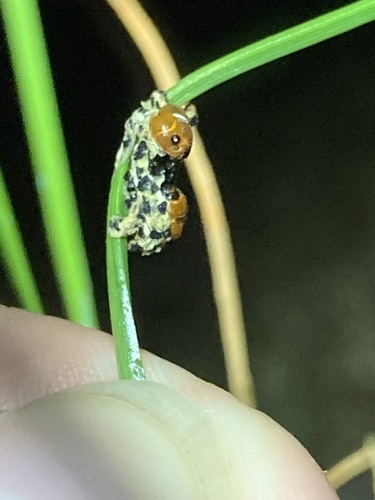
Young larvae are whitish with brown heads; older larvae turn yellow-green with up to eight rows of black spots and brown heads.
Source: Wikipedia
Size
Adults measure between 5 and 8.5 mm in length, with males slightly smaller than females.
Source: Wikipedia
Where it lives
They are found in eastern North America.
Source: Wikipedia
What it eats
Larvae feed on the foliage of many native and introduced pine species. They consume various members of the pine family.
Source: Wikipedia
Life cycle
Females cut slits in pine needles with their ovipositor and lay one egg in each slit. The larvae are gregarious and can strip entire branches of needles. They overwinter as prepupae, pupate in spring, and emerge from the cocoon as adults. In the north there is one generation per year, while farther south there may be two or three overlapping generations.
Source: Wikipedia
When you see it
The number of generations per year varies with latitude, from one in the north to up to three in the south.
Source: Wikipedia
Where it comes from
The species is native to eastern North America, ranging from southeastern Canada west to the Great Plains and south to Texas and Florida.
Source: Wikipedia
Where it is found in the US
Recorded in 30 of 51 states and DC. Most records: Florida, North Carolina, Virginia, New York, Georgia, Alabama, Illinois, Maryland.
Darker = more records. Counts are museum and citizen-science records, not population size.
Source: GBIF
Status: native in North America; native in Canada. Source: iNaturalist
Months it is reported in the US
Source: GBIF
More photos
Questions people ask
How can I recognize the red-headed pine sawfly?
Adults are 5 to 8.5 mm long; females have reddish-brown heads and thorax, while males are all black and smaller. Young larvae are whitish with brown heads, and older larvae turn yellow-green with black spots.
Source: Wikipedia
What damage do the larvae cause?
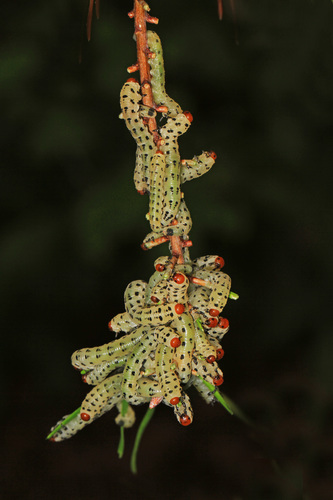
The gregarious larvae feed on pine foliage and can strip entire branches, especially on trees less than 5 m tall.
Source: Wikipedia
When are they most active?
In northern areas there is one generation per year, while in southern regions there may be two or three overlapping generations.
Source: Wikipedia
Same family (Diprionidae)

Sources
- Wikipedia: https://en.wikipedia.org/wiki/Neodiprion_lecontei
Look it up elsewhere: GBIF · iNaturalist · BugGuide · ITIS · Wikipedia
Text written 2026-10-24 from the sources above and checked sentence by sentence against them. Data fetched 2026-10-24.