 Bug FAQ
Introduced Pine Sawfly
Diprion similis · Order: Hymenoptera · Family: Diprionidae
Also called: Pine sawfly, White Pine Sawfly
Source: Wikipedia

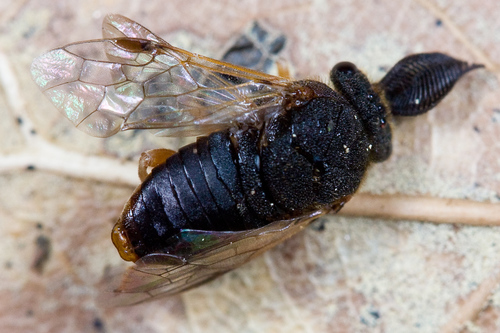
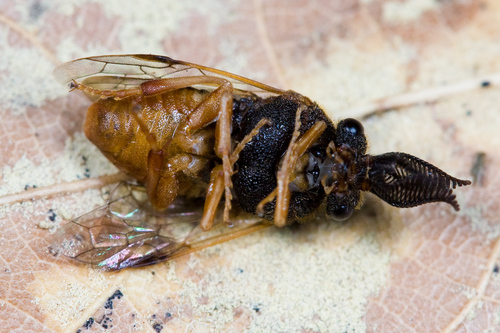
Adults are small black insects about 7 to 10 mm long, with a reddish-brown underside of the abdomen. They originated in central and northern Europe and Asia and were accidentally brought to North America, where they have become invasive. Larvae feed on pine needles, preferring white pine, and can cause serious defoliation of trees.
Source: Wikipedia
How to recognize it
The insect is black except for a sometimes reddish-brown underside of the abdomen.
Source: Wikipedia
Size
Males measure 7 to 9 mm and females 7.5 to 10 mm in length.
Source: Wikipedia
Is it a pest in the house?
In North America it faces few natural enemies, allowing it to become an invasive pest.
Source: Wikipedia
How to get rid of it
Because it lacks predators in the New World, it spreads quickly and is hard to control.
Source: Wikipedia
Where it lives
In North America it is called the introduced or imported pine sawfly.
Source: Wikipedia
What it eats
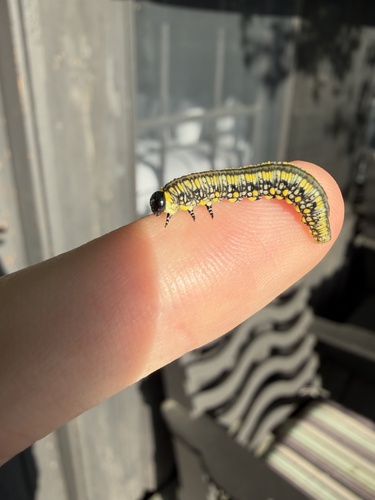
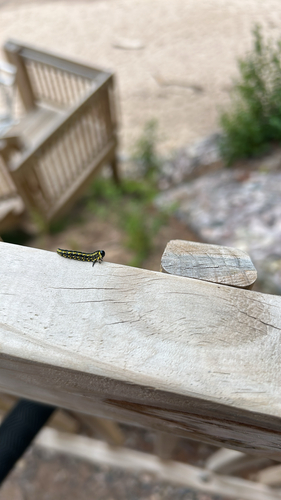
Larvae eat the needles of many pine species, especially white pine (Pinus strobus).
Source: Wikipedia
Life cycle
Unfertilized eggs develop into males (arrhenotoky). The first generation spins cocoons in July and emerges in August; the second generation overwinters as a prepupa in the soil.
Source: Wikipedia
When you see it
Adults appear in spring and stay active through most of the summer. Some individuals may remain in prepupal stage for up to three years.
Source: Wikipedia
Lookalikes
It is sometimes called the white pine sawfly, a name it shares with Neodiprion pinetum, which can cause confusion.
Source: Wikipedia
Where it is found in the US
Recorded in 27 of 51 states and DC. Most records: Maine, Michigan, New Hampshire, New York, Vermont, Massachusetts, Wisconsin, Pennsylvania.
Darker = more records. Counts are museum and citizen-science records, not population size.
Source: GBIF
Status: introduced in Canada; introduced in United States. Source: iNaturalist
Months it is reported in the US
Source: GBIF
More photos
Questions people ask
How can I tell this sawfly apart from similar species?
Look for a small black adult with a reddish-brown underside of the abdomen; other white-pine sawflies may look similar but differ in size and markings.
Source: Wikipedia
What damage does the pine sawfly cause?
Its larvae eat pine needles, especially on white pine, leading to defoliation that can weaken or kill trees.
Source: Wikipedia
When are adults active?
Adults emerge in spring and remain active through most of the summer months.
Source: Wikipedia
Why is this sawfly a problem in North America?
It was introduced accidentally, has few natural predators, and reproduces parthenogenetically, allowing rapid population growth.
Source: Wikipedia
Sources
- Wikipedia: https://en.wikipedia.org/wiki/Diprion_similis
Look it up elsewhere: GBIF · iNaturalist · BugGuide · ITIS · Wikipedia
Text written 2026-10-22 from the sources above and checked sentence by sentence against them. Data fetched 2026-10-22.