 Bug FAQ
Red-headed Bush Cricket
Phyllopalpus pulchellus · Order: Orthoptera · Family: Trigonidiidae
Also called: Handsome Trig

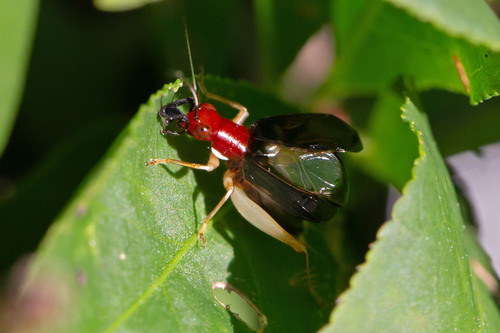
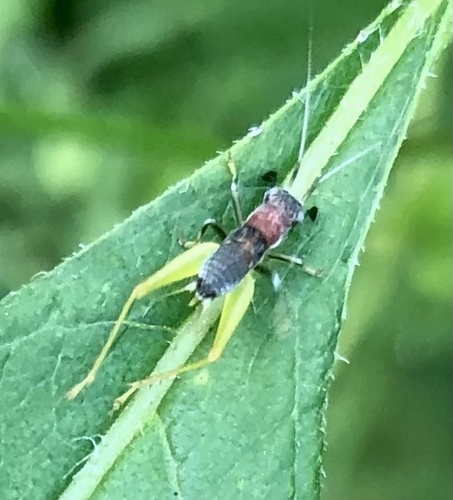
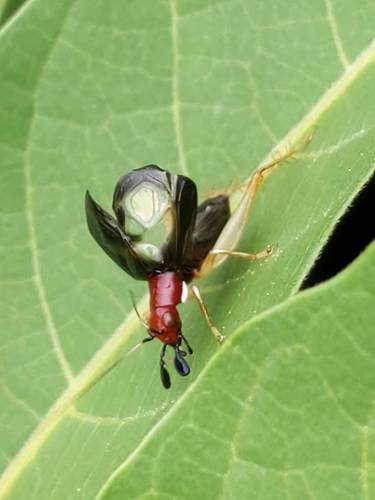
The red-headed bush cricket is a tiny insect about 7 to 9 mm long with a red head and thorax, black wings and abdomen, and translucent green to pale-yellow legs. It lives in the eastern United States, reaching as far west as Houston, Texas, and feeds on flowers, leaves, small insects and their eggs. Females lay eggs in tree trunks, and the adults are known for a loud, rattling trill song during the season.
Source: Wikipedia
How to recognize it
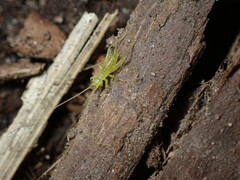
Adults have a red head and thorax. Their abdomen and wings are black. Their legs range from translucent green to pale yellow.
Source: Wikipedia
Size
They measure about 7 to 9 mm in length.
Source: Wikipedia
Where it lives
They are found throughout the eastern United States.
Source: Wikipedia
What it eats
They eat flowers, leaves, small insects and insect eggs. They are an omnivorous species.
Source: Wikipedia
Life cycle
Females deposit eggs in tree trunks.
Source: Wikipedia
When you see it
Their song is a loud, rattling trill.
Source: Wikipedia
Where it comes from
Their range extends westward to the Houston, Texas area.
Source: Wikipedia
Where it is found in the US
Recorded in 32 of 51 states and DC. Most records: Massachusetts, Ohio, North Carolina, Pennsylvania, New York, Virginia, Georgia, Michigan.
Darker = more records. Counts are museum and citizen-science records, not population size.
Source: GBIF
Status: native in North America; native in United States; native in Canada. Source: iNaturalist
Months it is reported in the US
Source: GBIF
More photos

Same family (Trigonidiidae)

Sources
- Wikipedia: https://en.wikipedia.org/wiki/Phyllopalpus_pulchellus
Look it up elsewhere: GBIF · iNaturalist · BugGuide · ITIS · Wikipedia
Text written 2026-10-22 from the sources above and checked sentence by sentence against them. Data fetched 2026-10-22.