 Bug FAQ
Red-green Carpet
Chloroclysta siterata · Order: Lepidoptera · Family: Geometridae
Source: Wikipedia
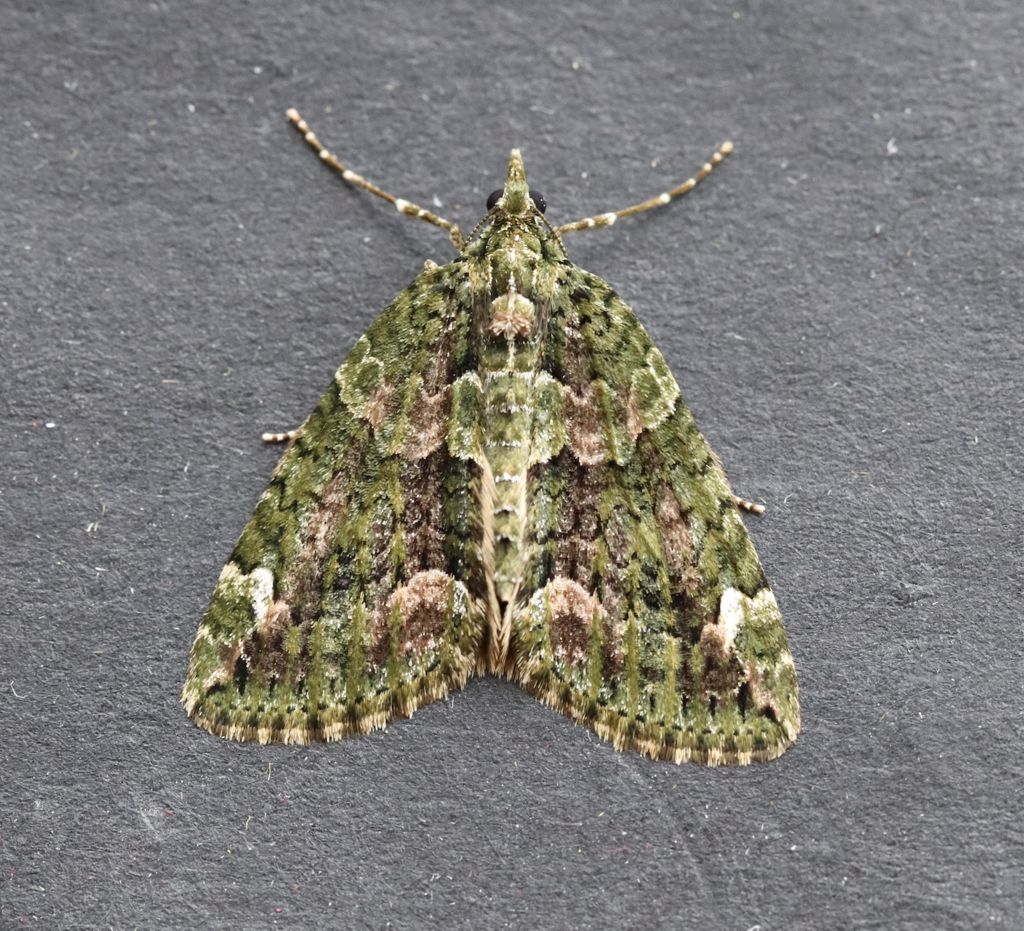
Adults have a wingspan of about 3 cm and show grey-green forewings with a reddish tint and a dark central band that may appear as wavy lines. The caterpillars are long, slender, green with red markings and feed on a wide range of trees and shrubs, which can lead to leaf damage in gardens and forests.
Source: Wikipedia
How to recognize it
Forewings are grey-green with a reddish hue and a dark central band that may be replaced by wavy crosslines; the wings are pointed.
Source: Wikipedia
Size
Wingspan ranges from 28 to 36 mm.
Source: Wikipedia
What it eats
Larvae feed on leaves of poplar, willow, several oak species, Japanese quince, rowan, dog rose, Japanese cherry, sycamore, alder buckthorn and linden.
Source: Wikipedia
Life cycle
Caterpillars are very long and slender, with a slightly less thin thorax and well-developed anal points; they are green with red dorsal lines and spots, and their legs and anal points are tipped in red.
Source: Wikipedia
Where it comes from
It occurs across most of Europe, extending to Asia Minor and the Caucasus.
Source: Wikipedia
More photos


Questions people ask
Does the red-green carpet damage trees or garden plants?
Yes, its larvae feed on many tree and shrub species and can strip leaves, causing damage in gardens and forests.
Source: Wikipedia
Same family (Geometridae)
 Willow BeautyPeribatodes rhomboidaria
 Pale BeautyCampaea perlataDamages trees, gardens or crops
 Large Lace-border MothScopula limboundataDamages trees, gardens or crops
 Riband WaveIdaea aversata
 Yellow Shell MothCamptogramma bilineata
 Large Maple Spanworm MothProchoerodes lineolaDamages trees, gardens or crops
Sources
- Wikipedia: https://en.wikipedia.org/wiki/Chloroclysta_siterata
Look it up elsewhere: GBIF · iNaturalist · BugGuide · Wikipedia
Text written 2026-10-22 from the sources above and checked sentence by sentence against them. Data fetched 2026-10-22.