 Bug FAQ
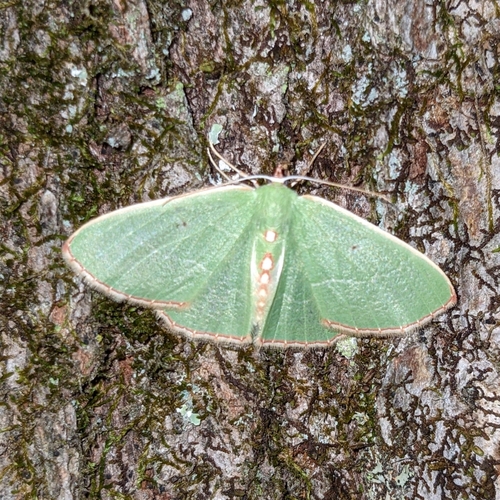
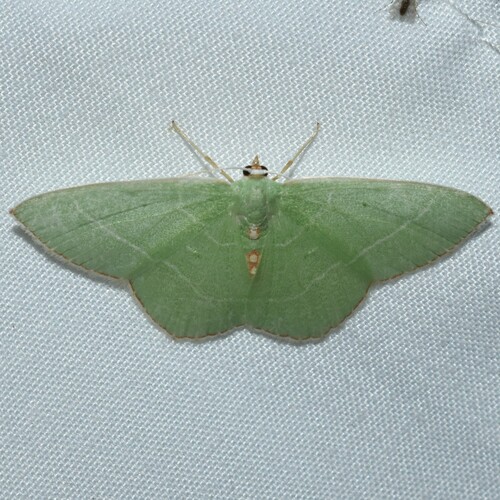
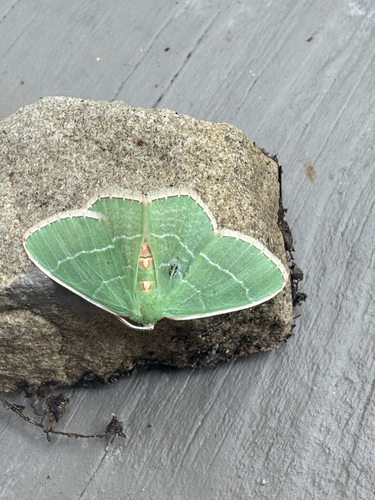
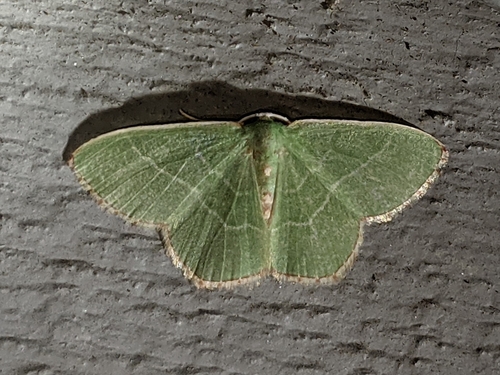
Red-fringed Emerald
Nemoria bistriaria · Order: Lepidoptera · Family: Geometridae
Also called: American Red-fringed Emerald, Red-fringed Emerald Moth

The red-fringed emerald is a moth in the Geometridae family, known scientifically as Nemoria bistriaria. Its wingspan measures about 22 mm. It lives across much of North America, from New Brunswick and Ontario down to Florida and across to the central coast of California.
Source: Wikipedia
Size
The adult’s wingspan is roughly 22 mm.
Source: Wikipedia
Life cycle
The species produces at least two generations each year.
Source: Wikipedia
When you see it
Adults fly from March to October in southern areas and from May to August in northern areas.
Source: Wikipedia
Where it comes from
Its range includes much of eastern Canada and the United States, extending west to California and north to Ontario.
Source: Wikipedia
Where it is found in the US
Recorded in 41 of 51 states and DC. Most records: Vermont, Ohio, Maryland, Massachusetts, Pennsylvania, Michigan, Connecticut, New York.
Darker = more records. Counts are museum and citizen-science records, not population size.
Source: GBIF
Status: native in North America; native in Canada; native in United States. Source: iNaturalist
Months it is reported in the US
Source: GBIF
More photos
Questions people ask
When are red-fringed emerald moths active?
In the south they are on wing from March through October, while in the north they appear from May to August.
Source: Wikipedia
Same family (Geometridae)
 Willow BeautyPeribatodes rhomboidaria
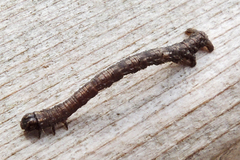 Pale BeautyCampaea perlataDamages trees, gardens or crops
 Large Lace-border MothScopula limboundataDamages trees, gardens or crops
 Riband WaveIdaea aversata
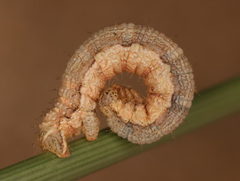 Yellow Shell MothCamptogramma bilineata
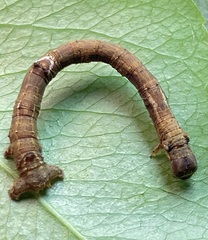 Large Maple Spanworm MothProchoerodes lineolaDamages trees, gardens or crops
Sources
- Wikipedia: https://en.wikipedia.org/wiki/Nemoria_bistriaria
Look it up elsewhere: GBIF · iNaturalist · BugGuide · ITIS · Wikipedia
Text written 2026-10-23 from the sources above and checked sentence by sentence against them. Data fetched 2026-10-23.