 Bug FAQ
Red Bull Ant
Myrmecia gulosa · Order: Hymenoptera · Family: Formicidae
Also called: Giant Red Bull Ant, Hoppy Joe Ant
Source: Wikipedia
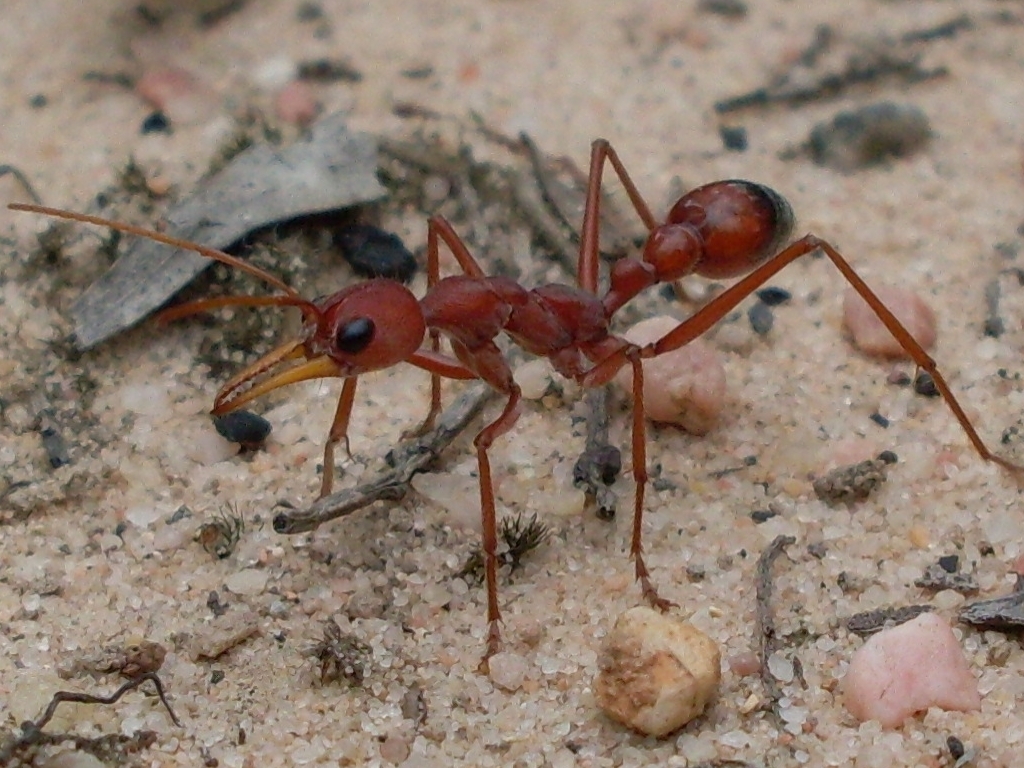
Adults are large, measuring 15 to 30 mm, with a red-brown head and thorax, a black rear abdomen, and brown-yellow mandibles. They build small mound nests in open, often burnt, areas and forage there, using powerful serrated mandibles and a venomous sting that can hurt for several days.
Source: Wikipedia
How to recognize it
Adults have long, powerful serrated mandibles and a venom-laden sting that can cause severe pain for a couple of days.
Source: Wikipedia
Size
Workers can be as long as 15 mm up to 30 mm.
Source: Wikipedia
Does it bite or sting?
They have powerful mandibles and a venomous sting that can cause severe pain for a few days. Unlike most ants, they lack chemical senses but have keen vision, spotting intruders up to two metres away.
Source: Wikipedia
Where it lives
They construct small mound nests in open areas and are often seen foraging around burnt ground.
Source: Wikipedia
What it eats
Adults cannot eat solid food; they drink juices from prey insects, while the meat is fed to larvae, and they also feed larvae with their own infertile eggs.
Source: Wikipedia
Life cycle
Nests consist of extensive tunnel systems.
Source: Wikipedia
When you see it
Foraging workers are frequently observed around burnt areas.
Source: Wikipedia
Where it comes from
The red bull ant is a bulldog ant species abundant throughout eastern Australia.
Source: Wikipedia
More photos
Questions people ask
Can Red Bull Ants sting people?
Yes, their venomous sting can cause severe pain that lasts for a couple of days.
Source: Wikipedia
What do Red Bull Ants look like?
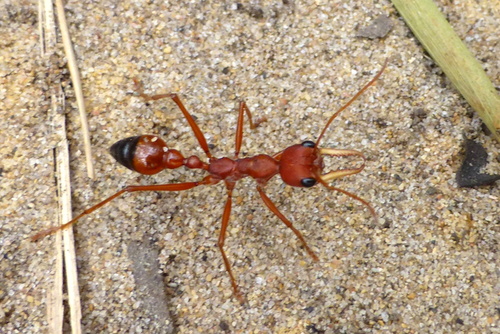
They are 15 to 30 mm long, with a red-brown head and thorax, a black rear abdomen, and brown-yellow mandibles.
Source: Wikipedia
Where are Red Bull Ants found?
They are common in eastern Australia, building small mound nests in open, often burnt, areas.
Source: Wikipedia
Same family (Formicidae)
 Eastern Black Carpenter AntCamponotus pennsylvanicusCan damage your home
 Red Imported Fire AntSolenopsis invictaCan sting
 American Winter AntPrenolepis imparis
 Argentine AntLinepithema humileNuisance, not dangerous
 Immigrant Pavement AntTetramorium immigransCan sting
 Odorous House AntTapinoma sessileCan damage your home
Sources
- Wikipedia: https://en.wikipedia.org/wiki/Myrmecia_gulosa
Look it up elsewhere: GBIF · iNaturalist · BugGuide · ITIS · Wikipedia
Text written 2026-10-23 from the sources above and checked sentence by sentence against them. Data fetched 2026-10-22.