 Bug FAQ
Rabid Wolf Spider
Rabidosa rabida · Order: Araneae · Family: Lycosidae
Source: Wikipedia, Penn State Extension

Females grow to about an inch while males are roughly half that size, and both have a dark-brown carapace with scattered gray hairs and solid-colored legs. They live in North-American cotton fields, woods, pondsides and debris-filled holes, hunting at night without building webs. Males perform a stridulating dance before mating; females carry egg sacs and later transport spiderlings on their backs.
Source: Wikipedia, Penn State Extension
How to recognize it
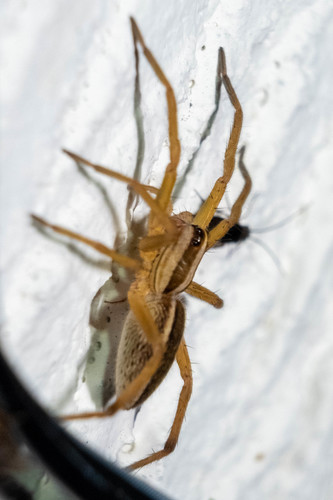
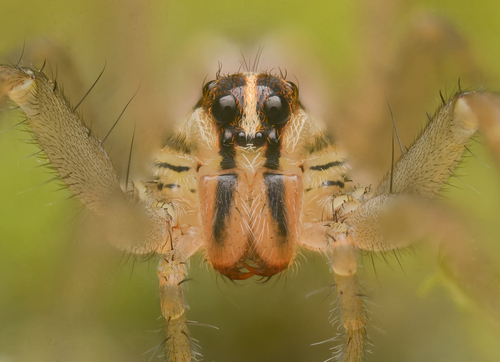
The spider’s head region shows two dark stripes and the abdomen a single stripe of the same color, with the rest of the body being yellow. It has eight eyes arranged in a moustache-like pattern, four above and four below. The carapace is dark brown with scattered gray hairs that lack a clear pattern. All legs are a uniform solid color.
Source: Wikipedia, Penn State Extension
Size
Females reach about one inch in body length, while males are about half that size.
Source: Wikipedia
Is it a pest in the house?
Related wolf spiders often make retreats in soil, under boards, stones, firewood, siding and similar protected spots in homes.
Source: Penn State Extension
Does it bite or sting?
They may bite if provoked or mishandled, but the bite is not dangerous to humans. A bite typically causes brief pain, redness and possibly some swelling that usually resolves within a day.
Source: Wikipedia, Penn State Extension
How to get rid of it
Wolf spiders will bite if they are mishandled or trapped against skin. No serious medical effects from their bites have been reported.
Source: Penn State Extension
Where it lives
They prefer cotton fields, wooded areas, and various holes or garbage piles, and can also be found near ponds or in deep, debris-covered burrows.
Source: Wikipedia
What it eats
It hunts at night, either ambushing or chasing prey, and uses silk blankets rather than webs to capture food or protect its young.
Source: Wikipedia
Life cycle
Males perform a dancing, stridulating display before mating; after successful copulation the female builds a silk egg sac and carries it.
Source: Wikipedia
When you see it
They are nocturnal hunters throughout the year.
Source: Wikipedia
Where it comes from
The species is native to North America. In the United States it occurs from Maine down to Florida in the east and from Oklahoma and Texas up to Idaho in the west.
Source: Wikipedia
Lookalikes
Males of this species have mostly black front legs, unlike the similar R. punctulata where all legs share the same color. Females of Tigrosa aspersa measure 18 to 25 mm and males 16 to 18 mm, providing a size reference for comparison.
Source: Wikipedia, Penn State Extension
Where it is found in the US
Recorded in 39 of 51 states and DC. Most records: Texas, North Carolina, Oklahoma, Virginia, Kansas, Maryland, Ohio, Tennessee.
Darker = more records. Counts are museum and citizen-science records, not population size.
Source: GBIF
Status: native in North America; native in Canada; native in United States. Source: iNaturalist
Months it is reported in the US
Source: GBIF
More photos

Questions people ask
Do rabid wolf spiders bite people?
Yes, they may bite if handled or provoked, but the bite is not dangerous to people.
Source: Wikipedia, Penn State Extension
Where are rabid wolf spiders found?
They live in North-American cotton fields, woods, pondsides and debris-filled holes, ranging from the eastern US down to Florida and across the western states from Texas to Idaho.
Source: Wikipedia
How big do they get?
Females are about an inch long, while males are roughly half that size.
Source: Wikipedia
How do they reproduce?
Males perform a dancing, stridulating display before mating; females then create a silk egg sac and carry their spiderlings on their backs until they are independent.
Source: Wikipedia
Same family (Lycosidae)

Sources
- Wikipedia: https://en.wikipedia.org/wiki/Rabidosa_rabida
- Penn State Extension: https://extension.psu.edu/wolf-spiders
Look it up elsewhere: GBIF · iNaturalist · BugGuide · ITIS · Wikipedia
Text written 2026-10-23 from the sources above and checked sentence by sentence against them. Data fetched 2026-10-23.