 Bug FAQ
Pioneer White
Belenois aurota · Order: Lepidoptera · Family: Pieridae
Also called: African Caper White, Brown-Veined White, Brownveined White, Caper White
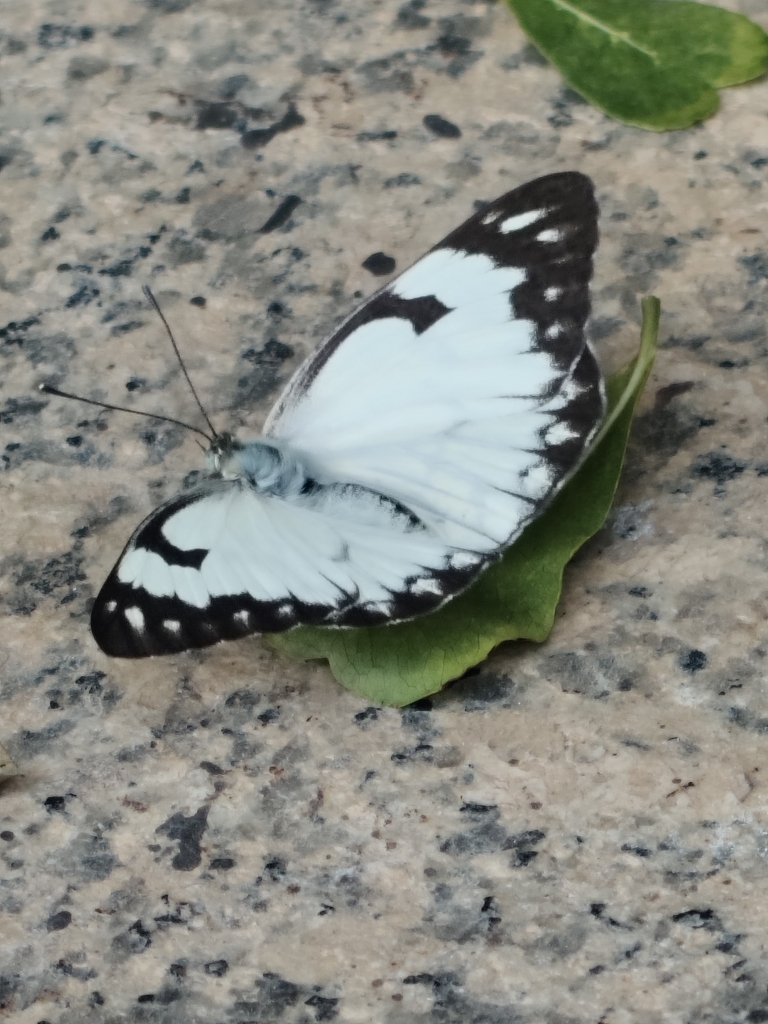
The Pioneer White butterfly has a wingspan of about 44 to 62 mm and shows distinctive black markings on a white background on both wing surfaces. It lives from the Himalayas and Sri Lanka through southern India, across Persia, Arabia and much of Sub-Saharan Africa. Its larvae feed on caper family plants such as Capparis zeylanica, Capparis pyrifolia and other Capparaceae species.
Source: Wikipedia
How to recognize it
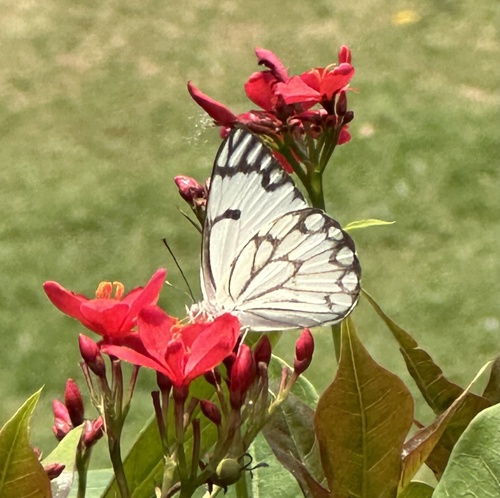
Males have white upper wings with a black costa on the forewing and a series of six pointed white spots in the black apical area; the underside shows similar patterns with larger white spots and black-bordered veins on a yellow-white hindwing.
Source: Wikipedia
Size
The wingspan ranges from 44 to 62 mm.
Source: Wikipedia
Where it lives
It inhabits regions from the Himalayas (below 1,800 m) through the plains of southern India and Sri Lanka, extending westward into Persia, Arabia and much of Sub-Saharan Africa.
Source: Wikipedia
What it eats
Caterpillars feed on caper plants, especially species of Capparis, Boscia and Maerua.
Source: Wikipedia
Life cycle
Females lay eggs in batches of about 20; the newly hatched larvae are gregarious and the eggs are small, transparent, pale cream-coloured.
Source: Wikipedia
When you see it
In Africa the butterfly is common in summer and autumn, when large numbers migrate northeast.
Source: Wikipedia
More photos

Questions people ask
When can I see Pioneer White butterflies?
They are most noticeable in summer and autumn, especially during their north-eastward migrations in Africa.
Source: Wikipedia
Same family (Pieridae)


Sources
- Wikipedia: https://en.wikipedia.org/wiki/Belenois_aurota
Look it up elsewhere: GBIF · iNaturalist · BugGuide · Wikipedia
Text written 2026-10-22 from the sources above and checked sentence by sentence against them. Data fetched 2026-10-22.