 Bug FAQ
Pearly Sedgesitter
Platycheirus hyperboreus · Order: Diptera · Family: Syrphidae
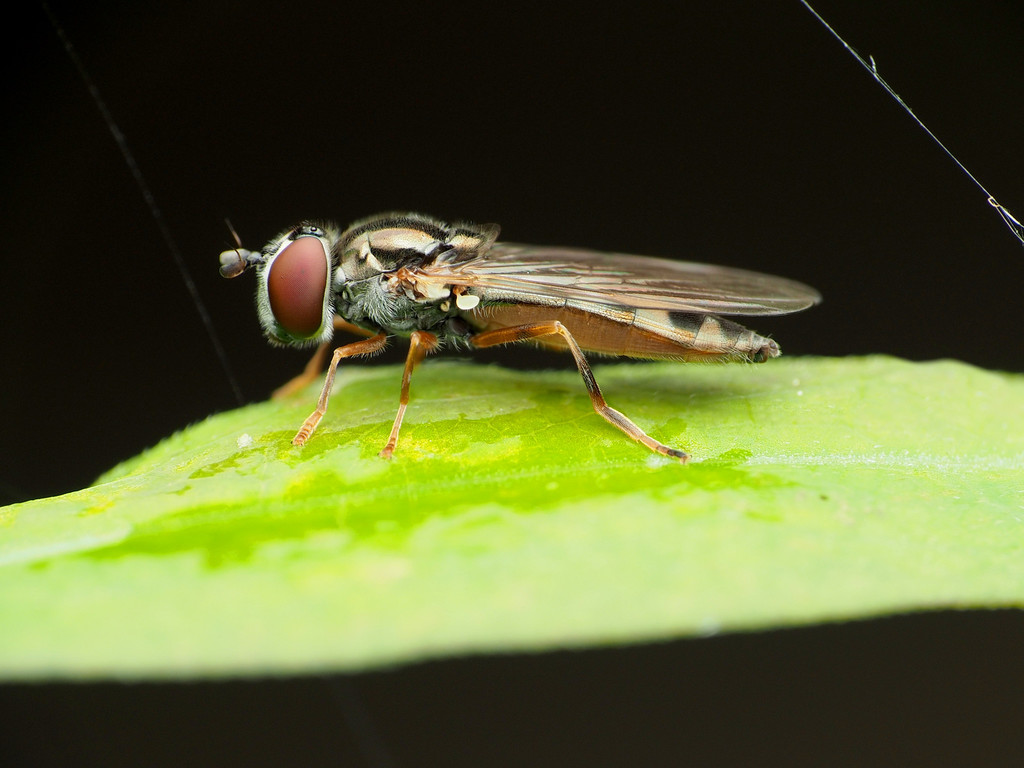
The Pearly Sedgesitter is a small hoverfly measuring about 5.3 to 8.7 mm in length. Its face is dusted with yellow-gray pollen except for a shiny tubercle and cheeks, and its abdomen shows a pattern of black with distinct green-ish spots on several segments. It is found across northern North America, from Alaska and Canada to the northern United States, and also in northern Europe from Norway and Finland into Siberia.
Source: Wikipedia
How to recognize it
The face is thickly covered with yellow-gray pollen, leaving the tubercle and front cheeks shiny. The abdomen is mostly opaque black with green-ish shining on the first and fifth segments; the second segment has small rounded spots, the third a large square spot, and the fourth similar spots, while the fifth segment is entirely shiny without yellow.
Source: Wikipedia
Where it comes from
In Europe it is native to western and northern regions such as Norway, Finland, the Kola Peninsula and further into northern Siberia.
Source: Wikipedia
Where it is found in the US
Recorded in 23 of 51 states and DC. Most records: Alaska, Pennsylvania, Illinois, Colorado, Ohio, North Dakota, New York, Massachusetts.
Darker = more records. Counts are museum and citizen-science records, not population size.
Source: GBIF
Status: native in North America; native in Canada. Source: iNaturalist
Months it is reported in the US
Source: GBIF
Same family (Syrphidae)






Sources
- Wikipedia: https://en.wikipedia.org/wiki/Platycheirus_hyperboreus
Look it up elsewhere: GBIF · iNaturalist · BugGuide · ITIS · Wikipedia
Text written 2026-10-27 from the sources above and checked sentence by sentence against them. Data fetched 2026-10-27.