 Bug FAQ
Pale Oak Beauty
Hypomecis punctinalis · Order: Lepidoptera · Family: Geometridae
Source: Wikipedia
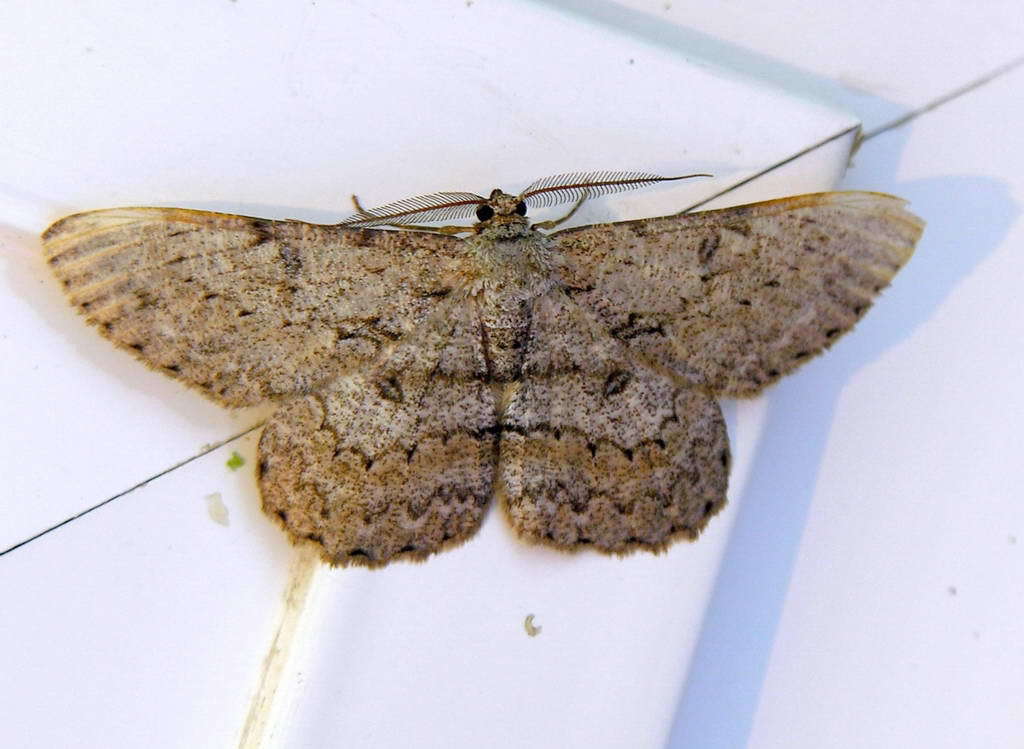
The Pale Oak Beauty moth has a wingspan of about 46 to 55 mm and forewings 22 to 26 mm long. Its forewings are grey-white with a brownish tint, fine black dusting, clear transverse lines and a pale-centered, dark-ringed discal spot. It flies from late April to July in one generation and the caterpillars eat oak and birch leaves.
Source: Wikipedia
How to recognize it
The forewings are grey-white with a brownish hue, fine black dusting, distinct crosswise lines and a pale-centered, dark-ringed discal mark.
Source: Wikipedia
Size
Wingspan ranges from 46 to 55 mm. Forewing length is 22 to 26 mm.
Source: Wikipedia
What it eats
Caterpillars feed on a variety of trees, notably oak and birch.
Source: Wikipedia
Life cycle
Adults are on the wing in a single generation from the end of April through July.
Source: Wikipedia
When you see it
The flight period is from late April to July.
Source: Wikipedia
Questions people ask
Do the larvae damage trees?
Yes, the caterpillars feed on oak and birch leaves, which can harm those trees.
Source: Wikipedia
How large is this moth?
Its wingspan is 46 to 55 mm and each forewing is 22 to 26 mm long.
Source: Wikipedia
Same family (Geometridae)
 Willow BeautyPeribatodes rhomboidaria
 Pale BeautyCampaea perlataDamages trees, gardens or crops
 Large Lace-border MothScopula limboundataDamages trees, gardens or crops
 Riband WaveIdaea aversata
 Yellow Shell MothCamptogramma bilineata
 Large Maple Spanworm MothProchoerodes lineolaDamages trees, gardens or crops
Sources
- Wikipedia: https://en.wikipedia.org/wiki/Hypomecis_punctinalis
Look it up elsewhere: GBIF · iNaturalist · BugGuide · Wikipedia
Text written 2026-10-22 from the sources above and checked sentence by sentence against them. Data fetched 2026-10-22.