 Bug FAQ
Orange-belted Leafwalker
Xylota segnis · Order: Diptera · Family: Syrphidae
Also called: Brown-toed Forest Fly, Orange-belted Hoverfly
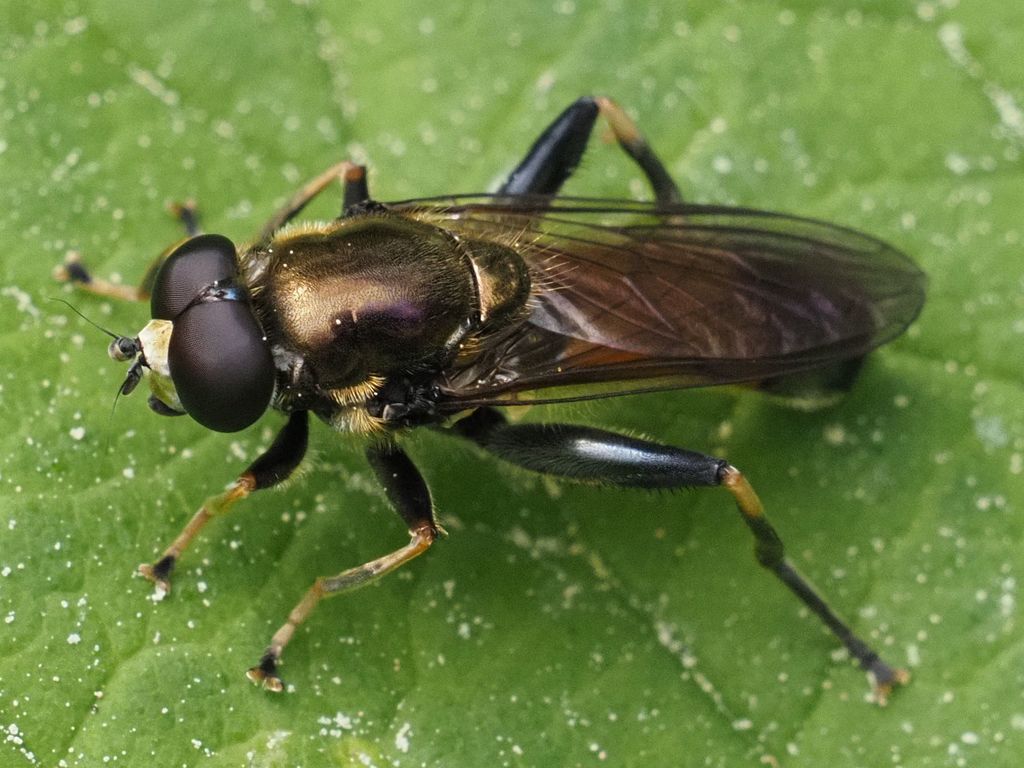
It is a small hoverfly about 1 to 1.4 cm long with greenish-black thorax, yellowish hairs and a red or yellow-red patch on a black abdomen. Adults feed on pollen from leaf surfaces and occasionally visit flowers, while larvae develop in decaying tree sap. It lives in low bushes in woods across Europe and parts of North America, flying from April to September and can have up to three generations per year.
Source: Wikipedia
How to recognize it
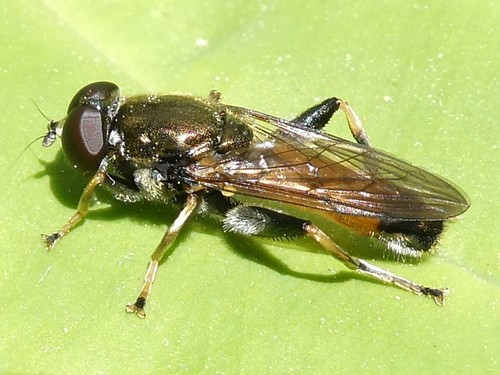
Front and hind legs are mostly yellow with dark femora; eyes are reddish and antennae are dark.
Source: Wikipedia
Size
Body length ranges from 10 to 14 mm and wing length from 7 to 9.5 mm.
Source: Wikipedia
Where it lives
Found mainly in low bushes within woodland areas.
Source: Wikipedia
What it eats
Adults graze pollen from leaf surfaces, sometimes visit flowers such as hazel, raspberry, and hawthorn, and also consume honeydew from aphids. Larvae are associated with decaying tree sap and have been found in decaying human remains.
Source: Wikipedia
Life cycle
The species can produce up to three generations each year. Larvae overwinter and pupate in spring.
Source: Wikipedia
When you see it
Adults are on the wing from April through September.
Source: Wikipedia
Where it comes from
Distributed across the Palearctic and Nearctic, present throughout Europe, the Mediterranean, the Caucasus, Russia to the Far East, Japan, southeastern Canada and the northeastern United States.
Source: Wikipedia
Where it is found in the US
Recorded in 5 of 51 states and DC. Most records: Maine, Vermont, New York, Ohio, Arizona.
Darker = more records. Counts are museum and citizen-science records, not population size.
Source: GBIF
Months it is reported in the US
Source: GBIF
More photos


Questions people ask
When can I see them?
They are active from spring to early fall, typically April to September.
Source: Wikipedia
Same family (Syrphidae)


Sources
- Wikipedia: https://en.wikipedia.org/wiki/Xylota_segnis
Look it up elsewhere: GBIF · iNaturalist · BugGuide · ITIS · Wikipedia
Text written 2026-10-22 from the sources above and checked sentence by sentence against them. Data fetched 2026-10-22.