 Bug FAQ
Omalus aeneus
Omalus aeneus · Order: Hymenoptera · Family: Chrysididae
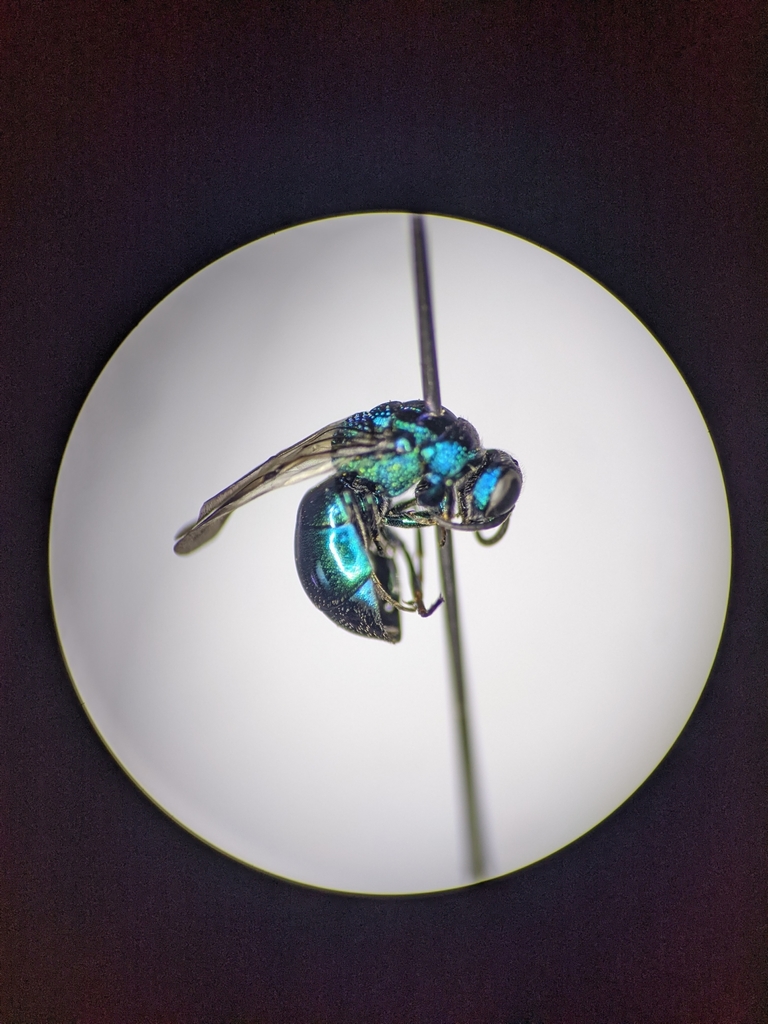
Adult Omalus aeneus are tiny wasps about 4.5 to 5.4 mm long, with front wings 3.3 to 4.2 mm in length. Their bodies shine in blue, green, purple or golden tones, the abdomen and legs are greenish-blue, antennae and parts of the thorax are black, and the tarsi are brown. They are found across Europe, the East Palaearctic (including China, Taiwan and Japan), the Near East, North Africa and the Nearctic region.
Source: Wikipedia
How to recognize it
The wasp’s body shows metallic blue-green or purple colors, with a black antennae and black middle of the pronotum and mesoscutum, while the tarsi are brown.
Source: Wikipedia
Size
Females measure 4.5 to 5.4 mm and males 4.4 to 5 mm in body length. The forewings are 3.3 to 4.2 mm long.
Source: Wikipedia
Where it lives
Omalus aeneus occurs in Europe, the East Palaearctic, the Near East, North Africa and the Nearctic.
Source: Wikipedia
What it eats
The species is a nesting parasite of several solitary crabronid wasps such as Pemphredon rufiger and Passaloecus species. It also lays eggs inside living aphids that are later captured by aphid-hunting crabronids.
Source: Wikipedia
Life cycle
In southern Europe the wasp can produce two or more generations each year.
Source: Wikipedia
When you see it
Two or more generations occur annually in southern Europe.
Source: Wikipedia
Where it comes from
Its range includes Europe, the East Palaearctic (China, Taiwan, Japan), the Near East, North Africa and the Nearctic.
Source: Wikipedia
Where it is found in the US
Recorded in 20 of 51 states and DC. Most records: Michigan, California, Wyoming, Alaska, Minnesota, Maine, Ohio, Nevada.
Darker = more records. Counts are museum and citizen-science records, not population size.
Source: GBIF
Status: native in North America; native in Canada. Source: iNaturalist
Months it is reported in the US
Source: GBIF
Questions people ask
How many generations does Omalus aeneus have per year?
In southern Europe it can have two or more generations each year.
Source: Wikipedia
Same family (Chrysididae)
Sources
- Wikipedia: https://en.wikipedia.org/wiki/Omalus_aeneus
Look it up elsewhere: GBIF · iNaturalist · BugGuide · Wikipedia
Text written 2026-10-26 from the sources above and checked sentence by sentence against them. Data fetched 2026-10-26.