 Bug FAQ
Pseudomalus auratus
Pseudomalus auratus · Order: Hymenoptera · Family: Chrysididae
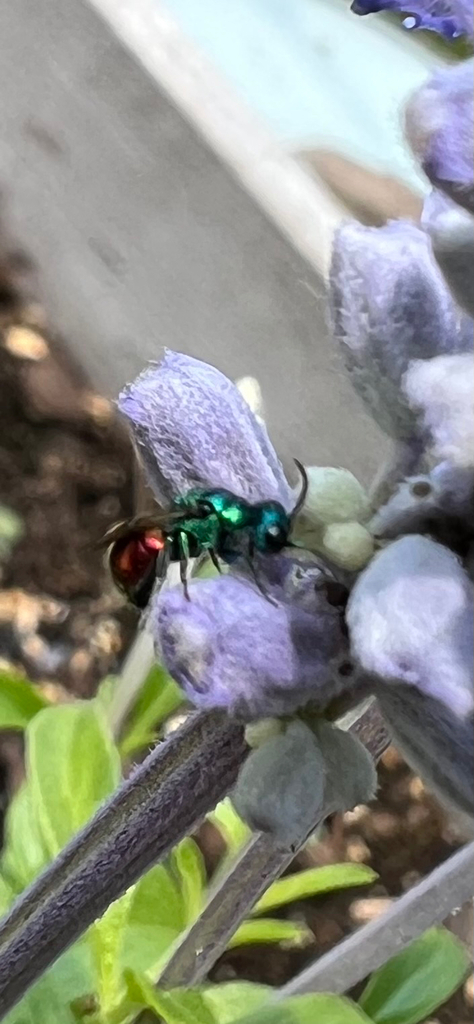
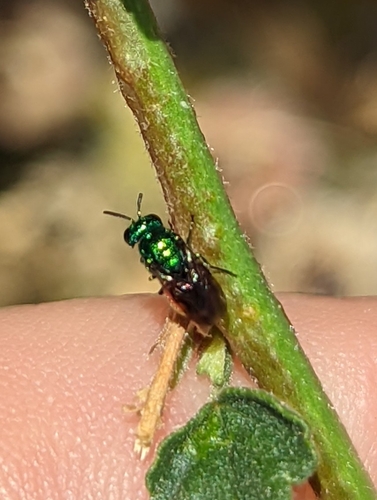
Pseudomalus auratus is a tiny wasp that measures about 3 to 7 mm long. Its head and thorax shine metallic blue while the abdomen is reddish, and the upper body is covered in hairs. It lives in open areas, forest edges and thickets across most of Europe, parts of the Near East, North Africa and Asia, and it flies from late May to early October.
Source: Wikipedia
How to recognize it
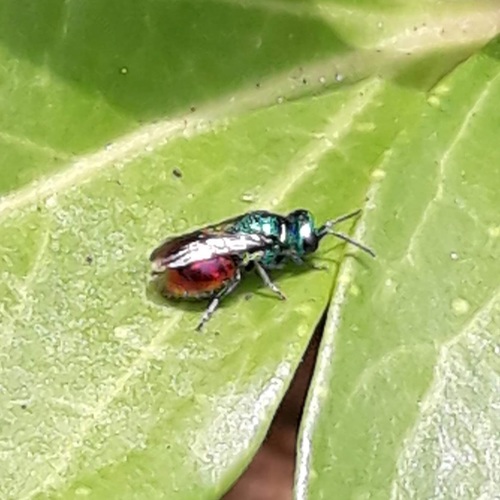
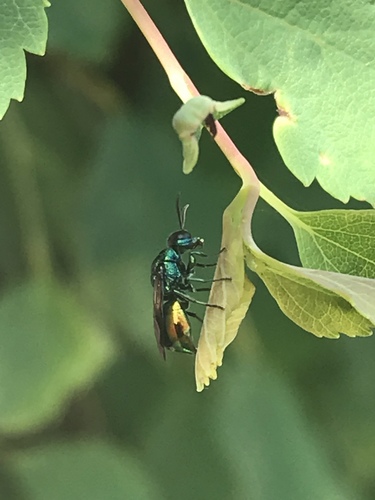
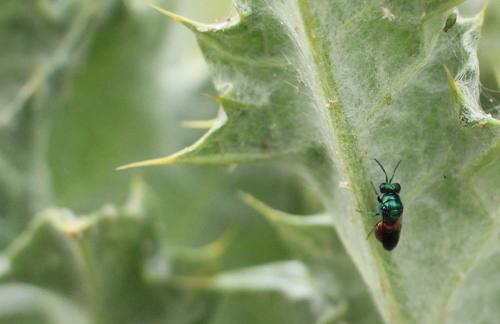
The wasp’s head and thorax are metallic bluish and hairy, and the abdomen is reddish.
Source: Wikipedia
Size
Adults range from 3 to 7 mm in length.
Source: Wikipedia
Where it lives
They are found in open habitats, forest edges and thickets where their hosts occur.
Source: Wikipedia
What it eats
Adults parasitize a range of solitary bees and wasps such as Ceratina, Hylaeus, Anthidium and several Pemphredon and Passaloecus species. Larvae are commonly found developing in blackberry and raspberry stems as well as in dead wood.
Source: Wikipedia
Life cycle
Adults are on the wing from late May through early October.
Source: Wikipedia
When you see it
Their flight period spans late May to early October.
Source: Wikipedia
Where it comes from
The species occurs throughout most of Europe, the Near East, North Africa and large parts of Asia, including Russia, Korea and Japan.
Source: Wikipedia
Where it is found in the US
Recorded in 33 of 51 states and DC. Most records: New York, California, Pennsylvania, Massachusetts, Ohio, Colorado, Illinois, Oregon.
Darker = more records. Counts are museum and citizen-science records, not population size.
Source: GBIF
Months it is reported in the US
Source: GBIF
More photos
Questions people ask
When are Pseudomalus auratus wasps active?
They fly from late May until early October.
Source: Wikipedia
What do the larvae of Pseudomalus auratus feed on?
Larvae develop inside blackberry and raspberry branches and in dead wood.
Source: Wikipedia
Where can I find Pseudomalus auratus?
Look for them in open areas, forest edges and thickets across Europe, the Near East, North Africa and parts of Asia.
Source: Wikipedia
Sources
- Wikipedia: https://en.wikipedia.org/wiki/Pseudomalus_auratus
Look it up elsewhere: GBIF · iNaturalist · BugGuide · Wikipedia
Text written 2026-10-25 from the sources above and checked sentence by sentence against them. Data fetched 2026-10-25.