 Bug FAQ
October Thorn
Synaxis jubararia · Order: Lepidoptera · Family: Geometridae
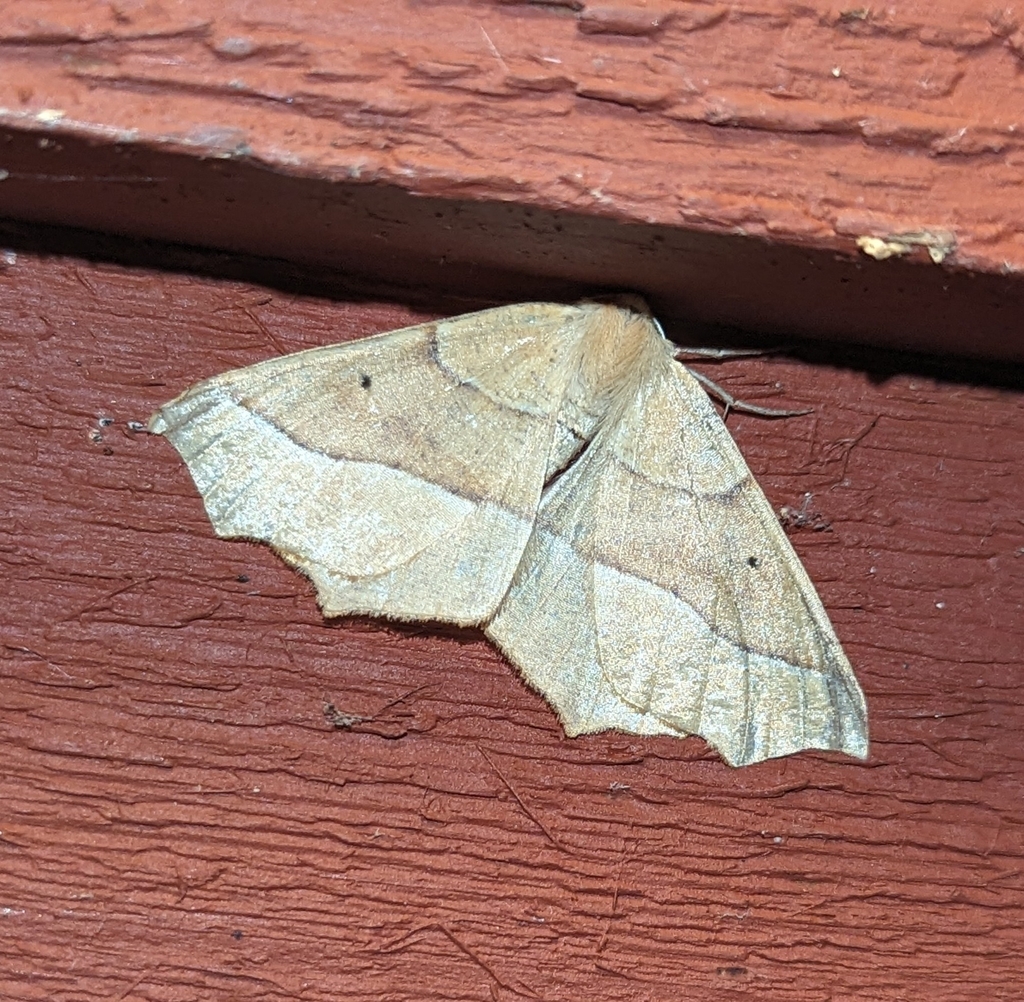
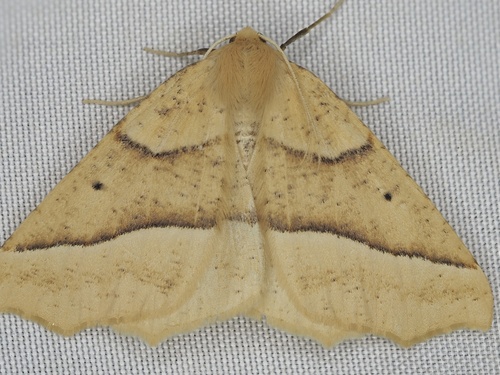
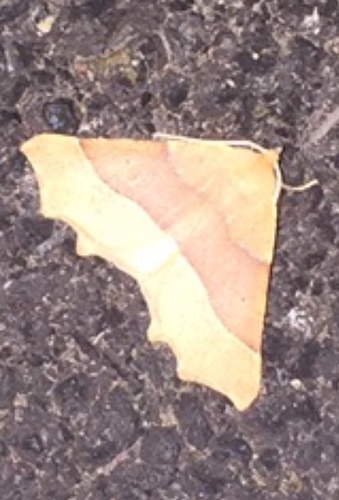
The October Thorn moth has pale yellow-brown wings with brown speckling, a pointed protrusion at the middle of each wing margin, two narrow brown crosslines, and a small black spot near the centre of each wing. It lives in western North America’s coniferous, mixed and deciduous forests, ranging from British Columbia and the Pacific states up into the Rocky Mountains and the Intermountain region. Adults appear from mid-August to late November, are nocturnal, and are attracted to light.
Source: Wikipedia
How to recognize it
Wings are pale yellow-brown or ochreous with brown speckling that mimics autumn leaves. Each wing shows a pointed protrusion at the mid-margin. Two narrow brown crosslines run across each wing. A small black discal spot is present on each wing.
Source: Wikipedia
Size
Forewing length ranges from 17 to 26 mm, with a total wingspan of about 44 mm.
Source: Wikipedia
Where it lives
It inhabits western coniferous, mixed, and deciduous forests.
Source: Wikipedia
What it eats
Larvae feed on a variety of trees and shrubs including alders, birches, dogwoods, poplars, currants, Pacific plum, willows, white and silver spruce, Douglas fir, and Thuja. Additional recorded hosts are alder, chinquapin, snowberry, salal, ocean spray, azalea, and elderberry.
Source: Wikipedia
Life cycle
There is one generation per year and the species overwinters as an egg. Adults are active at night and are attracted to lights.
Source: Wikipedia
When you see it
The subspecies sericeata flies from September to mid-November.
Source: Wikipedia
Where it comes from
The species is native to western North America. It occurs from British Columbia and the Pacific states eastward to the Rocky Mountains and Intermountain region, from sea level up to about 7,400 ft.
Source: Wikipedia
Lookalikes
It resembles Tetracis pallulata, which shares a similar appearance, range, and flight period. Tetracis mosesiani overlaps in coastal California. Elegant Thorn (Tetracis cervinaria) flies earlier (April-July) and has a straighter post-medial line. Large Maple Spanworm (Prochoerodes lineola) can be told apart by a hooked post-medial line near the costa.
Source: Wikipedia
Where it is found in the US
Recorded in 12 of 51 states and DC. Most records: Washington, Oregon, California, Montana, Colorado, Wyoming, Idaho, Utah.
Darker = more records. Counts are museum and citizen-science records, not population size.
Source: GBIF
Status: native in North America; native in United States; native in Canada. Source: iNaturalist
Months it is reported in the US
Source: GBIF
More photos
Questions people ask
When are October Thorn moths active?
Adults are on wing from mid-August through late November, with the exact timing depending on local elevation and region.
Source: Wikipedia
What trees do the caterpillars eat?
Caterpillars feed on a range of trees and shrubs such as alders, birches, dogwoods, poplars, spruces, Douglas fir, and Thuja, among others.
Source: Wikipedia
Same family (Geometridae)




Sources
- Wikipedia: https://en.wikipedia.org/wiki/Tetracis_jubararia
Look it up elsewhere: GBIF · iNaturalist · BugGuide · ITIS · Wikipedia
Text written 2026-10-24 from the sources above and checked sentence by sentence against them. Data fetched 2026-10-24.