 Bug FAQ
Ocellated shield bug
Cantao ocellatus · Order: Hemiptera · Family: Scutelleridae
Source: Wikipedia
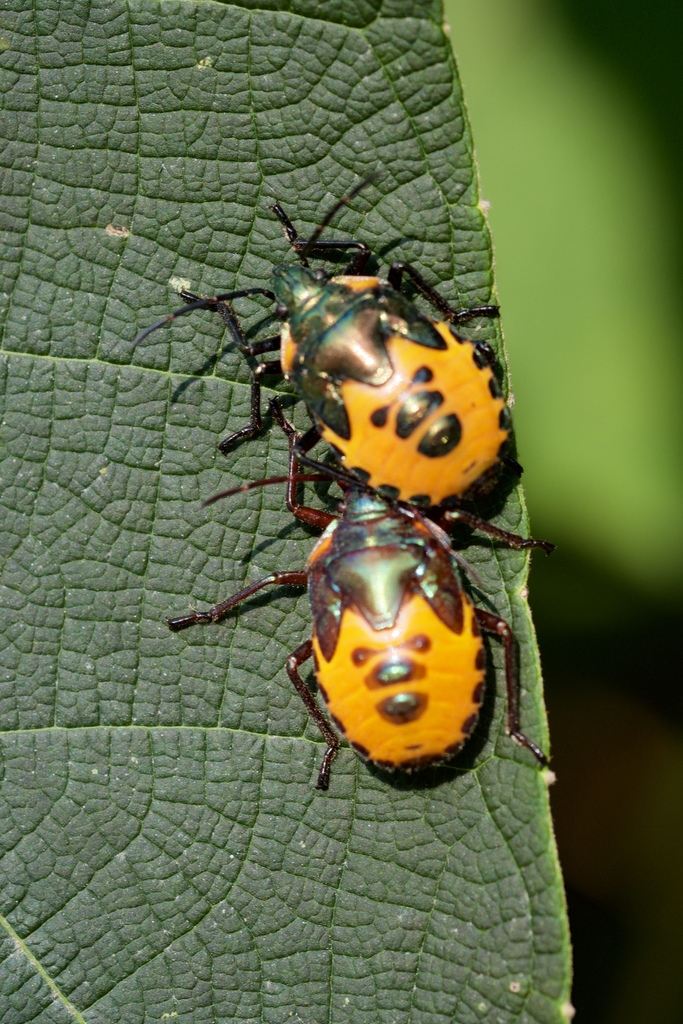
The ocellated shield bug is reddish-ochre with dark legs and bluish-black antennae. It eats sap from many plants such as Macaranga, Camellia sasanqua and Broussonetia papyrifera, and the female watches over her eggs after laying them.
Source: Wikipedia
How to recognize it
A dark bluish-black stripe runs down the middle of the head. The front edge of the pronotum may show two black spots or a series of up to eight spots. The scutellum bears six to eight black spots edged with yellow.
Source: Wikipedia
Size
Its overall colour is reddish or ochre, with dark legs and bluish-black antennae.
Source: Wikipedia
Where it lives
It has been recorded from the Indian subcontinent through Southeast Asia to Papua New Guinea. Additional records include Japan and Zaire.
Source: Wikipedia
Life cycle
Females stay on the egg mass and cover the eggs after they are laid. Eggs on the edge of the clutch that the female cannot cover are often parasitized by wasps.
Source: Wikipedia
Where it comes from
The species occurs across Asia as a member of the Scutelleridae family.
Source: Wikipedia
Questions people ask
What does the ocellated shield bug look like?
It is reddish-ochre with dark legs, bluish-black antennae, a dark stripe on the head, and spotted pronotum and scutellum.
Source: Wikipedia
Where is this bug found?
It occurs from the Indian subcontinent through Southeast Asia to Papua New Guinea, and also in Japan and Zaire.
Source: Wikipedia
Does the female care for the eggs?
Yes, the female stands over the eggs and covers them, though eggs on the edge may be parasitized by wasps.
Source: Wikipedia
Same family (Scutelleridae)



Sources
- Wikipedia: https://en.wikipedia.org/wiki/Cantao_ocellatus
Look it up elsewhere: GBIF · iNaturalist · BugGuide · Wikipedia
Text written 2026-10-22 from the sources above and checked sentence by sentence against them. Data fetched 2026-10-22.