 Bug FAQ
Nut-Tree Tussock
Colocasia coryli · Order: Lepidoptera · Family: Noctuidae
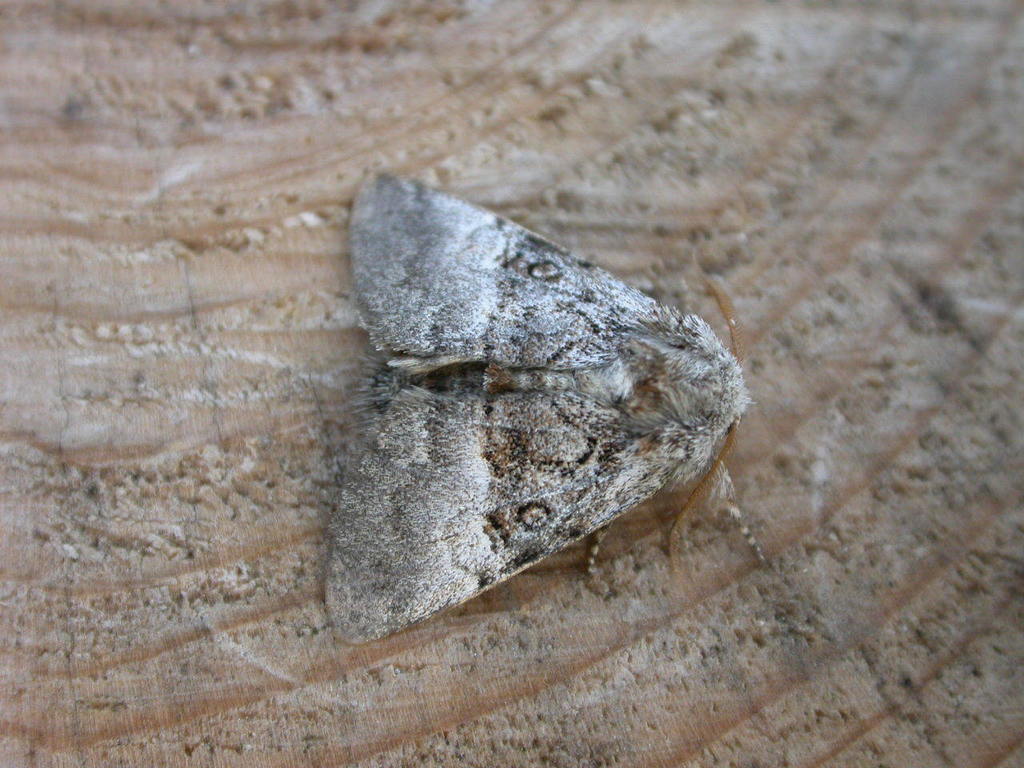
The Nut-Tree Tussock moth has a wingspan of about 27 to 35 mm and its forewings are a pearly grey with brown tinges and dark vertical lines. It lives across Europe and Asia, up to 1600 m in the Alps, and the northern part of its range reaches northern Scandinavia while the southern part is limited to mountainous areas of Spain, Sicily, Greece, Romania and Asia Minor. In southern Britain it has two generations per year, flying from April to June and again from July to September; farther north it has one generation that flies in May and June.
Source: Wikipedia
How to recognize it
The forewings vary from silvery to brownish-grey, with a pearly grey base, brown tint, and blackish vertical lines that are often separated by dark brown areas. A form from Amurland shows a more bluish-grey ground colour.
Source: Wikipedia
Size
Adults have a wingspan ranging between 27 and 35 mm.
Source: Wikipedia
Where it lives
The species occurs throughout Europe and Asia and can be found up to 1600 m elevation in the Alps.
Source: Wikipedia
Life cycle
In southern Britain the moth has two broods per year, flying April-June and July-September, while in northern areas it has a single brood in May-June.
Source: Wikipedia
When you see it
The flight period mirrors the voltinism: bivoltine in the south (April-June, July-September) and univoltine in the north (May-June).
Source: Wikipedia
Lookalikes
The Amurland form mus Oberth. displays a more bluish-grey ground colour compared with the typical form.
Source: Wikipedia
More photos

Questions people ask
When can I see them?
In southern Britain they fly from April to June and again from July to September; in northern areas they are on the wing in May and June.
Source: Wikipedia
Same family (Noctuidae)
 Ipsilon Dart MothAgrotis ipsilonDamages trees, gardens or crops
 Fall Armyworm MothSpodoptera frugiperdaDamages trees, gardens or crops
 Army Cutworm MothEuxoa auxiliarisDamages trees, gardens or crops
 Large Yellow UnderwingNoctua pronubaDamages trees, gardens or crops
 Silver ΥAutographa gamma
 American DaggerAcronicta americanaCan irritate skin
Sources
- Wikipedia: https://en.wikipedia.org/wiki/Colocasia_coryli
Look it up elsewhere: GBIF · iNaturalist · BugGuide · Wikipedia
Text written 2026-10-22 from the sources above and checked sentence by sentence against them. Data fetched 2026-10-22.