 Bug FAQ
Northern Crazy Ant
Nylanderia parvula · Order: Hymenoptera · Family: Formicidae

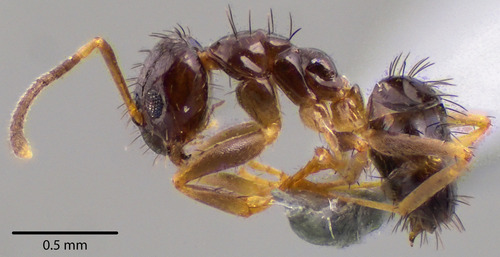
Northern Crazy Ants are tiny, ranging from about 1 to 4 mm long and can be pale yellow to black in color. Workers are recognized by six teeth on their mandibles and distinctive upright hairs on their antennae, legs, and the front of their thorax. They live above ground in many warm habitats, forming large, multi-nest colonies that forage openly.
Source: Wikipedia
How to recognize it
Workers have six mandibular teeth and erect macrosetae on the scapes, legs, pronotum, and mesonotum.
Source: Wikipedia
Is it a pest in the house?
Several Nylanderia species are recognized as tramp ants that have spread widely with human activity. One species has caused a sudden, explosive invasion in Texas and other southeastern U.S. states.
Source: Wikipedia
Where it lives
They occupy a wide range of habitats from deserts to rainforests, preferring warmer, forested areas. Most are conspicuous, ground-dwelling generalists that build large, multi-nest colonies.
Source: Wikipedia
What it eats
They are fast foragers that quickly locate food sources and recruit others, but they rarely defend a resource against later arriving ants. These ants are generalist foragers that live and feed primarily above ground.
Source: Wikipedia
Life cycle
In temperate zones, they produce winged reproductives in summer that overwinter in the nest and emerge in early spring. Reproductive biology of many tropical species remains poorly known.
Source: Wikipedia
Where it comes from
The genus Nylanderia is found worldwide except in high-latitude regions and is notably absent from Europe.
Source: Wikipedia
Lookalikes
Some species have a more elongated mesosoma that can look similar to the long-horned ant Paratrechina longicornis. Unlike the related genus Paraparatrechina, Nylanderia ants have multiple pairs of erect macrosetae rather than a single distinct pair.
Source: Wikipedia
Where it is found in the US
Recorded in 23 of 51 states and DC. Most records: Georgia, Florida, New York, Massachusetts, Illinois, North Carolina, Ohio, Indiana.
Darker = more records. Counts are museum and citizen-science records, not population size.
Source: GBIF
Status: native in North America; native in Canada; native in United States. Source: iNaturalist
Months it is reported in the US
Source: GBIF
More photos
Questions people ask
How can I tell Northern Crazy Ants apart from similar ants?
Look for six teeth on the mandibles and upright hairs on the antennae, legs, and the front of the thorax; these features distinguish them from other formicines.
Source: Wikipedia
Where are Northern Crazy Ants found?
They have a nearly worldwide distribution, occurring in most regions except high-latitude areas and are absent from Europe.
Source: Wikipedia
Do Northern Crazy Ants cause problems in homes?
They are known as tramp ants and have produced sudden, large infestations in parts of the southeastern United States.
Source: Wikipedia
Same family (Formicidae)
 Eastern Black Carpenter AntCamponotus pennsylvanicusCan bite
 Red Imported Fire AntSolenopsis invictaCan sting
 American Winter AntPrenolepis imparis
 Argentine AntLinepithema humileNuisance, not dangerous
 Immigrant Pavement AntTetramorium immigransCan sting
 Odorous House AntTapinoma sessileCan damage your home
Sources
- Wikipedia: https://en.wikipedia.org/wiki/Nylanderia
Look it up elsewhere: GBIF · iNaturalist · BugGuide · Wikipedia
Text written 2026-10-25 from the sources above and checked sentence by sentence against them. Data fetched 2026-10-25.