 Bug FAQ
Navigating Big-headed Ant
Pheidole navigans · Order: Hymenoptera · Family: Formicidae
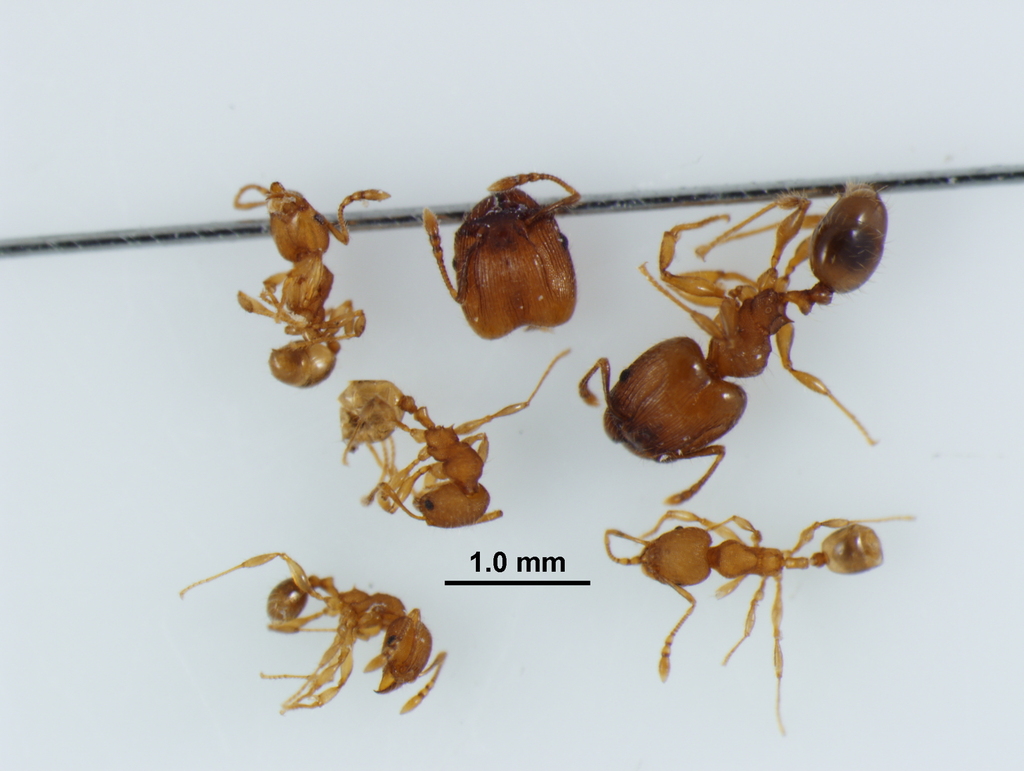
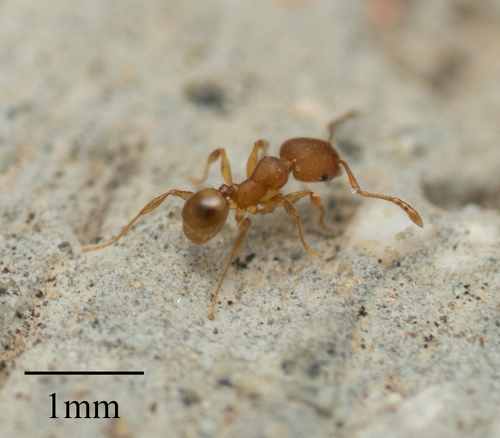
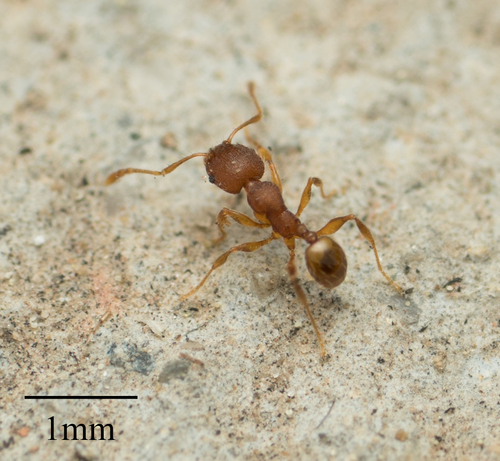
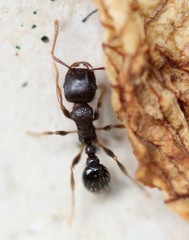
Big-headed ants are tiny reddish-brown ants, with workers only about 2 mm long and queens up to 3.5 mm. They nest in many small outdoor spots such as under boards, in wood, leaf litter and wall crevices, and they are common in Florida.
Source: Wikipedia
How to recognize it
The head is a bit wider than long, indented at the rear, and has a strongly sculptured surface with ridges and fine grooves.
Source: Wikipedia
Size
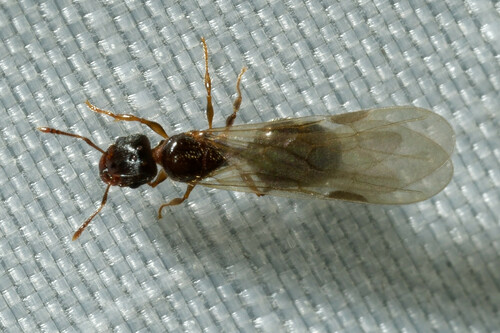
Minor workers are about 2 mm long, majors about 2.4 mm, males 2.8 mm, and queens up to 3.5 mm.
Source: Wikipedia
Is it a pest in the house?
They are not considered major house pests.
Source: Wikipedia
Does it bite or sting?
Their sting is highly reduced and nonfunctional.
Source: Wikipedia
How to get rid of it
Baits containing sugar or protein, such as tuna, attract both major and minor workers quickly.
Source: Wikipedia
What it eats
They eat a wide range of foods, including small arthropods, seeds, sugars and human foods.
Source: Wikipedia
Life cycle
Mature colonies have over 100 major workers and 500 minor workers, and queens may cooperate to start a colony but only one survives.
Source: Wikipedia
When you see it
Nuptial flights mainly happen in July. They are attracted quickly to both sugar and protein baits, especially tuna.
Source: Wikipedia
Where it comes from
They are native to the Neotropics. They have become a widespread invasive species.
Source: Wikipedia
Lookalikes
They have been frequently misidentified in their invasive range before 2015.
Source: Wikipedia
Where it is found in the US
Recorded in 12 of 51 states and DC. Most records: Mississippi, Florida, Alabama, California, Texas, Georgia, Louisiana, Hawaii.
Darker = more records. Counts are museum and citizen-science records, not population size.
Source: GBIF
Status: introduced in United States. Source: iNaturalist
Months it is reported in the US
Source: GBIF
More photos
Questions people ask
How can I get rid of them?
Use sugar or protein baits like tuna to attract and control them, and eliminate nesting sites such as wood debris and cracks.
Source: Wikipedia
When are they most active?
Nuptial flights occur mainly in July, and they quickly respond to food baits during that time.
Source: Wikipedia
Same family (Formicidae)
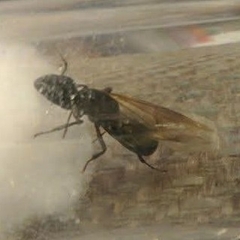 Eastern Black Carpenter AntCamponotus pennsylvanicusCan damage your home
 Red Imported Fire AntSolenopsis invictaCan sting
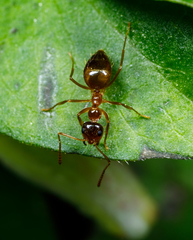 American Winter AntPrenolepis imparis
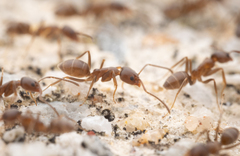 Argentine AntLinepithema humileNuisance, not dangerous
 Immigrant Pavement AntTetramorium immigransCan sting
 Odorous House AntTapinoma sessileCan damage your home
Sources
- Wikipedia: https://en.wikipedia.org/wiki/Pheidole_navigans
Look it up elsewhere: GBIF · iNaturalist · BugGuide · Wikipedia
Text written 2026-10-23 from the sources above and checked sentence by sentence against them. Data fetched 2026-10-23.