 Bug FAQ
Narcissus Bulb Fly
Merodon equestris · Order: Diptera · Family: Syrphidae
Also called: Greater Bulb-Fly, Hover Fly, Large Narcissus Bulb Fly
Source: Wikipedia

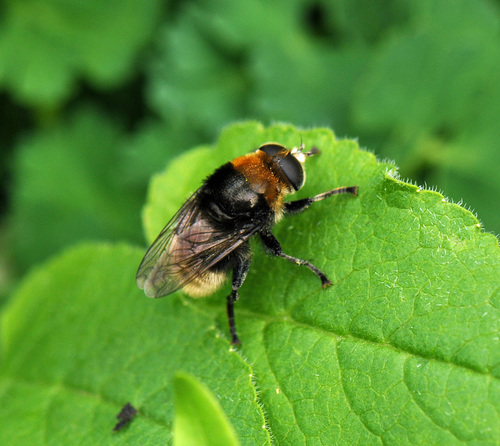
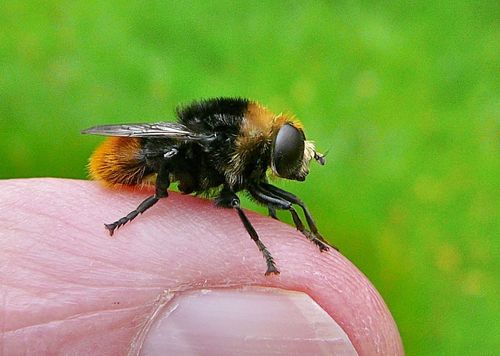
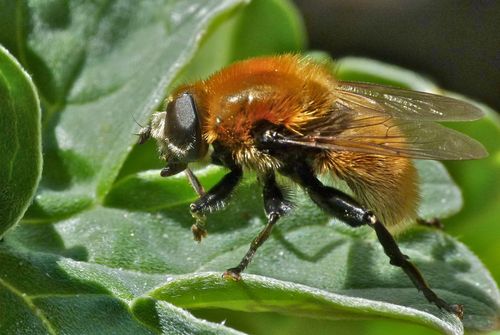
The Narcissus bulb fly is a 10 to 14 mm stout syrphid with dense erect hairs covering its thorax and abdomen. Adults fly from April to July, feed on pollen and nectar, and lay single eggs on or near host plant leaves. Larvae develop inside Amaryllidaceae bulbs, overwinter there, and can ruin Narcissus and related garden plants.
Source: Wikipedia
How to recognize it
The fly’s back plates are solid black, lacking the dust spots or blue-purple sheen seen in other Merodon species. Strong hind femora with a triangular projection near the tip set Merodon apart from other bee-mimic syrphids.
Source: Wikipedia
Size
It measures about 10 to 14 mm in length.
Source: Wikipedia
Is it a pest in the house?
It is considered a horticultural pest, especially of Narcissus bulbs.
Source: Wikipedia
Where it lives
It lives in open areas of deciduous forests up to the subalpine zone and is common in suburban parks, gardens, and horticultural land.
Source: Wikipedia
What it eats
Adults sip pollen and nectar. Larvae feed inside the tissues of bulbs of the Amaryllidaceae family.
Source: Wikipedia
Life cycle
Females deposit one egg at a time on host plant leaves or in the surrounding soil. The larvae remain in the bulbs through the winter before emerging as adults.
Source: Wikipedia
When you see it
Adults are active from April through July, flying low with a rapid zig-zag pattern.
Source: Wikipedia
Where it comes from
In the Palearctic it ranges from Fennoscandia to the Mediterranean and east through Europe into Russia and Japan. In North America it occurs from British Columbia south to California.
Source: Wikipedia
Lookalikes
Other bee-mimic syrphids include Mallota, Arctophila, Criorhina, Pocota, and Brachypalpus.
Source: Wikipedia
Where it is found in the US
Recorded in 40 of 51 states and DC. Most records: New York, Massachusetts, Oregon, California, Ohio, Washington, Illinois, Virginia.
Darker = more records. Counts are museum and citizen-science records, not population size.
Source: GBIF
Status: introduced in North America; introduced in Canada; introduced in United States. Source: iNaturalist
Months it is reported in the US
Source: GBIF
More photos

Questions people ask
How can I tell this fly apart from other bee-mimic flies?
Look for solid black back plates and very strong hind femora with a triangular projection near the tip.
Source: Wikipedia
What damage do the larvae cause?
The larvae live inside Amaryllidaceae bulbs, feeding on the tissue and often killing the bulb, which harms Narcissus and related garden plants.
Source: Wikipedia
When are the adults active?
Adults are seen from April to July, flying low with a quick zig-zag flight.
Source: Wikipedia
Same family (Syrphidae)


Sources
- Wikipedia: https://en.wikipedia.org/wiki/Merodon_equestris
Look it up elsewhere: GBIF · iNaturalist · BugGuide · ITIS · Wikipedia
Text written 2026-10-22 from the sources above and checked sentence by sentence against them. Data fetched 2026-10-22.