 Bug FAQ
Namib Desert Dune Ant
Camponotus detritus · Order: Hymenoptera · Family: Formicidae
Also called: Desert Balbyter ant
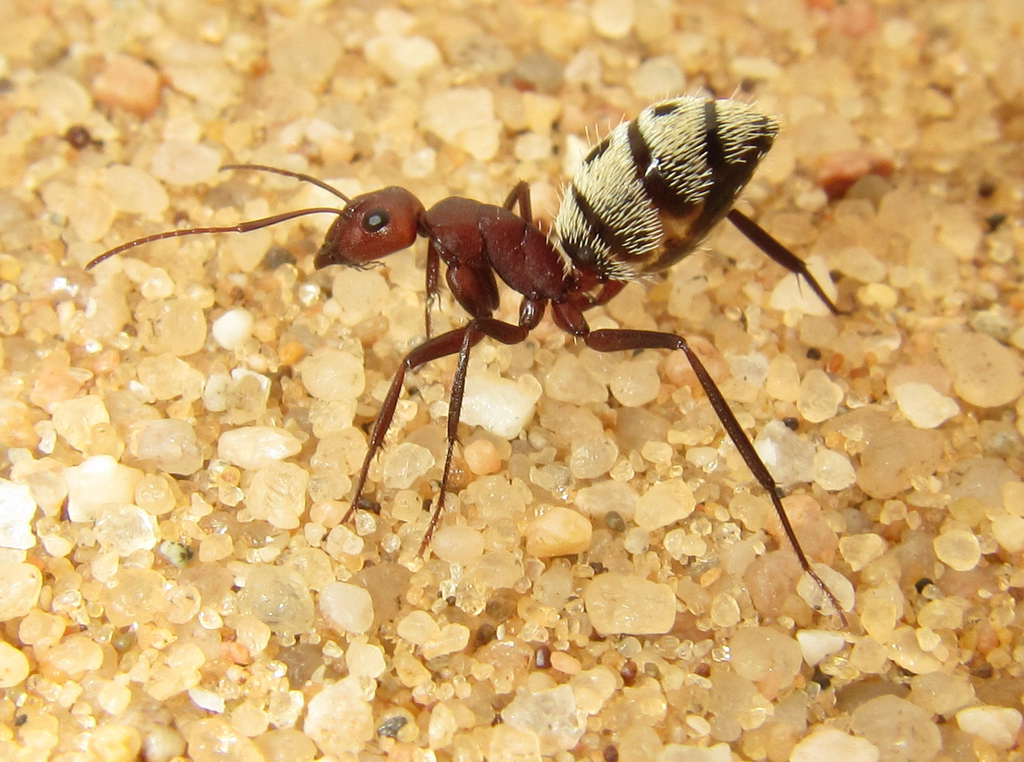
The Namib Desert dune ant weighs about 45 mg and shows white and black symmetrical stripes on a hairy abdomen. It lives on the hot, dry dunes of the central Namib Desert, where it builds stable nests using plant material. It feeds on honeydew from scale insects on shrubs, climbs plant stalks for moisture, and also eats dead insects.
Source: Wikipedia
Size
An adult weighs about 45 milligrams (0.0016 oz).
Source: Wikipedia
Where it lives
The ants construct stable nests by collecting organic plant material such as leaves.
Source: Wikipedia
What it eats
It obtains food and moisture by drinking honeydew from scale insects on shrubs. It also consumes dead insects.
Source: Wikipedia
Where it comes from
Its native range is the central Namib Desert of Southern Africa.
Source: Wikipedia
Same family (Formicidae)
 Eastern Black Carpenter AntCamponotus pennsylvanicusCan damage your home
 Red Imported Fire AntSolenopsis invictaCan sting
 American Winter AntPrenolepis imparis
 Argentine AntLinepithema humileNuisance, not dangerous
 Immigrant Pavement AntTetramorium immigransCan sting
 Odorous House AntTapinoma sessileCan damage your home
Sources
- Wikipedia: https://en.wikipedia.org/wiki/Namib_Desert_dune_ant
Look it up elsewhere: GBIF · iNaturalist · BugGuide · ITIS · Wikipedia
Text written 2026-10-23 from the sources above and checked sentence by sentence against them. Data fetched 2026-10-23.