 Bug FAQ
Moorland Clouded Yellow
Colias palaeno · Order: Lepidoptera · Family: Pieridae
Also called: Pale Arctic Clouded Yellow, Arctic Sulfur, Palaeno Sulphur
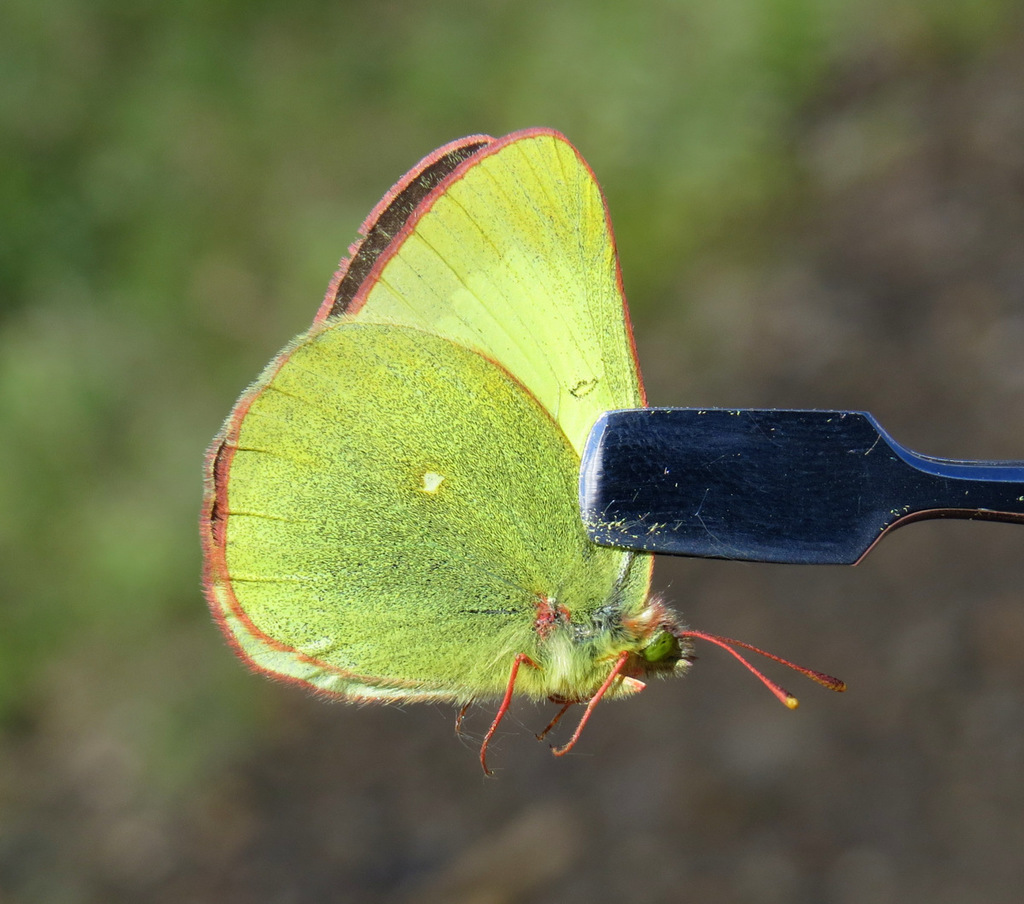
The Moorland Clouded Yellow is a small butterfly with a wingspan around 46 to 52 mm, males being slightly smaller than females. It lives on moorlands, forest meadows, open coniferous forests and upland bogs, often at elevations from 1,000 to over 1,500 m. Adults fly from June to August, and the greenish larvae feed on bilberry and related Vaccinium plants.
Source: Wikipedia
How to recognize it
Males have pale yellow upper wings with dark margins and a pale-centered spot on the forewing; the hindwing shows a light spot and red fringes. The underside of the forewing is pale yellow with a white-centered spot and red edges; the hindwing is yellow dusted with dark scales, has a mother-of-pearl spot, and red fringes.
Source: Wikipedia
Size
Males measure 46 to 50 mm across, while females are slightly larger at 50 to 52 mm.
Source: Wikipedia
Where it lives
It inhabits various moorlands, forest meadows, open coniferous forests and scrubby open areas. In southern parts of its range it lives high in the Alps above 1,500 m, and on upland bogs around 1,000 m.
Source: Wikipedia
What it eats
Larvae feed on bog bilberry, common bilberry and low-lying Vaccinium species.
Source: Wikipedia
Life cycle
It has one generation per year, with adults on the wing from June through August. The caterpillar is sea-green with a bright yellow lateral stripe edged in black; the pupa is greenish-yellow and convex on the back.
Source: Wikipedia
When you see it
Adults are active during the summer months, specifically June to August.
Source: Wikipedia
Where it comes from
The species is Holarctic, found across Europe, Asia and North America.
Source: Wikipedia
Lookalikes
Like other Colias butterflies, it is a strong, fast flyer, which can help distinguish it from slower-moving moths.
Source: Wikipedia
Where it is found in the US
Recorded in 4 of 51 states and DC. Most records: Alaska, Wyoming, Oregon, Arizona.
Darker = more records. Counts are museum and citizen-science records, not population size.
Source: GBIF
Status: native in North America; native in Canada; native in United States. Source: iNaturalist
Months it is reported in the US
Source: GBIF
More photos

Questions people ask
When can I see the Moorland Clouded Yellow?
Adults fly in the summer, typically from June to August.
Source: Wikipedia
What plants do the caterpillars eat?
The larvae feed on bilberry species such as bog bilberry and common bilberry.
Source: Wikipedia
Where does this butterfly live?
It lives in moorlands, forest meadows, open coniferous forests and upland bogs, often at elevations between 1,000 and 1,500 m.
Source: Wikipedia
How big is the Moorland Clouded Yellow?
Males have a wingspan of about 46 to 50 mm and females about 50 to 52 mm.
Source: Wikipedia
Same family (Pieridae)


Sources
- Wikipedia: https://en.wikipedia.org/wiki/Colias_palaeno
Look it up elsewhere: GBIF · iNaturalist · BugGuide · ITIS · Wikipedia
Text written 2026-10-23 from the sources above and checked sentence by sentence against them. Data fetched 2026-10-23.