 Bug FAQ
Mexican Honeypot Ant
Myrmecocystus mexicanus · Order: Hymenoptera · Family: Formicidae
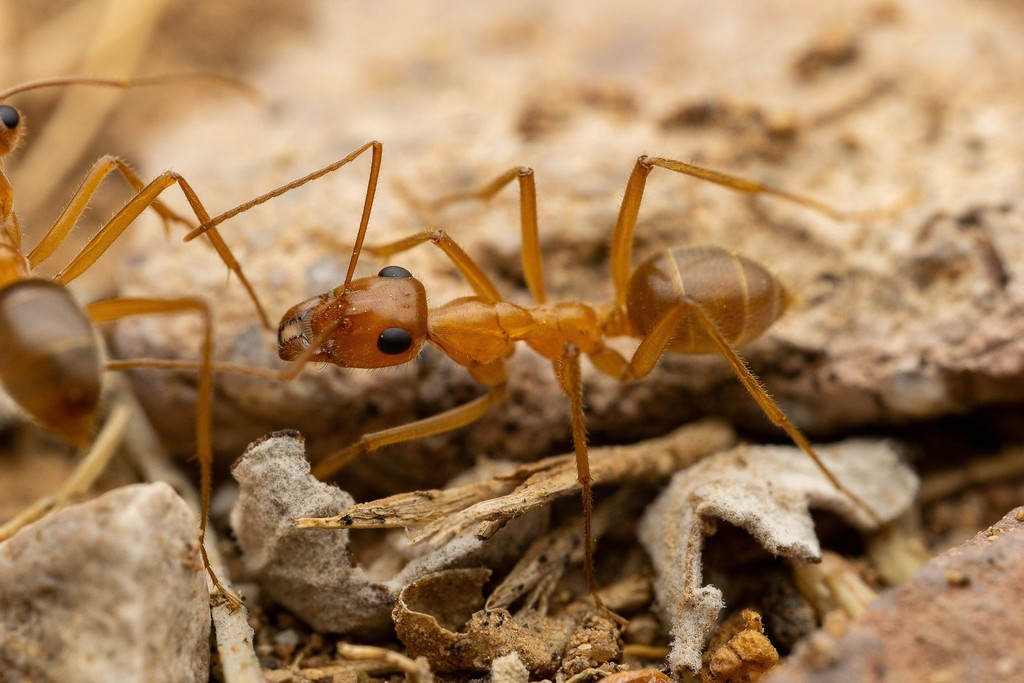
Mexican honeypot ants are medium-sized workers (3 to 7 mm) and queens about 9 mm long, with a light tan thorax and legs, a slightly darker head, black mandibles, and a brownish-gray gaster. Colonies can live up to 23 years, with workers emerging about two months after eggs are laid.
Source: Wikipedia
How to recognize it
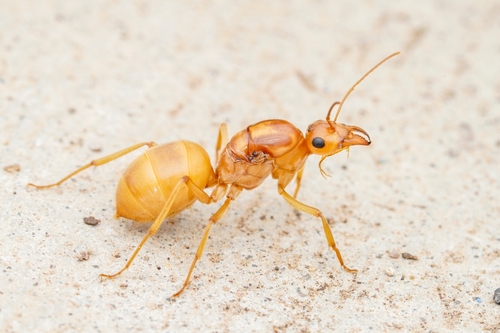
The ant has a light tan thorax and legs, a slightly darker head with black mandibles, and a brownish-gray gaster.
Source: Wikipedia
Size
Workers measure between 3 and 7 mm, while queens are roughly 9 mm long.
Source: Wikipedia
What it eats
Workers forage up to 20 m from the nest, mainly at night and in cooler temperatures ranging from about 0.5 °C to 30 °C.
Source: Wikipedia
Life cycle
Colonies average about 9 years in age but can live as long as 23 years. Adult workers appear roughly 63 days after eggs are laid.
Source: Wikipedia
When you see it
Foraging typically occurs from March through November.
Source: Wikipedia
Where it comes from
The species is native to the southwestern United States and Mexico, and members of its genus occur throughout North America.
Source: Wikipedia
Where it is found in the US
Recorded in 8 of 51 states and DC. Most records: Arizona, Colorado, Utah, Nevada, New Mexico, California, Texas, Tennessee.
Darker = more records. Counts are museum and citizen-science records, not population size.
Source: GBIF
Status: native in North America; native in United States. Source: iNaturalist
Months it is reported in the US
Source: GBIF
More photos


Same family (Formicidae)
 Eastern Black Carpenter AntCamponotus pennsylvanicusCan damage your home
 Red Imported Fire AntSolenopsis invictaCan sting
 American Winter AntPrenolepis imparis
 Argentine AntLinepithema humileNuisance, not dangerous
 Immigrant Pavement AntTetramorium immigransCan sting
 Odorous House AntTapinoma sessileCan damage your home
Sources
- Wikipedia: https://en.wikipedia.org/wiki/Myrmecocystus_mexicanus
Look it up elsewhere: GBIF · iNaturalist · BugGuide · ITIS · Wikipedia
Text written 2026-10-23 from the sources above and checked sentence by sentence against them. Data fetched 2026-10-23.