 Bug FAQ
Mary's Odorous Ant
Dolichoderus mariae · Order: Hymenoptera · Family: Formicidae

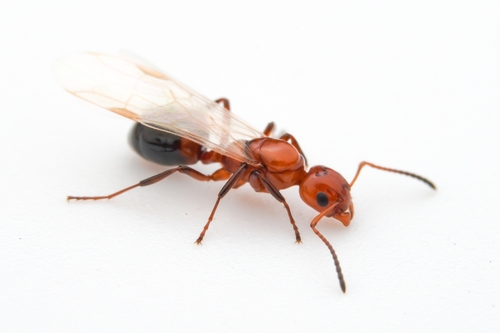
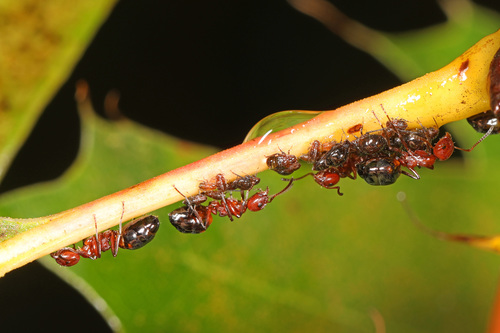
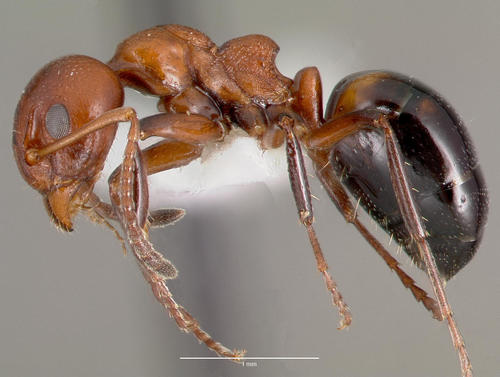
Mary's Odorous Ant has a reddish-brown head, antennae, thorax, legs, petiole and front part of the first abdominal segment, with the rest of the abdomen black or deep brown. It lives in prairies, glades and fens, nesting underground among plant roots, and is found across many eastern U.S. states from Illinois to Florida. Workers tend aphids and scale insects for honeydew and also scavenge dead insects.
Source: Wikipedia
How to recognize it
The ant’s body is smooth and reflective with fine granules visible under magnification; the propodeum is longer than wide and has fine vertical striations, and the ant is hairless.
Source: Wikipedia
Where it lives
It inhabits prairies, glades and fens, building its nests underground among plant roots.
Source: Wikipedia
Life cycle
The timing of alate emergence and nuptial flights indicates the reproductive period peaks in midsummer.
Source: Wikipedia
When you see it
Alates first appear in April, with most seen in July; nuptial flights occur early in the morning after heavy rains, involving thousands of male alates.
Source: Wikipedia
Where it comes from
Its range includes many U.S. states such as Illinois, Minnesota, Oklahoma, the Carolinas, Georgia, Mississippi, Louisiana and northern Florida, with the type locality in Vineland, New Jersey.
Source: Wikipedia
Where it is found in the US
Recorded in 24 of 51 states and DC. Most records: Mississippi, Georgia, Illinois, Massachusetts, North Carolina, South Carolina, Michigan, New Jersey.
Darker = more records. Counts are museum and citizen-science records, not population size.
Source: GBIF
Status: native in North America; native in Canada; native in United States. Source: iNaturalist
Months it is reported in the US
Source: GBIF
More photos

Questions people ask
What do Mary's Odorous Ants look like?
They have a reddish-brown head, antennae, thorax, legs, petiole and front abdominal segment, with the rest of the abdomen black or deep brown, and a smooth, hairless body.
Source: Wikipedia
Where are Mary's Odorous Ants found?
They occur in prairies, glades and fens across many eastern U.S. states, nesting underground among plant roots.
Source: Wikipedia
What do these ants eat?
They tend aphids and scale insects for honeydew and also scavenge dead insects.
Source: Wikipedia
When do the winged ants appear?
Winged alates first show up in April, with most appearing in July, and they take nuptial flights after heavy rains in the early morning.
Source: Wikipedia
Same family (Formicidae)
 Eastern Black Carpenter AntCamponotus pennsylvanicusCan damage your home
 Red Imported Fire AntSolenopsis invictaCan sting
 American Winter AntPrenolepis imparis
 Argentine AntLinepithema humileNuisance, not dangerous
 Immigrant Pavement AntTetramorium immigransCan sting
 Odorous House AntTapinoma sessileCan damage your home
Sources
- Wikipedia: https://en.wikipedia.org/wiki/Dolichoderus_mariae
Look it up elsewhere: GBIF · iNaturalist · BugGuide · ITIS · Wikipedia
Text written 2026-10-24 from the sources above and checked sentence by sentence against them. Data fetched 2026-10-24.