 Bug FAQ
Maiden's Blush
Cyclophora punctaria · Order: Lepidoptera · Family: Geometridae
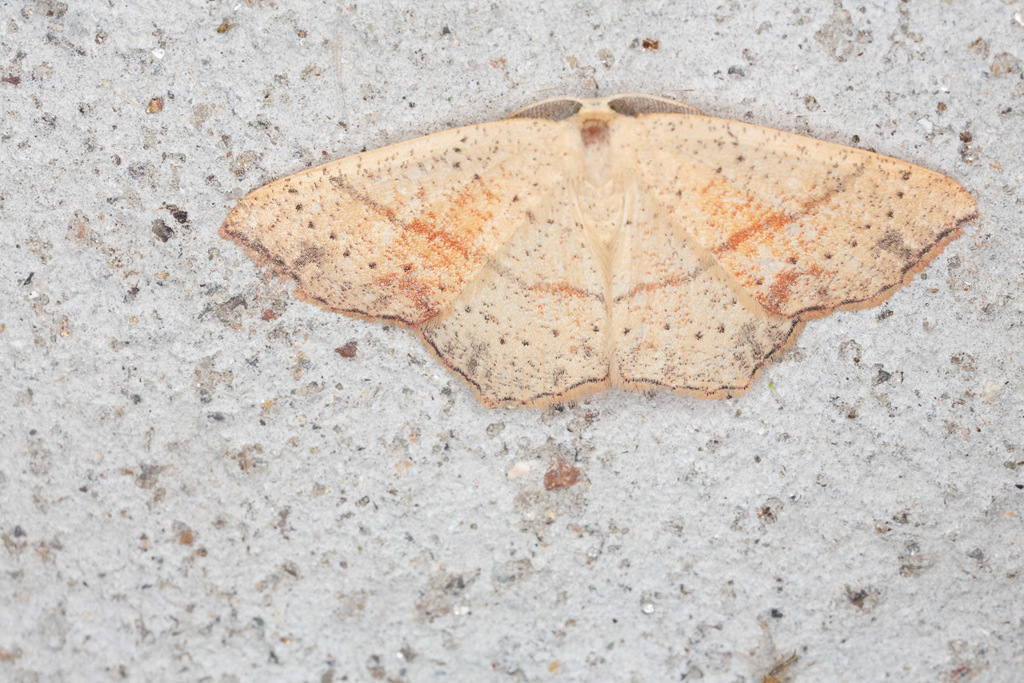
Maiden's Blush is a small moth with a wingspan of about 13 to 25 mm in its first generation and around 22 mm in the second generation. Its forewings are sandy-coloured, sometimes with reddish or yellowish tones, and show a distinct, slightly curved brown cross line. The species lives in oak-dominated woodlands across central and eastern Europe, flying in May-June and again in August.
Source: Wikipedia
How to recognize it
The forewings have a sand-coloured ground and may show reddish or yellowish tints. A medium-sized, slightly curved brown cross line is always clearly visible.
Source: Wikipedia
Size
First-generation adults have a wingspan of 13 to 25 mm; the second generation is smaller, about 22 mm.
Source: Wikipedia
Where it lives
Found mainly in oak scrub and oak forests, up to 700 m in central Europe, occasionally higher in the Alps and southern Europe.
Source: Wikipedia
What it eats
Larvae feed on oak leaves.
Source: Wikipedia
Life cycle
Adults fly in two generations: May-June and again in August in western Europe.
Source: Wikipedia
When you see it
Flight periods are May-June and August in western Europe.
Source: Wikipedia
Where it comes from
Common in central and eastern Europe, extending north to southern Fennoscandia and the British Isles, west to northern Spain, and south through Italy, the Balkans (except Greece) to Asia Minor.
Source: Wikipedia
Lookalikes
It can be confused with several other Cyclophora species: Blair's Mocha, False Mocha, Jersey Mocha, and Clay Triple-lines.
Source: Wikipedia
Questions people ask
When are Maiden's Blush moths active?
They are on the wing in two periods: from May to June and again in August.
Source: Wikipedia
Where can I find this moth?
Look for it in oak-dominated woodlands across central and eastern Europe, up to about 700 m altitude, higher in some southern areas.
Source: Wikipedia
How can I tell it apart from similar moths?
Check for the sand-coloured forewings with a clear, slightly curved brown cross line; other Cyclophora species may lack this exact pattern.
Source: Wikipedia
Same family (Geometridae)
 Willow BeautyPeribatodes rhomboidaria
 Pale BeautyCampaea perlataDamages trees, gardens or crops
 Large Lace-border MothScopula limboundataDamages trees, gardens or crops
 Riband WaveIdaea aversata
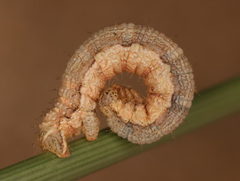 Yellow Shell MothCamptogramma bilineata
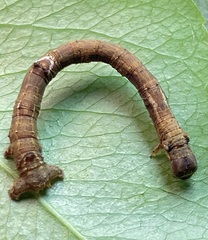 Large Maple Spanworm MothProchoerodes lineolaDamages trees, gardens or crops
Sources
- Wikipedia: https://en.wikipedia.org/wiki/Cyclophora_punctaria
Look it up elsewhere: GBIF · iNaturalist · BugGuide · Wikipedia
Text written 2026-10-22 from the sources above and checked sentence by sentence against them. Data fetched 2026-10-22.