 Bug FAQ
Longhorn Crazy Ant
Paratrechina longicornis · Order: Hymenoptera · Family: Formicidae
Also called: Black Crazy Ant, Longhorned crazy ant, crazy ant
Source: Wikipedia
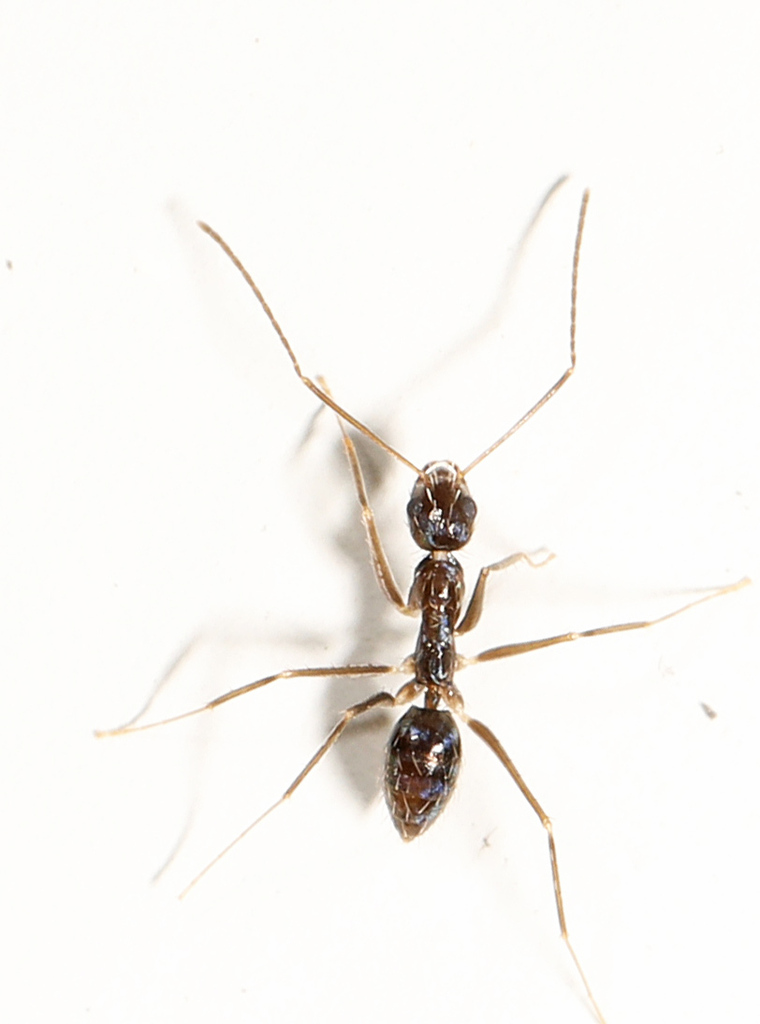
Workers are tiny, about 2.3 to 3 mm long, dark brown-black with a faint blue shine. They thrive in disturbed, artificial places and can live inside buildings far from the tropics.
Source: Wikipedia
Is it a pest in the house?
It is considered a pest in most tropical and subtropical regions and an indoor pest in temperate areas.
Source: Wikipedia
Does it bite or sting?
Like all Formicinae ants, it cannot sting.
Source: Wikipedia
Where it lives
Although tropical, it lives in disturbed and artificial habitats, including indoor spaces, and has spread to places like Estonia, Sweden and New Zealand.
Source: Wikipedia
What it eats
It eats seeds, dead insects, honeydew, plant secretions, fruit and various household scraps.
Source: Wikipedia
Where it comes from
The genus Paratrechina likely originated in tropical Africa.
Source: Wikipedia
Lookalikes
It is probably the world’s most widespread ant, with the pharaoh ant as another strong contender.
Source: Wikipedia
Where it is found in the US
Recorded in 19 of 51 states and DC. Most records: Florida, Texas, Arizona, Hawaii, Mississippi, Louisiana, California, Georgia.
Darker = more records. Counts are museum and citizen-science records, not population size.
Source: GBIF
Status: introduced in North America; introduced in United States; introduced in Canada. Source: iNaturalist
Months it is reported in the US
Source: GBIF
More photos


Same family (Formicidae)
 Eastern Black Carpenter AntCamponotus pennsylvanicusCan damage your home
 Red Imported Fire AntSolenopsis invictaCan sting
 American Winter AntPrenolepis imparis
 Argentine AntLinepithema humileNuisance, not dangerous
 Immigrant Pavement AntTetramorium immigransCan sting
 Odorous House AntTapinoma sessileCan damage your home
Sources
- Wikipedia: https://en.wikipedia.org/wiki/Longhorn_crazy_ant
Look it up elsewhere: GBIF · iNaturalist · BugGuide · ITIS · Wikipedia
Text written 2026-10-23 from the sources above and checked sentence by sentence against them. Data fetched 2026-10-22.