 Bug FAQ
Long-tailed Aphideater Complex
Eupeodes americanus · Order: Diptera · Family: Syrphidae
Also called: American Hover Fly, Long-tailed Aphideater
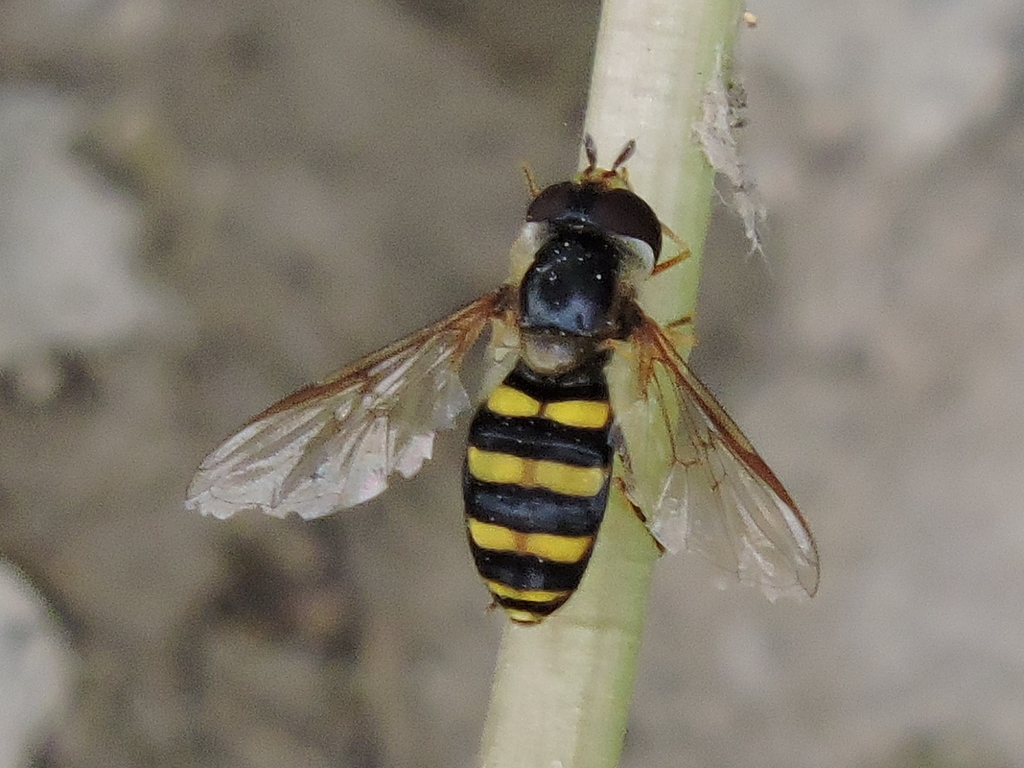
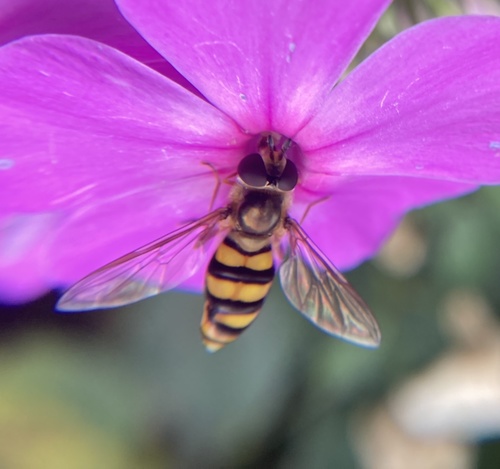
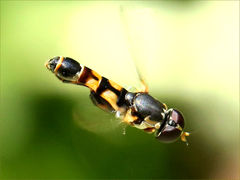
The Long-tailed Aphideater Complex is a hoverfly about 9 to 12 mm long as an adult and its larvae grow to about 11 mm. Adults are black to metallic green with three yellow bands on the abdomen, a light-yellow face, large black eyes, and clear wings; larvae have visible black hairs. It lives in North-American meadows and flower-filled fields, migrates south in autumn, feeds on nectar as an adult and its larvae eat aphids.
Source: Wikipedia
Size
Adults measure 9 to 12 mm in length. Larvae are mature at about 11 mm.
Source: Wikipedia
Where it lives
The species migrates from Canada to the southeastern United States in autumn.
Source: Wikipedia
What it eats
Adults feed on nectar, while the larvae feed on aphids.
Source: Wikipedia
Life cycle
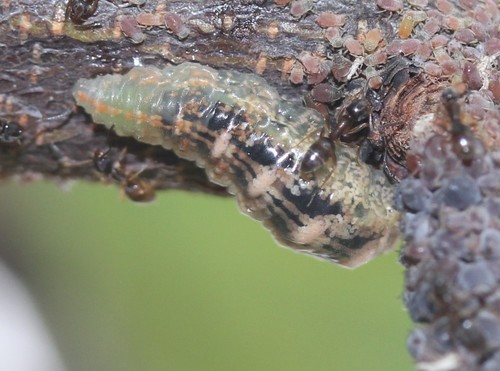
Larvae reach maturity at about 11 mm. Early instar larvae have visible black setae.
Source: Wikipedia
When you see it
The species migrates south in autumn.
Source: Wikipedia
Where it comes from
It is found throughout North America.
Source: Wikipedia
Where it is found in the US
Recorded in 42 of 51 states and DC. Most records: Georgia, Pennsylvania, Illinois, Texas, Nebraska, Massachusetts, Colorado, Ohio.
Darker = more records. Counts are museum and citizen-science records, not population size.
Source: GBIF
Months it is reported in the US
Source: GBIF
More photos
Questions people ask
Where does this hoverfly live?
It lives in meadows and flower-filled fields and migrates from Canada to the southeastern United States in autumn.
Source: Wikipedia
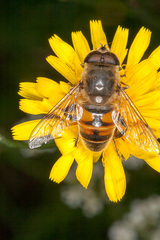
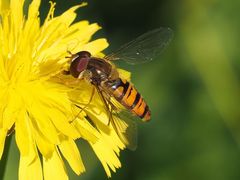
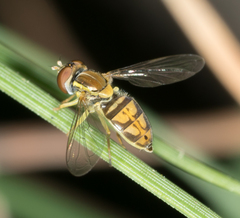
Same family (Syrphidae)


Sources
- Wikipedia: https://en.wikipedia.org/wiki/Eupeodes_americanus
Look it up elsewhere: GBIF · iNaturalist · BugGuide · ITIS · Wikipedia
Text written 2026-10-23 from the sources above and checked sentence by sentence against them. Data fetched 2026-10-23.