 Bug FAQ
Little grey
Eudonia lacustrata · Order: Lepidoptera · Family: Crambidae
Also called: Whitethorn Grey
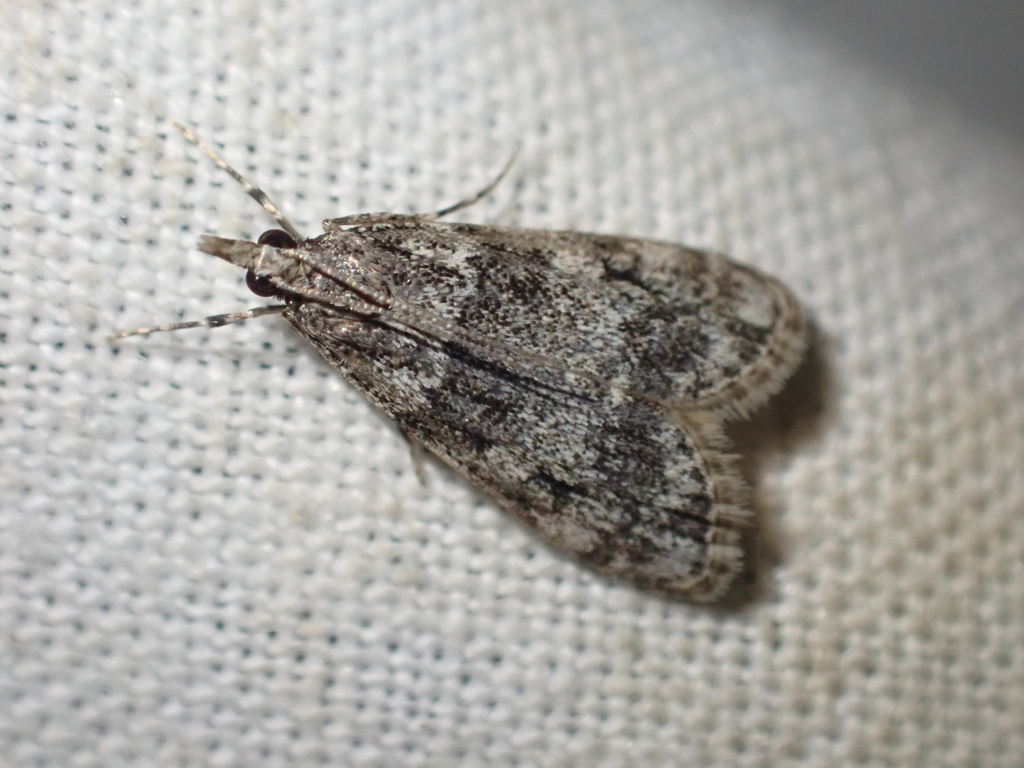
The little grey moth has a wingspan of about 16 to 18 mm and distinctive whitish forewings with black markings. It occurs across Europe, north-west Africa, and parts of Asia, and its larvae feed on mosses. Adults are on the wing from May to August, depending on location.
Source: Wikipedia
How to recognize it
Forewings are whitish, sometimes tinged with light ochreous-yellow, sprinkled with black; they have a black-marked base, whitish lines edged in black, a black X-shaped discal mark, and a grey-black mixed terminal area with a white subterminal line that is broken in the middle. Hindwings are whitish-grey, becoming darker toward the edge.
Source: Wikipedia
Size
The wingspan ranges from 16 to 18 mm (about 0.63 to 0.71 in).
Source: Wikipedia
What it eats
Larvae feed on a variety of mosses.
Source: Wikipedia
Life cycle
Adults fly from May to August, timing varying by region.
Source: Wikipedia
When you see it
Flight period is May through August, depending on location.
Source: Wikipedia
Where it comes from
Found throughout Europe, north-west Africa, and from Turkey and Iran eastward to Siberia and western China; the subspecies E. lacustrata persica occurs in Iran and Armenia.
Source: Wikipedia
Questions people ask
Are they a pest for the home or garden?
They are not reported to damage food, fabrics, wood, or garden plants; the larvae feed on mosses.
Source: Wikipedia
When can I expect to see them?
Adults are active from May to August, with exact timing depending on where you live.
Source: Wikipedia
Same family (Crambidae)
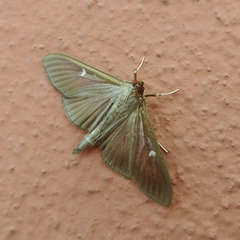 Box Tree MothCydalima perspectalisDamages trees, gardens or crops
 Celery Leaftier MothUdea rubigalisDamages trees, gardens or crops
 Elegant Grass-veneerMicrocrambus elegans
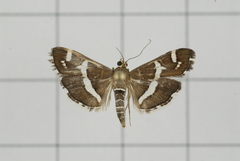 Hawaiian Beet Webworm MothSpoladea recurvalisDamages trees, gardens or crops
 Garden Grass-veneerChrysoteuchia culmellaDamages trees, gardens or crops
 Bluegrass Webworm MothParapediasia teterrellusDamages trees, gardens or crops
Sources
- Wikipedia: https://en.wikipedia.org/wiki/Eudonia_lacustrata
Look it up elsewhere: GBIF · iNaturalist · BugGuide · Wikipedia
Text written 2026-10-22 from the sources above and checked sentence by sentence against them. Data fetched 2026-10-22.