 Bug FAQ
Liometopum luctuosum
Liometopum luctuosum · Order: Hymenoptera · Family: Formicidae
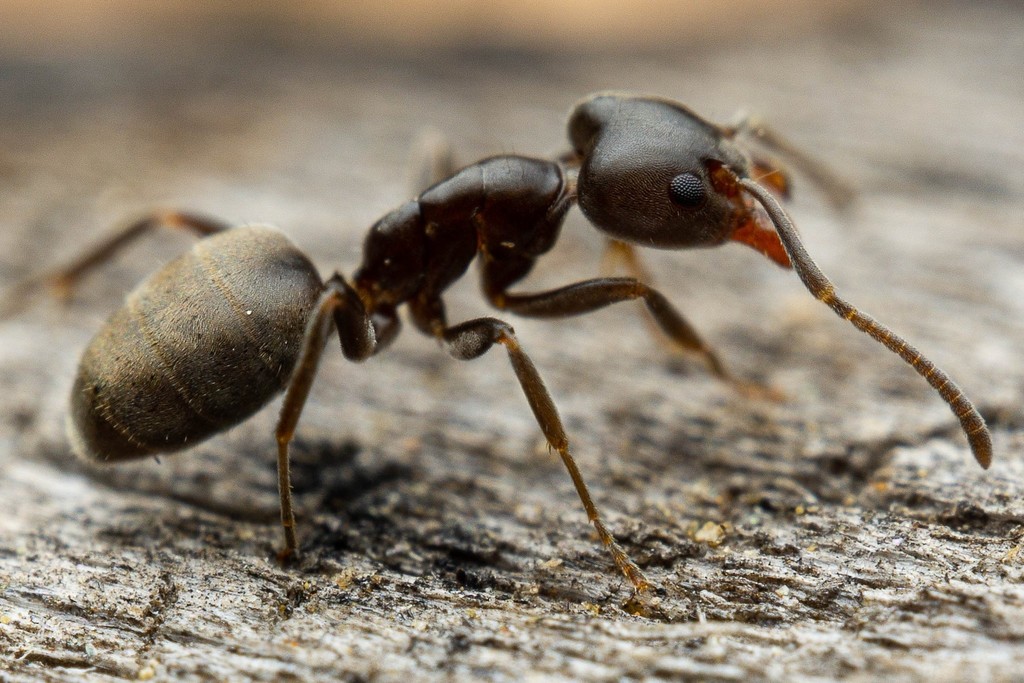
Liometopum luctuosum is often confused with carpenter ants because its workers vary in size, have a smooth convex thorax, and can excavate wood. Its native range runs from British Columbia in Canada down through central Mexico and western Texas.
Source: Wikipedia
How to recognize it
People often mistake this ant for carpenter ants because the workers are polymorphic, the thorax is smooth and convex, and they excavate wood.
Source: Wikipedia
Is it a pest in the house?
Homeowners and pest managers often mistake this species for carpenter ants because of similar looks and wood-excavating behavior.
Source: Wikipedia
Where it lives
It is found from low elevations of about 59 m up to high elevations, typically above 2400 m in more southern areas. Habitats include pine, oak, Douglas-fir, juniper forests, sagebrush, and high-elevation riparian zones.
Source: Wikipedia
What it eats
It is an omnivore that feeds on plant secretions, aphids, membracids, scales, as well as meat, eggs, fruit and bread.
Source: Wikipedia
When you see it
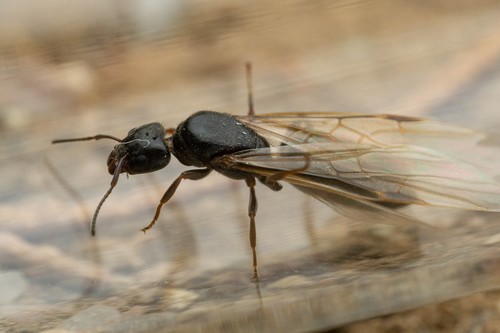
Reproductives are observed flying in June and July.
Source: Wikipedia
Where it comes from
Its range extends from temperate British Columbia down to the arid regions of central Mexico and western Texas.
Source: Wikipedia
Lookalikes
It is frequently confused with carpenter ants and also with Tapinoma sessile, which share its coloration, size, and a similar alarm pheromone odor.
Source: Wikipedia
Where it is found in the US
Recorded in 13 of 51 states and DC. Most records: Arizona, California, Colorado, Utah, New Mexico, Nevada, Texas, Washington.
Darker = more records. Counts are museum and citizen-science records, not population size.
Source: GBIF
Status: native in North America; native in Canada; native in United States. Source: iNaturalist
Months it is reported in the US
Source: GBIF
More photos

Questions people ask
How can I tell Liometopum luctuosum apart from carpenter ants?
Look for polymorphic workers, a smooth convex thorax, and wood-excavating activity, which are the traits that cause the confusion.
Source: Wikipedia
Where is Liometopum luctuosum usually found?
It lives in pine, oak, Douglas-fir, juniper forests, sagebrush and high-elevation riparian areas, often above 2400 m in southern latitudes.
Source: Wikipedia
What does Liometopum luctuosum eat?
It feeds on plant secretions, aphids, membracids, scales, and also on meat, eggs, fruit and bread.
Source: Wikipedia
When do the reproductive ants fly?
Reproductives take their nuptial flights in June and July.
Source: Wikipedia
Same family (Formicidae)
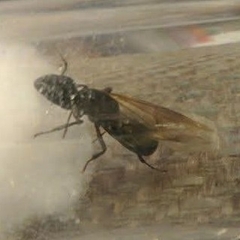 Eastern Black Carpenter AntCamponotus pennsylvanicusCan damage your home
 Red Imported Fire AntSolenopsis invictaCan sting
 American Winter AntPrenolepis imparis
 Argentine AntLinepithema humileNuisance, not dangerous
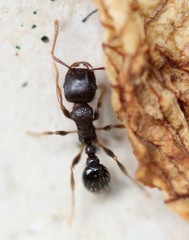 Immigrant Pavement AntTetramorium immigransCan sting
 Odorous House AntTapinoma sessileCan damage your home
Sources
- Wikipedia: https://en.wikipedia.org/wiki/Liometopum_luctuosum
Look it up elsewhere: GBIF · iNaturalist · BugGuide · ITIS · Wikipedia
Text written 2026-10-24 from the sources above and checked sentence by sentence against them. Data fetched 2026-10-24.