 Bug FAQ
Light-spotted Quaker
Protorthodes alfkenii · Order: Lepidoptera · Family: Noctuidae
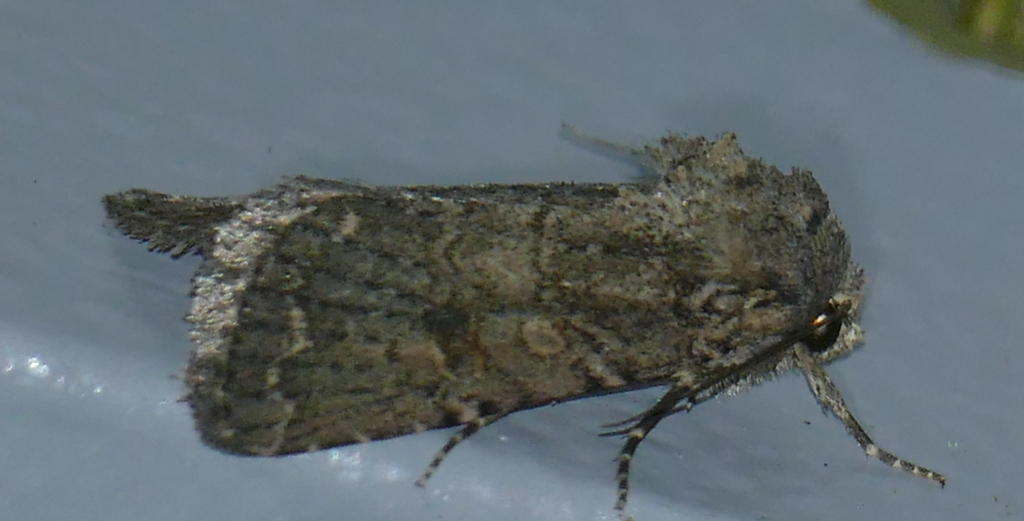
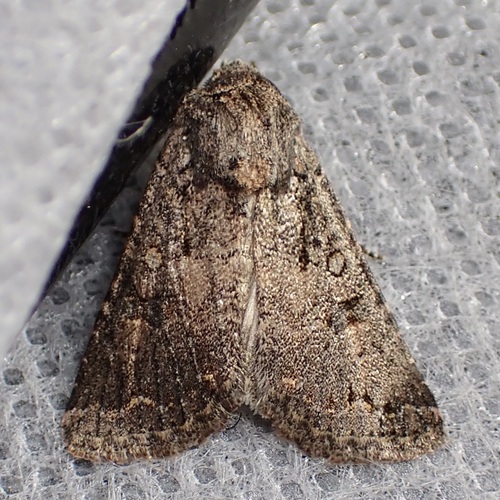
The Light-spotted Quaker is a moth with forewings 11 to 14 mm long and a very variable appearance, but it can be recognized by a rounded orbicular spot edged in black and an oblique reniform spot that points toward the wing’s anal angle. It lives in open, dry woodlands across a broad swath of North America from central Oregon and Idaho down through Texas to southern Mexico, and its larvae feed on a range of herbaceous plants.
Source: Wikipedia
How to recognize it
The orbicular spot is usually round, surrounded by a thin black line, and lighter than the surrounding wing color. The reniform spot is slanted, with its lower part extending toward the anal angle of the wing.
Source: Wikipedia
Size
Forewing length ranges from 11 to 14 mm.
Source: Wikipedia
Where it lives
It prefers open, arid woodland habitats.
Source: Wikipedia
What it eats
The caterpillars feed on various herbaceous plants.
Source: Wikipedia
Life cycle
In the Pacific Northwest adults are on the wing from mid-July to late September.
Source: Wikipedia
When you see it
Southern adults appear in spring-early summer and again in early fall; Pacific Northwest adults appear midsummer through early fall.
Source: Wikipedia
Lookalikes
Although highly variable in size, colour and pattern, it can be distinguished by the combination of its rounded, lightly-coloured orbicular spot with a black outline and the oblique reniform spot pointing toward the anal angle.
Source: Wikipedia
Where it is found in the US
Recorded in 10 of 51 states and DC. Most records: California, Arizona, New Mexico, Oregon, Nevada, Utah, Texas, Colorado.
Darker = more records. Counts are museum and citizen-science records, not population size.
Source: GBIF
Status: native in North America; native in United States. Source: iNaturalist
Months it is reported in the US
Source: GBIF
More photos
Questions people ask
Where can I find this moth?
It lives in open, dry woodlands across central Oregon, southern Idaho, central Wyoming, north-western Texas, and down to southern Mexico.
Source: Wikipedia
Same family (Noctuidae)
 Ipsilon Dart MothAgrotis ipsilonDamages trees, gardens or crops
 Fall Armyworm MothSpodoptera frugiperdaDamages trees, gardens or crops
 Army Cutworm MothEuxoa auxiliarisDamages trees, gardens or crops
 Large Yellow UnderwingNoctua pronubaDamages trees, gardens or crops
 Silver ΥAutographa gamma
 American DaggerAcronicta americanaCan irritate skin
Sources
- Wikipedia: https://en.wikipedia.org/wiki/Protorthodes_alfkenii
Look it up elsewhere: GBIF · iNaturalist · BugGuide · ITIS · Wikipedia
Text written 2026-10-24 from the sources above and checked sentence by sentence against them. Data fetched 2026-10-24.