 Bug FAQ
Light Emerald
Campaea margaritaria · Order: Lepidoptera · Family: Geometridae
Source: Wikipedia
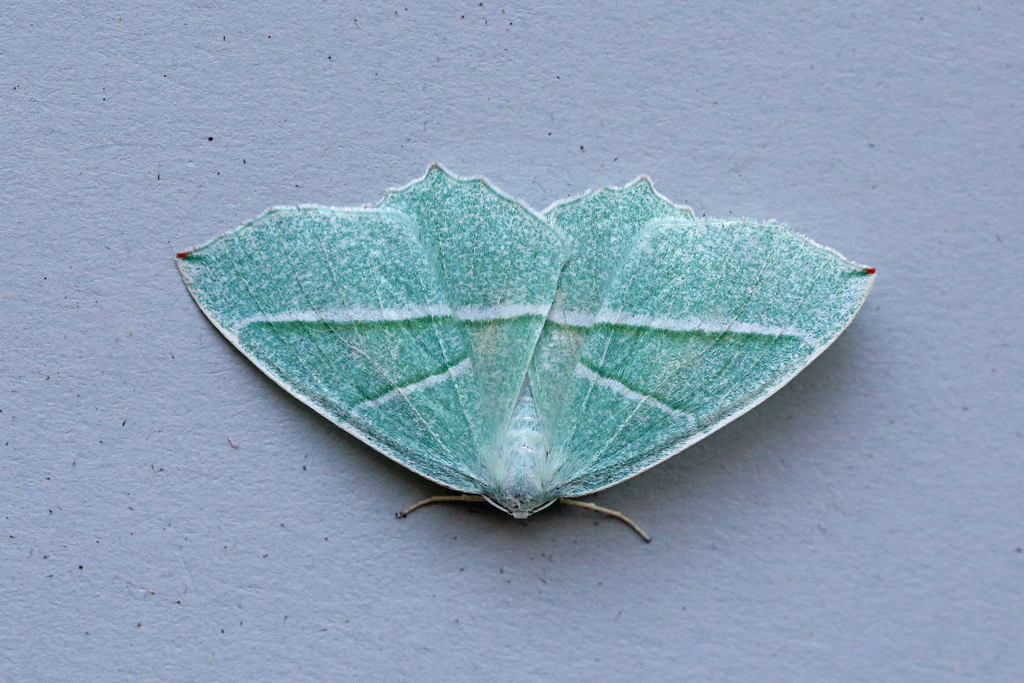
Adult Light Emerald moths have a wingspan of about 4 to 5.5 cm, with females larger than males. Fresh adults show pale green wings with distinct green and white bands, but the green fades to almost white as they age.
Source: Wikipedia
How to recognize it
Newly emerged moths have delicate pale-green wings marked with two green-white bands on each forewing and one on the hindwing. The green colour fades over time, and older moths appear almost pure white.
Source: Wikipedia
Size
The wingspan ranges from 42 to 54 mm, with females noticeably larger than males.
Source: Wikipedia
Where it lives
It lives in mixed forests, parks and large gardens.
Source: Wikipedia
What it eats
The caterpillars eat the leaves and soft bark of many deciduous trees such as apple, beech, birch, elm, hawthorn, hazel, oak and several Prunus species.
Source: Wikipedia
Life cycle
One or two generations are produced each year, with adults flying from July to September.
Source: Wikipedia
When you see it
Adults can be seen from July through September.
Source: Wikipedia
Where it is found in the US
Recorded in 4 of 51 states and DC. Most records: California, Pennsylvania, Washington, Colorado.
Darker = more records. Counts are museum and citizen-science records, not population size.
Source: GBIF
More photos

Questions people ask
Can they damage my garden plants?
Yes, the larvae feed on the leaves and bark of many garden trees and shrubs, which can harm those plants.
Source: Wikipedia
Same family (Geometridae)
 Willow BeautyPeribatodes rhomboidaria
 Pale BeautyCampaea perlataDamages trees, gardens or crops
 Large Lace-border MothScopula limboundataDamages trees, gardens or crops
 Riband WaveIdaea aversata
 Yellow Shell MothCamptogramma bilineata
 Large Maple Spanworm MothProchoerodes lineolaDamages trees, gardens or crops
Sources
- Wikipedia: https://en.wikipedia.org/wiki/Campaea_margaritata
Look it up elsewhere: GBIF · iNaturalist · BugGuide · Wikipedia
Text written 2026-10-22 from the sources above and checked sentence by sentence against them. Data fetched 2026-10-22.