 Bug FAQ
Lesser Hornet Hoverfly
Volucella inanis · Order: Diptera · Family: Syrphidae
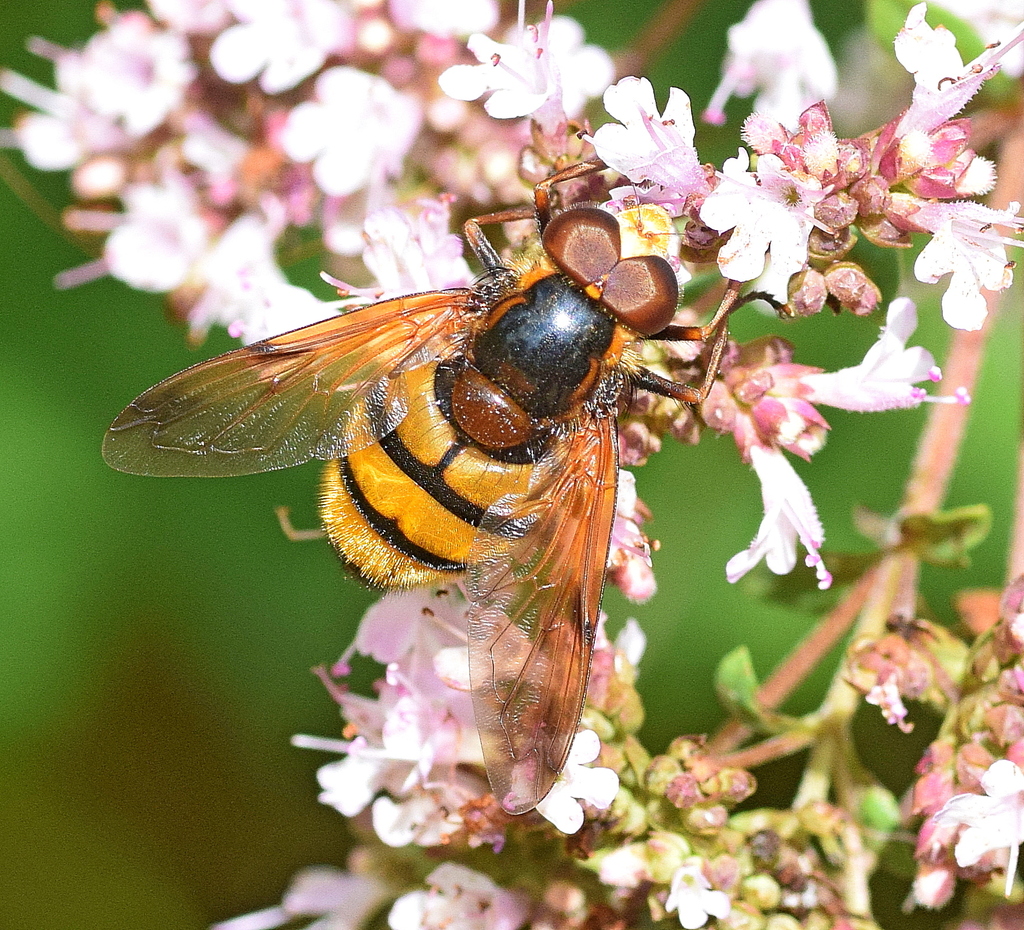
Adult Lesser Hornet Hoverflies are 15 to 17 mm long and have three yellow bands on a black abdomen, mimicking wasps. They fly from early July to early September, visiting flowers such as yarrow, dill, heather, thistles and Buddleja.
Source: Wikipedia
How to recognize it
The abdomen shows three yellow bands on a black background, with the first two bands often broken by a black wedge.
Source: Wikipedia
Size
Adults measure 15 to 17 mm (about 0.6 in) in length.
Source: Wikipedia
Where it lives
They are seen on a variety of flowers including yarrow, dill, heather, thistles and Buddleja davidii.
Source: Wikipedia
What it eats
Adults feed on nectar and pollen from many flowering plants such as yarrow, dill, heather, thistles and Buddleja. Females deposit eggs in social wasp and hornet nests; the hatched larvae eat the wasp larvae.
Source: Wikipedia
Life cycle
Eggs are laid in wasp or hornet nests and the hoverfly larvae develop as ectoparasites of the host larvae.
Source: Wikipedia
When you see it
Adults are active from early July through early September.
Source: Wikipedia
Where it comes from
The species occurs across most of Europe, the eastern Palearctic, the Near East and North Africa.
Source: Wikipedia
Lookalikes
Their black and yellow banded pattern makes them look like wasps, a form of mimicry.
Source: Wikipedia
Questions people ask
Why do they look like wasps?
Their black abdomen with three yellow bands mimics wasps, likely to deter predators.
Source: Wikipedia
What do the larvae eat?
The larvae feed on the larvae of social wasps and hornets inside the nests.
Source: Wikipedia
Same family (Syrphidae)






Sources
- Wikipedia: https://en.wikipedia.org/wiki/Volucella_inanis
Look it up elsewhere: GBIF · iNaturalist · BugGuide · Wikipedia
Text written 2026-10-22 from the sources above and checked sentence by sentence against them. Data fetched 2026-10-22.