 Bug FAQ
Lesser Bulb Fly
Eumerus funeralis · Order: Diptera · Family: Syrphidae
Also called: Syrphid fly, Lesser Roundface
Source: Wikipedia
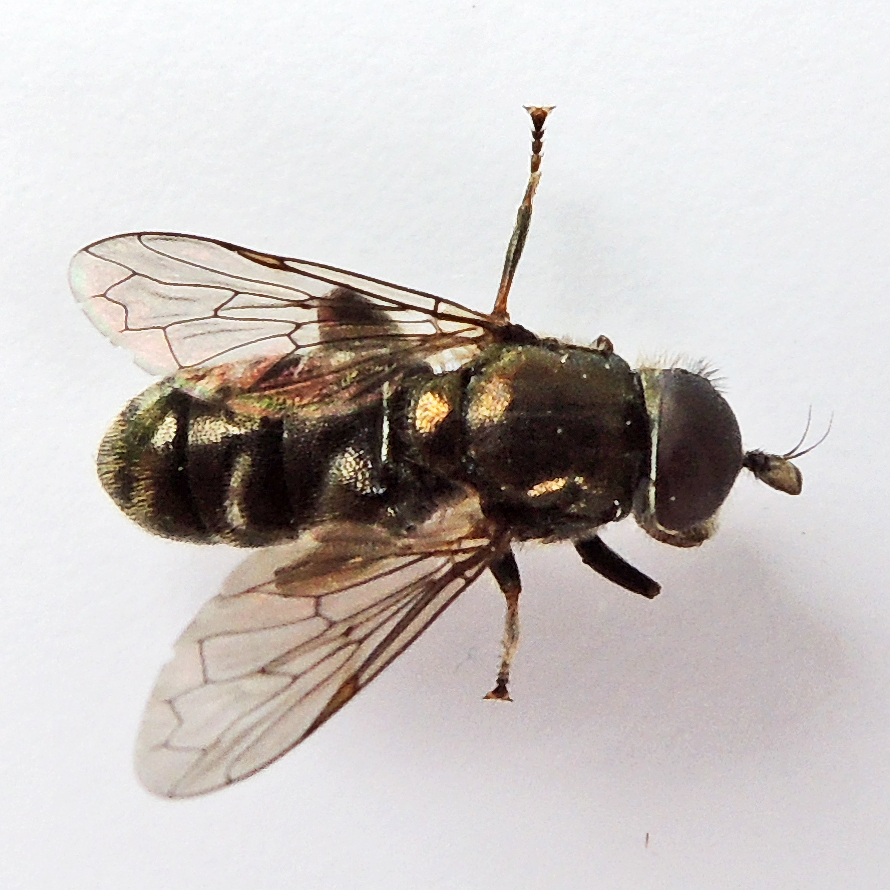
The lesser bulb fly has wings 3.5 to 6 mm long and is found on open dry ground, in grasslands, woodland clearings, suburban gardens and horticultural sites.
Source: Wikipedia
How to recognize it
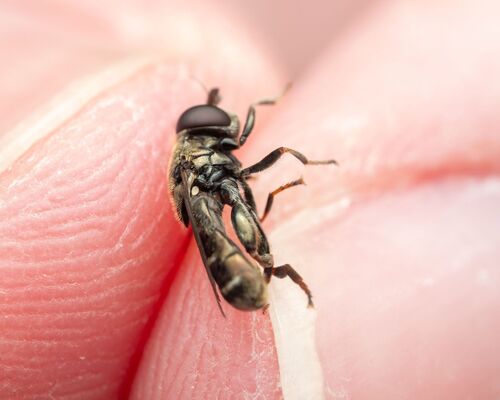
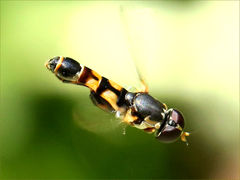
Its wing stigma are dark brown to blackish. Females have a large, square shiny patch on the frons that spans its full width except for narrow white dust strips near the eyes. The abdominal tergites are uniformly blackish without any red-brown markings.
Source: Wikipedia
Size
Wing length ranges from 3.5 to 6 mm (0.14 to 0.24 in).
Source: Wikipedia
Is it a pest in the house?
It is a minor pest of bulb plants such as Amaryllis, Hyacinthus and Narcissus.
Source: Wikipedia
Where it lives
It also occurs in suburban gardens and horticultural areas.
Source: Wikipedia
What it eats
Larvae are phytophagous, feeding inside damaged bulbs. Adults visit flowers such as Euphorbia, Fragaria, Leucanthemum and Ranunculus.
Source: Wikipedia
Life cycle
Adults are on the wing from April through September, with activity peaks in June and August.
Source: Wikipedia
When you see it
The flight period extends from April to September, especially in June and August.
Source: Wikipedia
Where it comes from
The species originated in the Mediterranean basin and is now spreading across the Palaearctic and Nearctic regions.
Source: Wikipedia
Lookalikes
It was once considered a synonym of E. strigatus but has been reinstated as the correct name for the species formerly called tuberculatus.
Source: Wikipedia
Where it is found in the US
Recorded in 17 of 51 states and DC. Most records: California, Georgia, Illinois, Maryland, New York, Minnesota, Pennsylvania, Colorado.
Darker = more records. Counts are museum and citizen-science records, not population size.
Source: GBIF
Status: introduced in Canada. Source: iNaturalist
Months it is reported in the US
Source: GBIF
More photos
Questions people ask
What plants does the lesser bulb fly damage?
The larvae feed inside and damage the bulbs of Amaryllis, Hyacinthus and Narcissus.
Source: Wikipedia
When are adult lesser bulb flies active?
Adults are active from April to September, with the highest numbers in June and August.
Source: Wikipedia
Where can I find this fly?
It is found on open dry ground, in grasslands, woodland clearings, suburban gardens and horticultural sites.
Source: Wikipedia
How can I tell it apart from similar flies?
Look for dark brown-black stigma, a small ventral process on the third femur with a shiny bare area, and in females a large square shiny patch on the frons; the abdomen is uniformly blackish without red-brown markings.
Source: Wikipedia
Same family (Syrphidae)


Sources
- Wikipedia: https://en.wikipedia.org/wiki/Eumerus_funeralis
Look it up elsewhere: GBIF · iNaturalist · BugGuide · Wikipedia
Text written 2026-10-27 from the sources above and checked sentence by sentence against them. Data fetched 2026-10-27.