 Bug FAQ
Leichenum canaliculatum
Leichenum canaliculatum · Order: Coleoptera · Family: Tenebrionidae
Source: Wikipedia
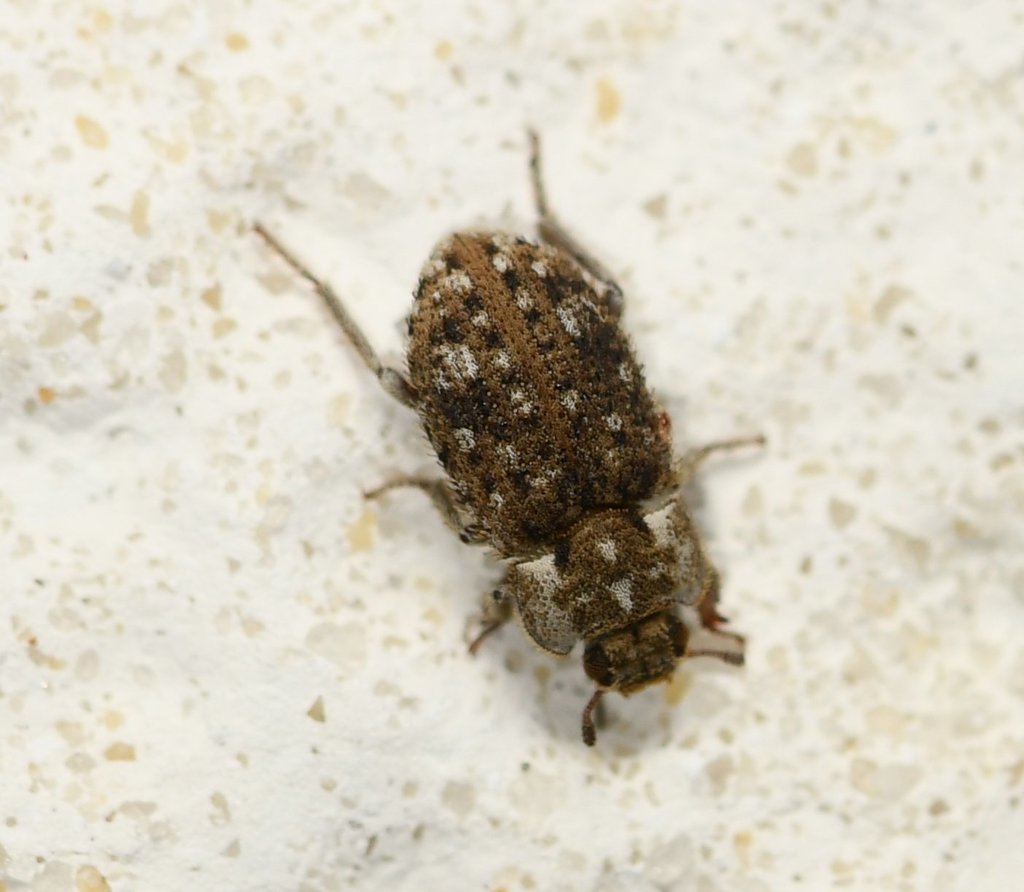
Leichenum canaliculatum is a small oval beetle about 5 mm long as an adult, while its mature larva reaches about 12 mm. It lives in sandy habitats near beaches, lakes and river shores, often hiding under leaf litter in sand depressions, and it feeds on the roots of several crops and can damage peach trees and Amaryllis bulbs. The species is found across many African, Asian and Oceanian countries, including Australia, India, Japan, Kenya and several European nations.
Source: Wikipedia
How to recognize it
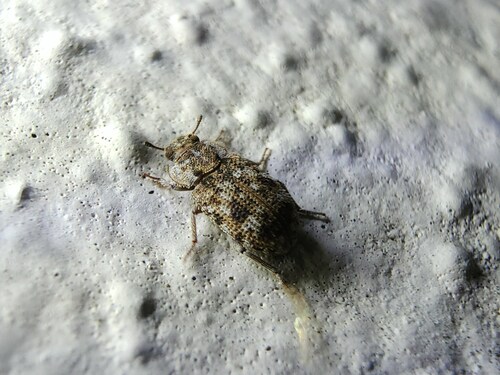
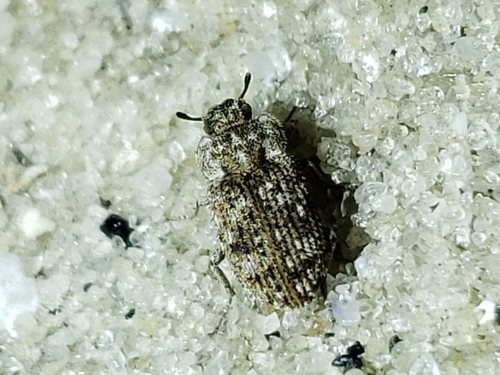
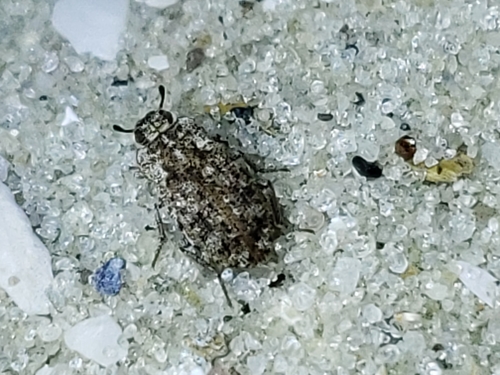
Its body is grayish with black, gray and brown mottling. It has whitish, spatula-shaped, scaly setae.
Source: Wikipedia
Size
Adults are oval and average about 5 mm in length. Mature larvae grow to roughly 12 mm long.
Source: Wikipedia
What it eats
Larvae have also been observed feeding on the nap of rugs and are associated with damage to peach trees and Amaryllis bulbs.
Source: Wikipedia
Life cycle
The pupa is about 6 mm long. During pupation the urogomphi fuse into a long spine-like process ending in two small round lobes.
Source: Wikipedia
When you see it
The highest aggregations are recorded from March through November.
Source: Wikipedia
Where it comes from
It occurs in many countries across Africa, Asia and Oceania, such as Australia, Kenya, India, Japan, Thailand and Vietnam, as well as in some European locations like France, Italy and Spain.
Source: Wikipedia
Where it is found in the US
Recorded in 9 of 51 states and DC. Most records: Florida, South Carolina, Louisiana, Georgia, Alabama, Mississippi, North Carolina, Texas.
Darker = more records. Counts are museum and citizen-science records, not population size.
Source: GBIF
Status: introduced in North America; introduced in United States. Source: iNaturalist
Months it is reported in the US
Source: GBIF
More photos
Questions people ask
Where is this beetle usually found?
It lives in sandy areas near beaches, lakes and river shorelines, often hiding under leaf litter in sand depressions.
Source: Wikipedia
Can they cause damage inside the house?
Yes, larvae can feed on the nap of rugs, leading to household damage.
Source: Wikipedia
Same family (Tenebrionidae)


Sources
- Wikipedia: https://en.wikipedia.org/wiki/Leichenum_canaliculatum
Look it up elsewhere: GBIF · iNaturalist · BugGuide · Wikipedia
Text written 2026-10-26 from the sources above and checked sentence by sentence against them. Data fetched 2026-10-26.