 Bug FAQ
Lawn Armyworm Moth
Spodoptera mauritia · Order: Lepidoptera · Family: Noctuidae
Also called: Lawn Armyworm
Source: Wikipedia
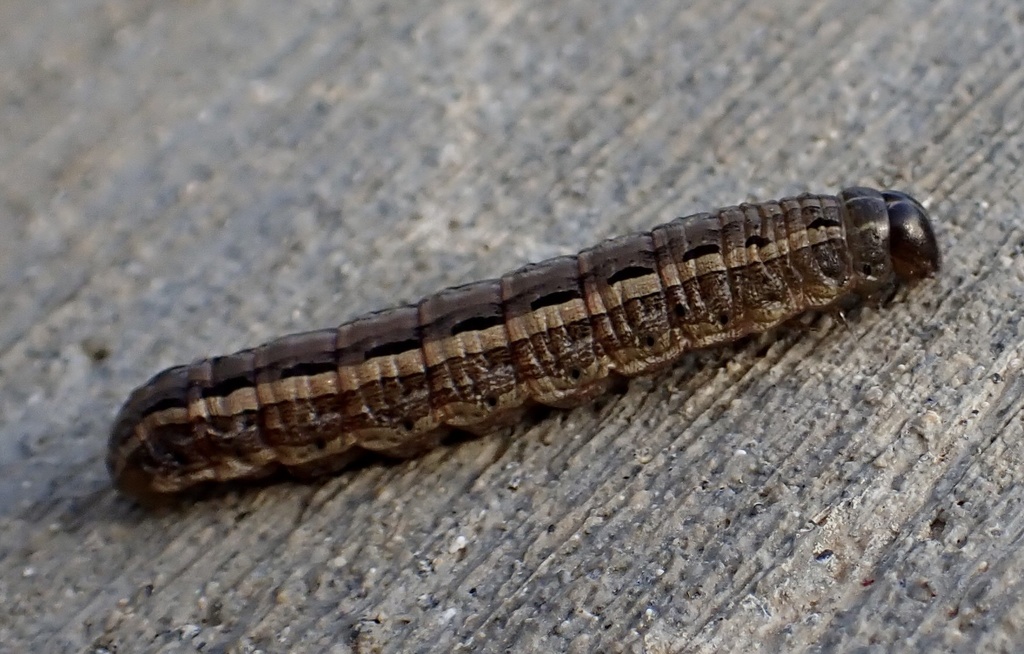
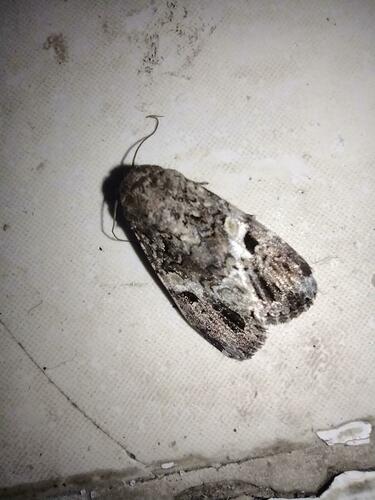
Adults have a 40 mm wingspan and are dark grey-brown with a rusty tint, showing distinctive double-waved lines on the forewings and a white patch between the orbicular and reniform spots. The caterpillars feed on many grasses and crops such as rice, wheat, sorghum and sugarcane, and they are a major international agricultural pest that can devastate whole fields.
Source: Wikipedia
How to recognize it
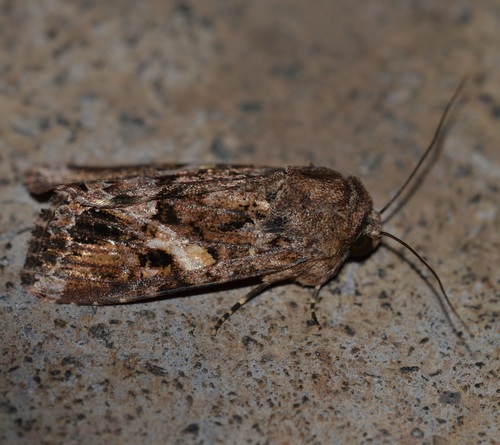
The forewings display faint double-waved sub-basal, antemedial and postmedial lines, a small ochreous orbicular spot, a blackish reniform spot, a whitish irregular submarginal line, a white patch between the two spots, and a dark central marginal patch; hindwings are semi-transparent white with an opalescent sheen and a dark edge.
Source: Wikipedia
Size
The moth’s wingspan measures about 40 mm.
Source: Wikipedia
Is it a pest in the house?
Infested plants show skeletonized leaves, shot holes, and dying stems. A swarm of caterpillars can cause an entire paddy crop to die within a few days.
Source: Wikipedia
How to get rid of it
- Hand-picking and other mechanical methods can reduce infestations.
- Introducing bolas spiders that mimic female pheromones can trap adult males.
- Applying the nematode Steinernema carpocapsae or nucleopolyhedrovirus can kill larvae.
- Wing traps and unitraps are useful for catching adult moths.
Source: Wikipedia
Where it lives
It occurs across a wide area from the Red Sea through India, Myanmar, Sri Lanka, Malaysia to Australia and many Pacific islands such as Fiji, Samoa and Hawaii.
Source: Wikipedia
What it eats
Larvae eat a variety of grasses including rice, wheat, sorghum, and also trees like Casuarina. Because they feed heavily on crops and pastures, they are considered a major international agricultural pest.
Source: Wikipedia
Life cycle
In the sixth larval stage they excrete urea instead of uric acid as their nitrogen waste.
Source: Wikipedia
Where it comes from
Its native distribution matches its habitat, spanning the Red Sea region to India, Southeast Asia, Australia and numerous Pacific islands.
Source: Wikipedia
Where it is found in the US
Recorded in 1 of 51 states and DC. Most records: Hawaii.
Darker = more records. Counts are museum and citizen-science records, not population size.
Source: GBIF
Months it is reported in the US
Source: GBIF
More photos
Questions people ask
How can I control lawn armyworm moth infestations?
Use hand-picking, mechanical removal, bolas spiders, beneficial nematodes, viral sprays, and moth traps to lower numbers.
Source: Wikipedia
What crops are at risk from this moth?
Rice, wheat, sorghum, and other grasses can be heavily damaged by the larvae.
Source: Wikipedia
What does damage from the larvae look like?
Leaves become skeletonized with shot holes and stems may die back.
Source: Wikipedia
Same family (Noctuidae)
 Ipsilon Dart MothAgrotis ipsilonDamages trees, gardens or crops
 Fall Armyworm MothSpodoptera frugiperdaDamages trees, gardens or crops
 Army Cutworm MothEuxoa auxiliarisDamages trees, gardens or crops
 Large Yellow UnderwingNoctua pronubaDamages trees, gardens or crops
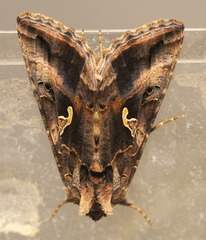 Silver ΥAutographa gamma
 American DaggerAcronicta americanaCan irritate skin
Sources
- Wikipedia: https://en.wikipedia.org/wiki/Spodoptera_mauritia
Look it up elsewhere: GBIF · iNaturalist · BugGuide · ITIS · Wikipedia
Text written 2026-10-27 from the sources above and checked sentence by sentence against them. Data fetched 2026-10-27.