 Bug FAQ
Latticed Heath
Chiasmia clathrata · Order: Lepidoptera · Family: Geometridae
Source: Wikipedia
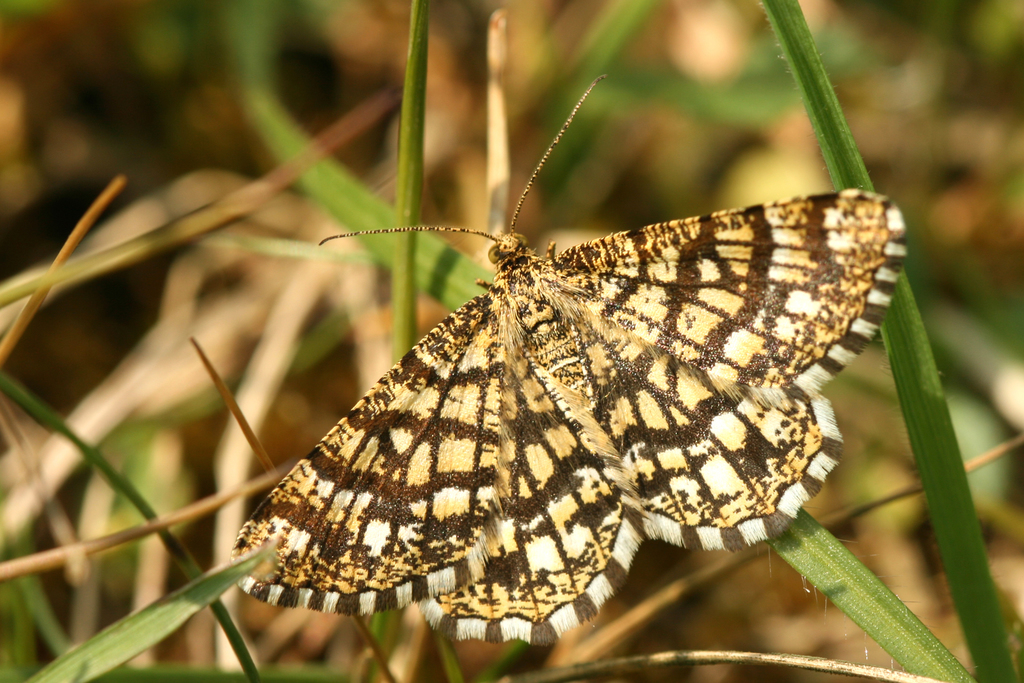
Latticed Heath moth has a 20 to 25 mm wingspan and variable yellow-white wings with a brown net pattern. The caterpillars are pale green with white lines and feed on bedstraws and various legumes such as clover and lucerne. Adults fly from May to September in Europe and the species overwinters as a pupa.
Source: Wikipedia
How to recognize it
Final-instar larvae are pale green with a strong white lateral line and thin dorsal white lines.
Source: Wikipedia
Size
Wingspan ranges from 20 to 25 mm.
Source: Wikipedia
Where it lives
Found in open habitats such as grassland, moorland and waste ground.
Source: Wikipedia
What it eats
Larvae eat bedstraw species and a variety of legumes including clovers, trefoils, lucerne and meadow vetchling.
Source: Wikipedia
Life cycle
The species overwinters in the pupal stage.
Source: Wikipedia
When you see it
Adults may be encountered any time between May and September.
Source: Wikipedia
Questions people ask
Can they damage my garden?
Yes, the caterpillars feed on legumes such as clover and lucerne, which can harm garden plants.
Source: Wikipedia
When are they active?
Adults are on the wing from May through September, with one or two generations per year in the British Isles.
Source: Wikipedia
Same family (Geometridae)
 Willow BeautyPeribatodes rhomboidaria
 Pale BeautyCampaea perlataDamages trees, gardens or crops
 Large Lace-border MothScopula limboundataDamages trees, gardens or crops
 Riband WaveIdaea aversata
 Yellow Shell MothCamptogramma bilineata
 Large Maple Spanworm MothProchoerodes lineolaDamages trees, gardens or crops
Sources
- Wikipedia: https://en.wikipedia.org/wiki/Latticed_heath
Look it up elsewhere: GBIF · iNaturalist · BugGuide · Wikipedia
Text written 2026-10-22 from the sources above and checked sentence by sentence against them. Data fetched 2026-10-22.