 Bug FAQ
Large Grey Owlet
Ichneutica ustistriga · Order: Lepidoptera · Family: Noctuidae
Source: Wikipedia
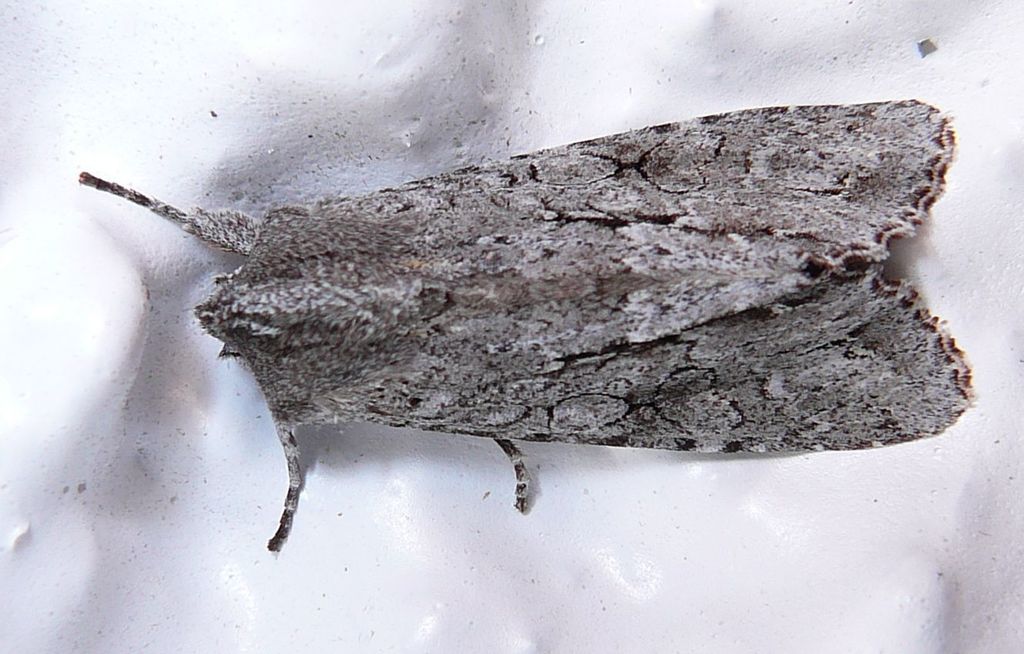
The Large Grey Owlet moth has a wingspan of 36 to 46 mm for males and 38 to 53 mm for females. Its larvae eat a range of herbaceous plants such as Muehlenbeckia, Olearia and Plantago, which can include garden species.
Source: Wikipedia
How to recognize it
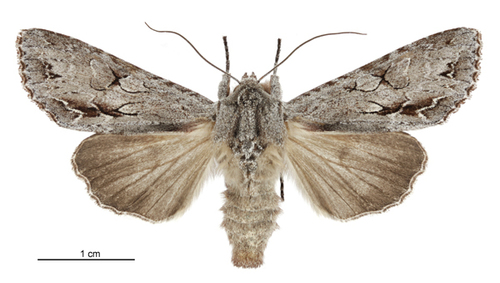
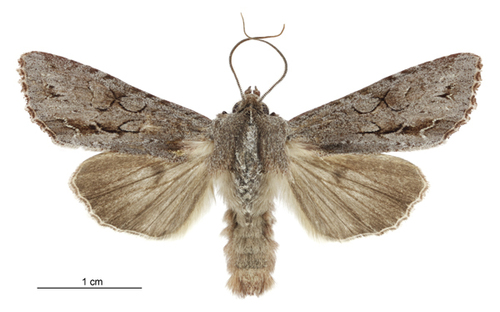
The moth’s forewings are mauvish-grey with distinctive irregular black rings and ferruginous-brown markings.
Source: Wikipedia
Size
Males have a wingspan of 36 to 46 mm; females are slightly larger at 38 to 53 mm.
Source: Wikipedia
Where it lives
It is found in gardens, orchards, grasslands, and native forest.
Source: Wikipedia
What it eats
Larvae feed on herbaceous plants including Muehlenbeckia australis, M. complexa, Olearia hectorii and Plantago lanceolata.
Source: Wikipedia
Life cycle
Eggs are pale green, semi-globose with many fine ribs radiating from the micropyle. The caterpillar is dull grey-brown with blackish lines and pale spots along its sides.
Source: Wikipedia
When you see it
Adults can be seen flying throughout the year.
Source: Wikipedia
Where it comes from
The species is endemic to New Zealand, from the Three Kings Islands down to Stewart Island.
Source: Wikipedia
Lookalikes
Its mauvish-grey colour and unique forewing pattern make it unlikely to be confused with other moths.
Source: Wikipedia
More photos
Questions people ask
What plants do the larvae eat?
The caterpillars feed on herbaceous plants such as Muehlenbeckia, Olearia and Plantago species.
Source: Wikipedia
Where are they found in New Zealand?
They occur from the Three Kings Islands in the north to Stewart Island in the south, in many habitats including gardens and forests.
Source: Wikipedia
Same family (Noctuidae)
 Ipsilon Dart MothAgrotis ipsilonDamages trees, gardens or crops
 Fall Armyworm MothSpodoptera frugiperdaDamages trees, gardens or crops
 Army Cutworm MothEuxoa auxiliarisDamages trees, gardens or crops
 Large Yellow UnderwingNoctua pronubaDamages trees, gardens or crops
 Silver ΥAutographa gamma
 American DaggerAcronicta americanaCan irritate skin
Sources
- Wikipedia: https://en.wikipedia.org/wiki/Ichneutica_ustistriga
Look it up elsewhere: GBIF · iNaturalist · BugGuide · Wikipedia
Text written 2026-10-23 from the sources above and checked sentence by sentence against them. Data fetched 2026-10-22.