 Bug FAQ
Ladder-backed Hover Fly
Melanostoma scalare · Order: Diptera · Family: Syrphidae
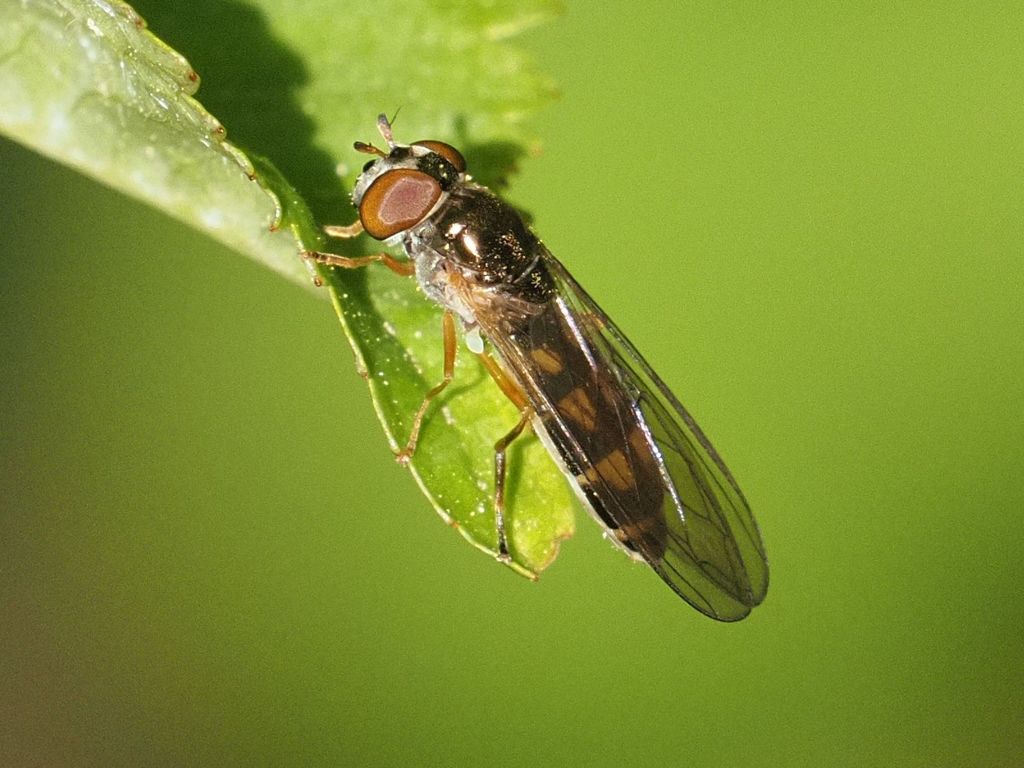
The ladder-backed hoverfly is a small (7 to 10 mm) black-thoraced fly with yellow markings that differ between males and females. Adults are active from spring through autumn in gardens, meadows and on flowering bushes, where they feed on nectar and help control small insects.
Source: Wikipedia
How to recognize it
The thorax shines black, and males have round or diamond-shaped yellow spots while females show triangular yellow patches.
Source: Wikipedia
Size
Adults measure about 7 to 10 mm in length.
Source: Wikipedia
Where it lives
They are seen flying from April to November in gardens, meadows and on flowering bushes.
Source: Wikipedia
What it eats
Larvae eat aphids, and adults are thought to prey on small insects in leaf litter.
Source: Wikipedia
Life cycle
Adults are active from spring to late autumn, while little is known about other stages, though they likely hunt small insects in leaf litter.
Source: Wikipedia
When you see it
They are on the wing from April through November.
Source: Wikipedia
Lookalikes
Melanostoma scalare, also called the chequered hoverfly, is a very common hoverfly species.
Source: Wikipedia
Where it is found in the US
Recorded in 2 of 51 states and DC. Most records: Oregon, Pennsylvania.
Darker = more records. Counts are museum and citizen-science records, not population size.
Source: GBIF
More photos


Questions people ask
Are they a garden pest?
No, the larvae feed on aphids and the adults help control small insects, so they are beneficial.
Source: Wikipedia
Same family (Syrphidae)






Sources
- Wikipedia: https://en.wikipedia.org/wiki/Melanostoma_scalare
Look it up elsewhere: GBIF · iNaturalist · BugGuide · Wikipedia
Text written 2026-10-22 from the sources above and checked sentence by sentence against them. Data fetched 2026-10-22.