 Bug FAQ
Lacebark Looper
Epiphryne undosata · Order: Lepidoptera · Family: Geometridae

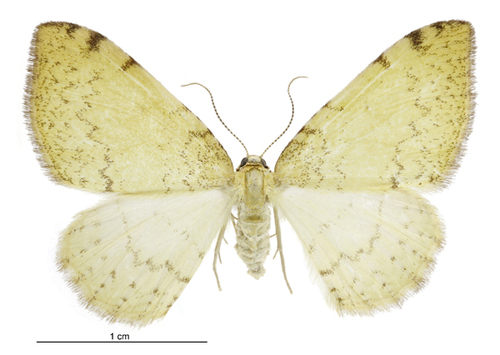
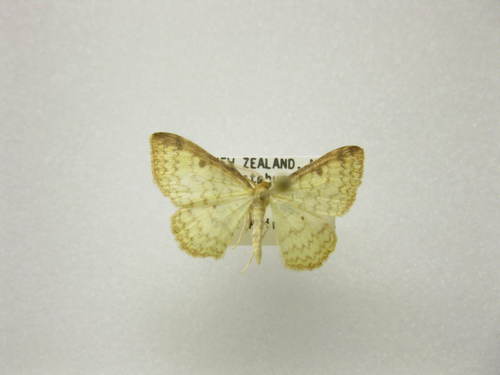
The adult Lacebark Looper has a wingspan just under an inch and a body length a little over half an inch. Its pale-yellow wings show fine jagged reddish-brown lines that become clearer toward the edge, plus a broad reddish-brown stripe on the forewing leading edge, a small blackish dot near the middle, and a tiny brown spot near the tip. Adults are on the wing all year but are most common from November to February.
Source: Wikipedia
Size
The moth’s wings spread just under an inch and its body measures a little over half an inch long.
Source: Wikipedia
Where it lives
It has been observed in forests of Kunzea ericoides.
Source: Wikipedia
What it eats
Caterpillars feed on leaves and seeds of Hoheria and Plagianthus species.
Source: Wikipedia
Life cycle
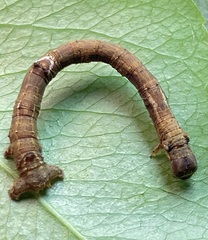
Eggs are greenish and hatch after about two weeks. Larvae are active in spring and summer, feeding on host leaves and seeds, then pupate in a delicate silk cocoon among dead leaves.
Source: Wikipedia
When you see it
Adults can be seen flying all year, but they are most common from November through February.
Source: Wikipedia
Where it comes from
The species is endemic to New Zealand and occurs on both the North and South Islands.
Source: Wikipedia
Lookalikes
The adult moth shows a lot of variation in colour intensity and wing pattern, making it hard to pin down a single look.
Source: Wikipedia
More photos
Questions people ask
What do the caterpillars eat?
They feed on the leaves and seeds of Hoheria and Plagianthus plants.
Source: Wikipedia
When are the moths most active?
Adults are present year-round but are most frequently seen from November to February.
Source: Wikipedia
Where is the Lacebark Looper found?
It is native to New Zealand and occurs on both the North and South Islands.
Source: Wikipedia
Same family (Geometridae)
 Willow BeautyPeribatodes rhomboidaria
 Pale BeautyCampaea perlataDamages trees, gardens or crops
 Large Lace-border MothScopula limboundataDamages trees, gardens or crops
 Riband WaveIdaea aversata
 Yellow Shell MothCamptogramma bilineata
 Large Maple Spanworm MothProchoerodes lineolaDamages trees, gardens or crops
Sources
- Wikipedia: https://en.wikipedia.org/wiki/Epiphryne_undosata
Look it up elsewhere: GBIF · iNaturalist · BugGuide · Wikipedia
Text written 2026-10-23 from the sources above and checked sentence by sentence against them. Data fetched 2026-10-23.