 Bug FAQ
July Highflyer and Allies
Hydriomena furcata · Order: Lepidoptera · Family: Geometridae
Also called: July Highflyer, July Highflyer Moth
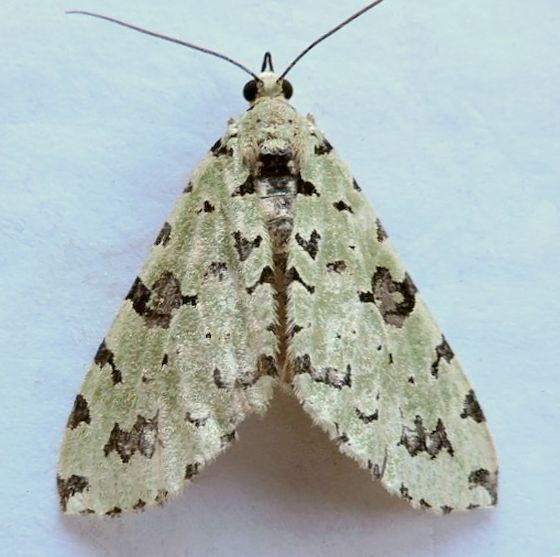
The July Highflyer moth has a wingspan of about 23 to 30 mm. Adults fly from May through August and the species overwinters as an egg. Its larvae feed on a variety of broad-leaved trees and shrubs such as willow, hazel, rose, aspen and bilberry.
Source: Wikipedia
How to recognize it
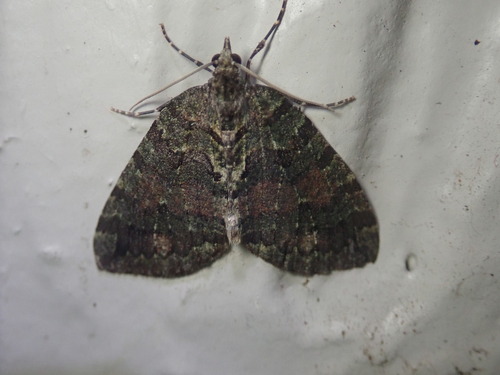
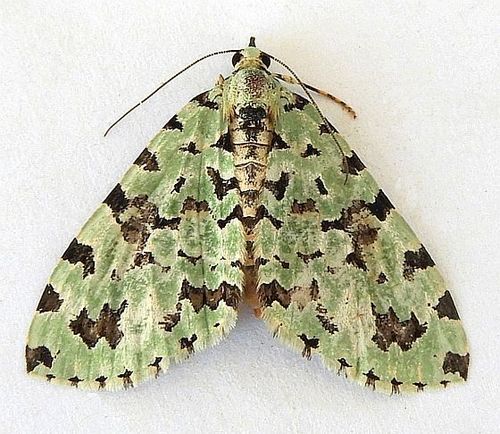
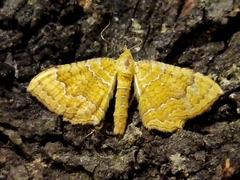
The moth’s colour ranges from olive green to grey, brown or reddish brown, with reddish-brown to blackish bands that have whitish spots and dark speckles, plus an anapical streak on the forewings.
Source: Wikipedia
Size
Wingspan measures between 23 and 30 mm (0.9 to 1.2 in).
Source: Wikipedia
Where it lives
It prefers moorland in sub-alpine and montane zones, as well as hedgerows and woodland edges.
Source: Wikipedia
What it eats
Caterpillars eat leaves of goat willow, hazel, rose, aspen and bilberry.
Source: Wikipedia
Life cycle
The species has one generation per year and survives the winter as an egg.
Source: Wikipedia
When you see it
Adults are on the wing from May to August.
Source: Wikipedia
Where it comes from
It occurs throughout the Holarctic region, being very common in northern Europe and widespread in Siberia and central Asia.
Source: Wikipedia
Lookalikes
It can be told apart from other European Hydriomena by its shorter palpus, irregular markings between the subbasal line and median area, a dark subterminal band usually broken by a pale spot, and lack of black vein-streaks near the wing tip.
Source: Wikipedia
Where it is found in the US
Recorded in 15 of 51 states and DC. Most records: Alaska, Wyoming, Colorado, Idaho, Montana, Washington, California, Maine.
Darker = more records. Counts are museum and citizen-science records, not population size.
Source: GBIF
Months it is reported in the US
Source: GBIF
More photos
Questions people ask
When can I see adult July Highflyer moths?
Adults are active from May through August.
Source: Wikipedia
What plants do the caterpillars eat?
The larvae feed on willow, hazel, rose, aspen and bilberry leaves.
Source: Wikipedia
How many generations does this moth have each year?
It produces one generation per year.
Source: Wikipedia
How can I tell it apart from similar moths?
Look for a shorter palpus, irregular markings, a dark subterminal band often split by a pale spot, and no black streaks on veins near the wing tip.
Source: Wikipedia
Same family (Geometridae)




Sources
- Wikipedia: https://en.wikipedia.org/wiki/Hydriomena_furcata
Look it up elsewhere: GBIF · iNaturalist · BugGuide · ITIS · Wikipedia
Text written 2026-10-26 from the sources above and checked sentence by sentence against them. Data fetched 2026-10-26.