 Bug FAQ
Jasmine Moth
Palpita vitrealis · Order: Lepidoptera · Family: Crambidae
Also called: Olive-tree Pearl
Source: Wikipedia
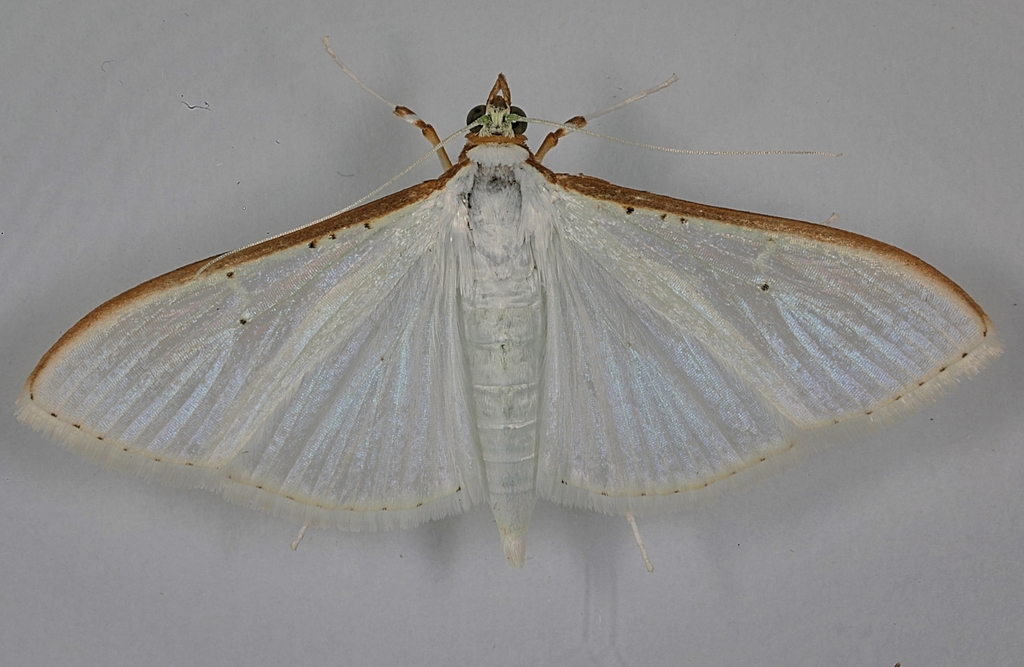
The Jasmine Moth has a wingspan of about 27 to 31 mm and translucent wings with a broad orange or brown border and two black spots on each forewing. Adults are active from August through late October and visit nectar-bearing flowers such as ivy and buddleia.
Source: Wikipedia
How to recognize it
The body and wings are see-through with a slight sheen, and the forewings have a wide orange or brown edge plus two central black spots. Legs show alternating white and brown rings.
Source: Wikipedia
Size
Wingspan ranges from 27 to 31 mm.
Source: Wikipedia
Is it a pest in the house?
Larvae are considered pests in olive orchards because they damage leaves and fruits.
Source: Wikipedia
Where it lives
Adults fly from August to late October, depending on location, and feed on nectar from various flowers.
Source: Wikipedia
What it eats
Adults sip nectar from flowers such as ivy and buddleia. Larvae eat leaves of jasmine, privet, forsythia, strawberry tree, and especially olive.
Source: Wikipedia
Life cycle
Young larvae are yellow, later turn green, grow to about 2 cm, and spin a silk cocoon from tied leaves to pupate.
Source: Wikipedia
When you see it
Flight period is mainly August through late October.
Source: Wikipedia
Where it comes from
The species occurs worldwide, including Africa, Asia, Australia, and Europe, mainly in southern Europe but also farther north.
Source: Wikipedia
Questions people ask
What plants do the larvae damage?
They feed on the leaves and fruits of olive trees and can also eat jasmine, privet, forsythia, and strawberry tree.
Source: Wikipedia
When can I expect to see these moths?
Adults are typically on the wing from August until late October.
Source: Wikipedia
Same family (Crambidae)
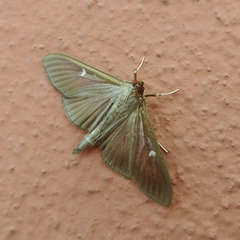 Box Tree MothCydalima perspectalisDamages trees, gardens or crops
 Celery Leaftier MothUdea rubigalisDamages trees, gardens or crops
 Elegant Grass-veneerMicrocrambus elegans
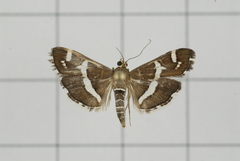 Hawaiian Beet Webworm MothSpoladea recurvalisDamages trees, gardens or crops
 Garden Grass-veneerChrysoteuchia culmellaDamages trees, gardens or crops
 Bluegrass Webworm MothParapediasia teterrellusDamages trees, gardens or crops
Sources
- Wikipedia: https://en.wikipedia.org/wiki/Palpita_vitrealis
Look it up elsewhere: GBIF · iNaturalist · BugGuide · Wikipedia
Text written 2026-10-22 from the sources above and checked sentence by sentence against them. Data fetched 2026-10-22.