 Bug FAQ
Indian Red Bug
Probergrothius sanguinolens · Order: Hemiptera · Family: Pyrrhocoridae

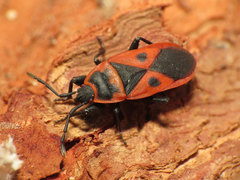
The adult Indian Red Bug is mostly red with black antenna segments, scutellum, part of the clavus and wing membrane, and a creamy-white fourth antennal segment tipped dark. It lives in India and is commonly found on seeds of Sterculia and other Malvaceae, but it also eats freshly dead animal matter, especially when young.
Source: Wikipedia
How to recognize it
Adults are predominantly red. The second antennal segment is a bit longer than the first. The fourth antennal segment is creamy white with a dusky tip.
Source: Wikipedia
Where it lives
It is found in India.
Source: Wikipedia
What it eats
It feeds on a variety of seeds, especially those of Sterculia and other Malvaceae. Early instar nymphs also feed on freshly dead animal matter.
Source: Wikipedia
Life cycle
Gut bacteria of the genus Gordonibacter are passed from parent to offspring, and the genus split from related bugs about 86 million years ago.
Source: Wikipedia
Where it comes from
Its native range is India.
Source: Wikipedia
Lookalikes
Genetic studies show the genus Probergrothius diverged from Dysdercus, Dindymus, Scanthius and Pyrrhocoris around 86 million years ago.
Source: Wikipedia
Questions people ask
What does the Indian Red Bug look like?
Adults are mainly red, with black second and third antennal segments, scutellum, part of the clavus and wing membrane, and a creamy-white fourth antennal segment that ends dark.
Source: Wikipedia
Where can I find Indian Red Bugs?
They occur in India, often on seeds of Sterculia and other Malvaceae plants.
Source: Wikipedia
What do Indian Red Bugs eat?
They feed on a range of seeds, especially from Sterculia and related plants, and young bugs also eat freshly dead animal matter.
Source: Wikipedia
Same family (Pyrrhocoridae)



Sources
- Wikipedia: https://en.wikipedia.org/wiki/Probergrothius_sanguinolens
Look it up elsewhere: GBIF · iNaturalist · BugGuide · Wikipedia
Text written 2026-10-23 from the sources above and checked sentence by sentence against them. Data fetched 2026-10-22.